

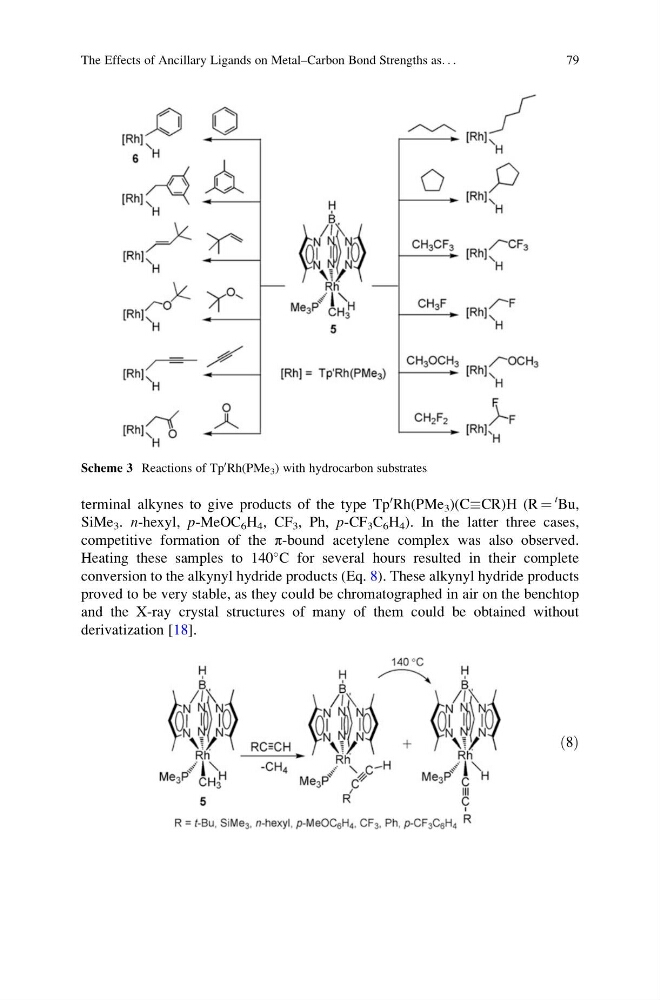
terminal alkynes to give products of the type Tp
0 Rh(PMe 3 )(CCR)H (R ¼
t Bu,
SiMe 3 . n-hexyl, p-MeOC 6 H 4 , CF 3 , Ph, p-CF 3 C 6 H 4 ). In the latter three cases,
competitive formation of the π-bound acetylene complex was also observed.
Heating these samples to 140
C for several hours resulted in their complete
conversion to the alkynyl hydride products (Eq. 8). These alkynyl hydride products
proved to be very stable, as they could be chromatographed in air on the benchtop
and the X-ray crystal structures of many of them could be obtained without
derivatization [18].
ð8Þ
Scheme 3 Reactions of Tp
0 Rh(PMe 3 ) with hydrocarbon substrates
The Effects of Ancillary Ligands on Metal–Carbon Bond Strengths as. . .
79
0 Rh(PMe 3 )(CCR)H (R ¼
t Bu,
SiMe 3 . n-hexyl, p-MeOC 6 H 4 , CF 3 , Ph, p-CF 3 C 6 H 4 ). In the latter three cases,
competitive formation of the π-bound acetylene complex was also observed.
Heating these samples to 140
C for several hours resulted in their complete
conversion to the alkynyl hydride products (Eq. 8). These alkynyl hydride products
proved to be very stable, as they could be chromatographed in air on the benchtop
and the X-ray crystal structures of many of them could be obtained without
derivatization [18].
ð8Þ
Scheme 3 Reactions of Tp
0 Rh(PMe 3 ) with hydrocarbon substrates
The Effects of Ancillary Ligands on Metal–Carbon Bond Strengths as. . .
79