

4 Hydrocarbon Activation by [Tp
0 Rh(PMe 3 )]
In order to investigate the effect of the ancillary ligands on the metal–carbon bond
strengths, we also examined the reactivity of the fragment [Tp
0 Rh(PMe 3 )] with
hydrocarbons and substituted methyl derivatives. Here, the strongly electrondonating PMe 3 ligand replaces the electron-withdrawing neopentyl isocyanide
ligand in the above studies and was anticipated to have a significant effect on the
bond strengths.
To generate the 16-electron fragment, Tp
0 Rh(PMe 3 )H 2 (4) was used as a photochemical precursor of the reactive intermediate [16, 17]. Irradiation of 4 in a variety
of hydrocarbons led to the formation of oxidative addition products of the type
Tp
0 Rh(PMe 3 )(R)H (R ¼ α-mesityl, tert-butylvinyl, CH 2 O
t
Bu, CH 2 CCMe,
CH 2 C(¼O)CH 3 , pentyl, cyclopentyl) along with a small amount of by-products
Tp
0 Rh(PMe 3 ) 2 and Tp
0 Rh(PMe 3 )R 2 . The latter are formed as a result of photolysis
of the product(s). As an alternative, Tp
0 Rh(PMe 3 )MeH (5) was prepared by the
-35
-25
-15
-5
5
15
25
80
90
100
110
120
130
Carbon-Hydrogen Bond Strengths (kcal/mol)
Relative Experimental M-C Bond Strengths
(kcal/mol)
c -pentyl
methyl
n -pentyl
phenyl
t -butylvinyl
c -hexyl
slope = 1.40(14)
slope = 1.38(3)
-CºCR; R = Ph, SiMe 3 , hexyl,
p -CF 3 C 6 H 4 , t -Bu, CF 3 , p -MeOC 6 H 4
-(CH 2 ) n CN (n=2-5)
C 6 F 5
CHF 2
CH 2 F
CH 2 Cl
CH 2 CF 3
O
CH 2 CN
MeOCH 2
t BuOCH 2
MeCºCCH 2
ArCH 2
methallyl
sp
sp
2
sp
3
Tp'Rh(CNR')RH Tp'Rh(CNR')RH
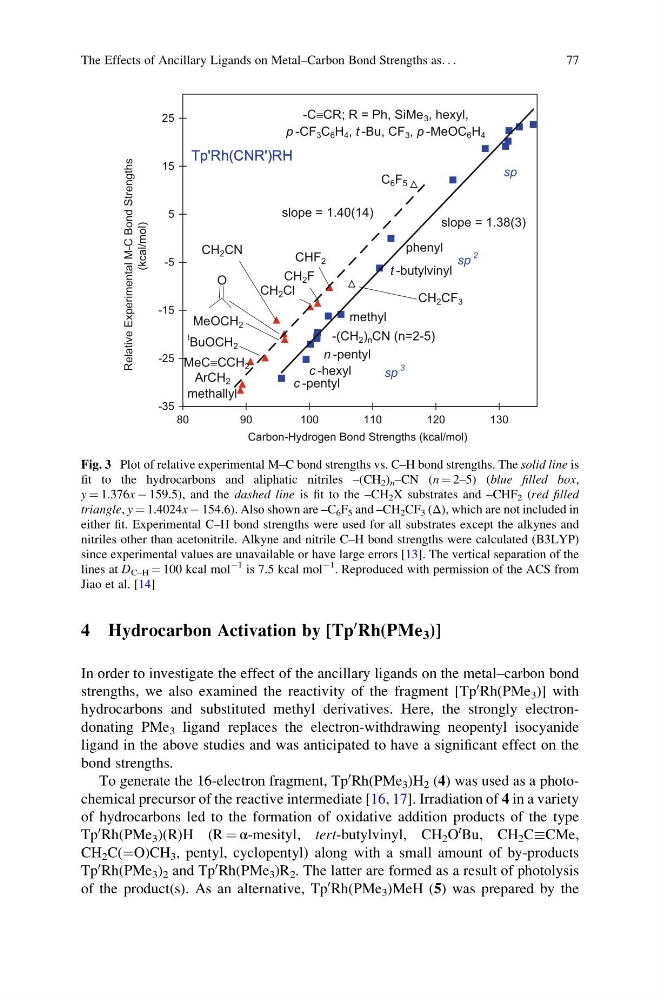
Fig. 3 Plot of relative experimental M–C bond strengths vs. C–H bond strengths. The solid line is
fit to the hydrocarbons and aliphatic nitriles –(CH 2 ) n –CN (n ¼ 2–5) (blue filled box,
y ¼ 1.376x À 159.5), and the dashed line is fit to the –CH 2 X substrates and –CHF 2 (red filled
triangle, y ¼ 1.4024x À 154.6). Also shown are –C 6 F 5 and –CH 2 CF 3 (Δ), which are not included in
either fit. Experimental C–H bond strengths were used for all substrates except the alkynes and
nitriles other than acetonitrile. Alkyne and nitrile C–H bond strengths were calculated (B3LYP)
since experimental values are unavailable or have large errors [13]. The vertical separation of the
lines at D C–H ¼ 100 kcal mol
À1 is 7.5 kcal mol
À1 . Reproduced with permission of the ACS from
Jiao et al. [14]
The Effects of Ancillary Ligands on Metal–Carbon Bond Strengths as. . .
77
0 Rh(PMe 3 )]
In order to investigate the effect of the ancillary ligands on the metal–carbon bond
strengths, we also examined the reactivity of the fragment [Tp
0 Rh(PMe 3 )] with
hydrocarbons and substituted methyl derivatives. Here, the strongly electrondonating PMe 3 ligand replaces the electron-withdrawing neopentyl isocyanide
ligand in the above studies and was anticipated to have a significant effect on the
bond strengths.
To generate the 16-electron fragment, Tp
0 Rh(PMe 3 )H 2 (4) was used as a photochemical precursor of the reactive intermediate [16, 17]. Irradiation of 4 in a variety
of hydrocarbons led to the formation of oxidative addition products of the type
Tp
0 Rh(PMe 3 )(R)H (R ¼ α-mesityl, tert-butylvinyl, CH 2 O
t
Bu, CH 2 CCMe,
CH 2 C(¼O)CH 3 , pentyl, cyclopentyl) along with a small amount of by-products
Tp
0 Rh(PMe 3 ) 2 and Tp
0 Rh(PMe 3 )R 2 . The latter are formed as a result of photolysis
of the product(s). As an alternative, Tp
0 Rh(PMe 3 )MeH (5) was prepared by the
-35
-25
-15
-5
5
15
25
80
90
100
110
120
130
Carbon-Hydrogen Bond Strengths (kcal/mol)
Relative Experimental M-C Bond Strengths
(kcal/mol)
c -pentyl
methyl
n -pentyl
phenyl
t -butylvinyl
c -hexyl
slope = 1.40(14)
slope = 1.38(3)
-CºCR; R = Ph, SiMe 3 , hexyl,
p -CF 3 C 6 H 4 , t -Bu, CF 3 , p -MeOC 6 H 4
-(CH 2 ) n CN (n=2-5)
C 6 F 5
CHF 2
CH 2 F
CH 2 Cl
CH 2 CF 3
O
CH 2 CN
MeOCH 2
t BuOCH 2
MeCºCCH 2
ArCH 2
methallyl
sp
sp
2
sp
3
Tp'Rh(CNR')RH Tp'Rh(CNR')RH
Fig. 3 Plot of relative experimental M–C bond strengths vs. C–H bond strengths. The solid line is
fit to the hydrocarbons and aliphatic nitriles –(CH 2 ) n –CN (n ¼ 2–5) (blue filled box,
y ¼ 1.376x À 159.5), and the dashed line is fit to the –CH 2 X substrates and –CHF 2 (red filled
triangle, y ¼ 1.4024x À 154.6). Also shown are –C 6 F 5 and –CH 2 CF 3 (Δ), which are not included in
either fit. Experimental C–H bond strengths were used for all substrates except the alkynes and
nitriles other than acetonitrile. Alkyne and nitrile C–H bond strengths were calculated (B3LYP)
since experimental values are unavailable or have large errors [13]. The vertical separation of the
lines at D C–H ¼ 100 kcal mol
À1 is 7.5 kcal mol
À1 . Reproduced with permission of the ACS from
Jiao et al. [14]
The Effects of Ancillary Ligands on Metal–Carbon Bond Strengths as. . .
77