

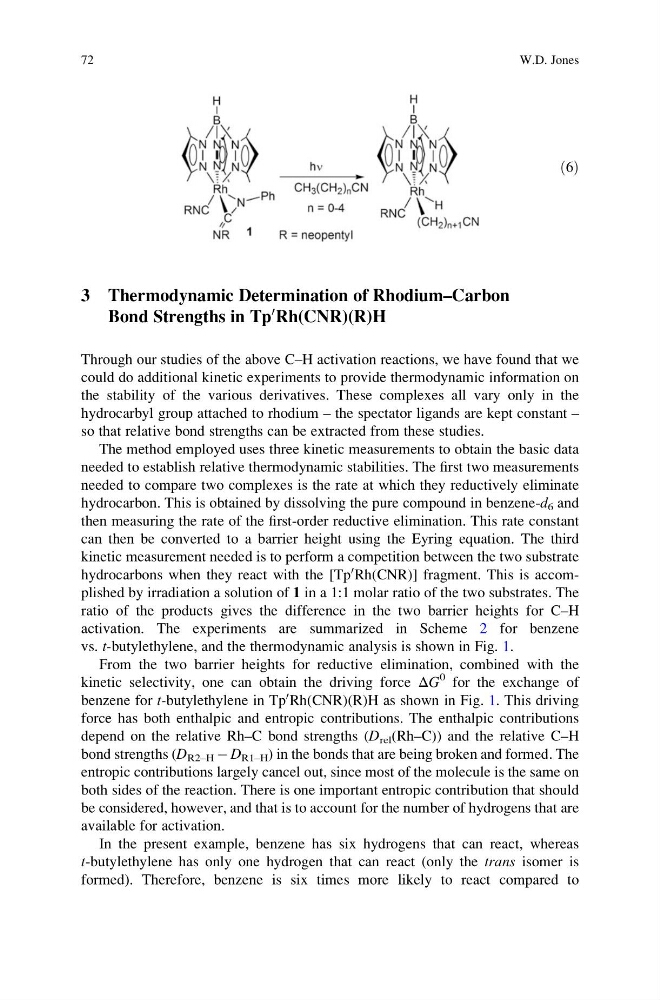
ð6Þ
3 Thermodynamic Determination of Rhodium–Carbon
Bond Strengths in Tp
0 Rh(CNR)(R)H
Through our studies of the above C–H activation reactions, we have found that we
could do additional kinetic experiments to provide thermodynamic information on
the stability of the various derivatives. These complexes all vary only in the
hydrocarbyl group attached to rhodium – the spectator ligands are kept constant –
so that relative bond strengths can be extracted from these studies.
The method employed uses three kinetic measurements to obtain the basic data
needed to establish relative thermodynamic stabilities. The first two measurements
needed to compare two complexes is the rate at which they reductively eliminate
hydrocarbon. This is obtained by dissolving the pure compound in benzene-d 6 and
then measuring the rate of the first-order reductive elimination. This rate constant
can then be converted to a barrier height using the Eyring equation. The third
kinetic measurement needed is to perform a competition between the two substrate
hydrocarbons when they react with the [Tp
0 Rh(CNR)] fragment. This is accomplished by irradiation a solution of 1 in a 1:1 molar ratio of the two substrates. The
ratio of the products gives the difference in the two barrier heights for C–H
activation. The experiments are summarized in Scheme 2 for benzene
vs. t-butylethylene, and the thermodynamic analysis is shown in Fig. 1.
From the two barrier heights for reductive elimination, combined with the
kinetic selectivity, one can obtain the driving force ΔG
0 for the exchange of
benzene for t-butylethylene in Tp
0 Rh(CNR)(R)H as shown in Fig. 1. This driving
force has both enthalpic and entropic contributions. The enthalpic contributions
depend on the relative Rh–C bond strengths (D rel (Rh–C)) and the relative C–H
bond strengths (D R2–H À D R1–H ) in the bonds that are being broken and formed. The
entropic contributions largely cancel out, since most of the molecule is the same on
both sides of the reaction. There is one important entropic contribution that should
be considered, however, and that is to account for the number of hydrogens that are
available for activation.
In the present example, benzene has six hydrogens that can react, whereas
t-butylethylene has only one hydrogen that can react (only the trans isomer is
formed). Therefore, benzene is six times more likely to react compared to
72
W.D. Jones
3 Thermodynamic Determination of Rhodium–Carbon
Bond Strengths in Tp
0 Rh(CNR)(R)H
Through our studies of the above C–H activation reactions, we have found that we
could do additional kinetic experiments to provide thermodynamic information on
the stability of the various derivatives. These complexes all vary only in the
hydrocarbyl group attached to rhodium – the spectator ligands are kept constant –
so that relative bond strengths can be extracted from these studies.
The method employed uses three kinetic measurements to obtain the basic data
needed to establish relative thermodynamic stabilities. The first two measurements
needed to compare two complexes is the rate at which they reductively eliminate
hydrocarbon. This is obtained by dissolving the pure compound in benzene-d 6 and
then measuring the rate of the first-order reductive elimination. This rate constant
can then be converted to a barrier height using the Eyring equation. The third
kinetic measurement needed is to perform a competition between the two substrate
hydrocarbons when they react with the [Tp
0 Rh(CNR)] fragment. This is accomplished by irradiation a solution of 1 in a 1:1 molar ratio of the two substrates. The
ratio of the products gives the difference in the two barrier heights for C–H
activation. The experiments are summarized in Scheme 2 for benzene
vs. t-butylethylene, and the thermodynamic analysis is shown in Fig. 1.
From the two barrier heights for reductive elimination, combined with the
kinetic selectivity, one can obtain the driving force ΔG
0 for the exchange of
benzene for t-butylethylene in Tp
0 Rh(CNR)(R)H as shown in Fig. 1. This driving
force has both enthalpic and entropic contributions. The enthalpic contributions
depend on the relative Rh–C bond strengths (D rel (Rh–C)) and the relative C–H
bond strengths (D R2–H À D R1–H ) in the bonds that are being broken and formed. The
entropic contributions largely cancel out, since most of the molecule is the same on
both sides of the reaction. There is one important entropic contribution that should
be considered, however, and that is to account for the number of hydrogens that are
available for activation.
In the present example, benzene has six hydrogens that can react, whereas
t-butylethylene has only one hydrogen that can react (only the trans isomer is
formed). Therefore, benzene is six times more likely to react compared to
72
W.D. Jones