

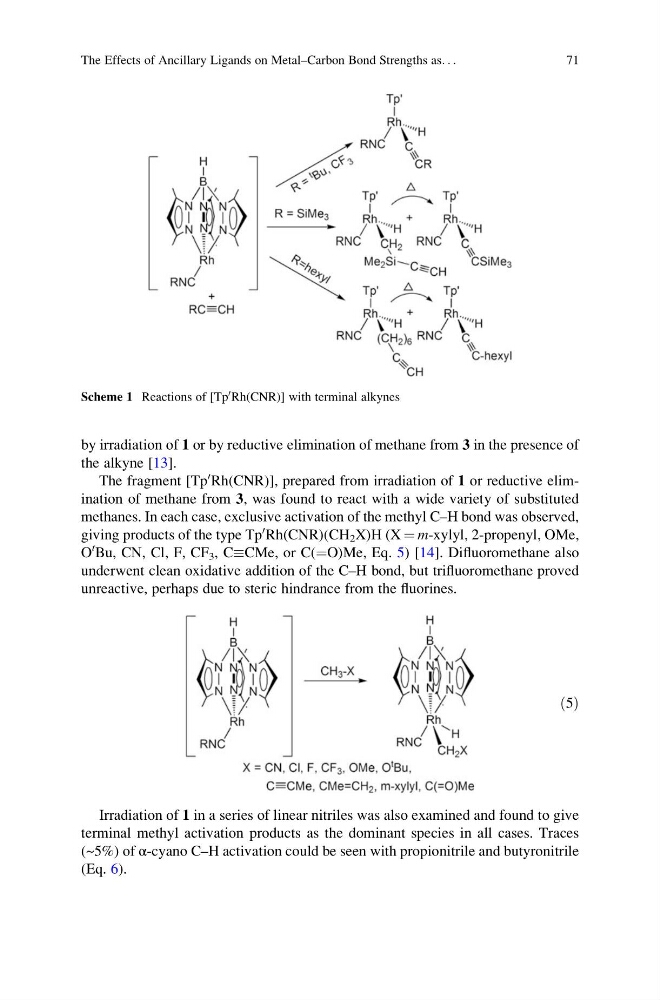
by irradiation of 1 or by reductive elimination of methane from 3 in the presence of
the alkyne [13].
The fragment [Tp
0 Rh(CNR)], prepared from irradiation of 1 or reductive elimination of methane from 3, was found to react with a wide variety of substituted
methanes. In each case, exclusive activation of the methyl C–H bond was observed,
giving products of the type Tp
0 Rh(CNR)(CH 2 X)H (X ¼ m-xylyl, 2-propenyl, OMe,
O
t
Bu, CN, Cl, F, CF 3 , CCMe, or C(¼O)Me, Eq. 5) [14]. Difluoromethane also
underwent clean oxidative addition of the C–H bond, but trifluoromethane proved
unreactive, perhaps due to steric hindrance from the fluorines.
ð5Þ
Irradiation of 1 in a series of linear nitriles was also examined and found to give
terminal methyl activation products as the dominant species in all cases. Traces
(~5%) of α-cyano C–H activation could be seen with propionitrile and butyronitrile
(Eq. 6).
Scheme 1 Reactions of [Tp
0 Rh(CNR)] with terminal alkynes
The Effects of Ancillary Ligands on Metal–Carbon Bond Strengths as. . .
71
the alkyne [13].
The fragment [Tp
0 Rh(CNR)], prepared from irradiation of 1 or reductive elimination of methane from 3, was found to react with a wide variety of substituted
methanes. In each case, exclusive activation of the methyl C–H bond was observed,
giving products of the type Tp
0 Rh(CNR)(CH 2 X)H (X ¼ m-xylyl, 2-propenyl, OMe,
O
t
Bu, CN, Cl, F, CF 3 , CCMe, or C(¼O)Me, Eq. 5) [14]. Difluoromethane also
underwent clean oxidative addition of the C–H bond, but trifluoromethane proved
unreactive, perhaps due to steric hindrance from the fluorines.
ð5Þ
Irradiation of 1 in a series of linear nitriles was also examined and found to give
terminal methyl activation products as the dominant species in all cases. Traces
(~5%) of α-cyano C–H activation could be seen with propionitrile and butyronitrile
(Eq. 6).
Scheme 1 Reactions of [Tp
0 Rh(CNR)] with terminal alkynes
The Effects of Ancillary Ligands on Metal–Carbon Bond Strengths as. . .
71