

4.1 S-Nucleophiles
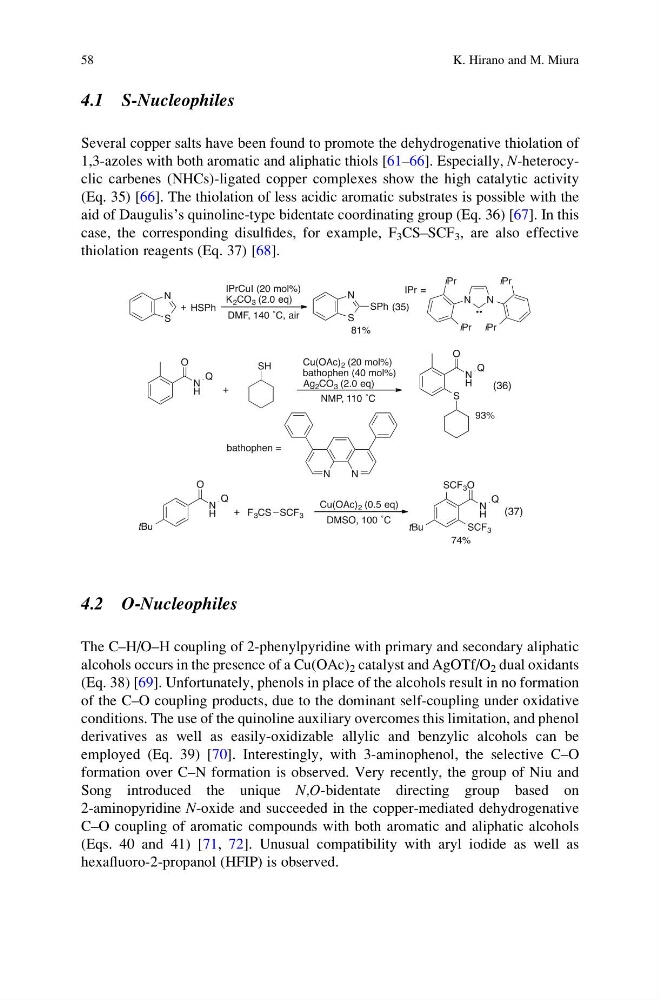
Several copper salts have been found to promote the dehydrogenative thiolation of
1,3-azoles with both aromatic and aliphatic thiols [61–66]. Especially, N-heterocyclic carbenes (NHCs)-ligated copper complexes show the high catalytic activity
(Eq. 35) [66]. The thiolation of less acidic aromatic substrates is possible with the
aid of Daugulis’s quinoline-type bidentate coordinating group (Eq. 36) [67]. In this
case, the corresponding disulfides, for example, F 3 CS–SCF 3 , are also effective
thiolation reagents (Eq. 37) [68].
(36)
(37)
4.2 O-Nucleophiles
The C–H/O–H coupling of 2-phenylpyridine with primary and secondary aliphatic
alcohols occurs in the presence of a Cu(OAc) 2 catalyst and AgOTf/O 2 dual oxidants
(Eq. 38) [69]. Unfortunately, phenols in place of the alcohols result in no formation
of the C–O coupling products, due to the dominant self-coupling under oxidative
conditions. The use of the quinoline auxiliary overcomes this limitation, and phenol
derivatives as well as easily-oxidizable allylic and benzylic alcohols can be
employed (Eq. 39) [70]. Interestingly, with 3-aminophenol, the selective C–O
formation over C–N formation is observed. Very recently, the group of Niu and
Song introduced the unique N,O-bidentate directing group based on
2-aminopyridine N-oxide and succeeded in the copper-mediated dehydrogenative
C–O coupling of aromatic compounds with both aromatic and aliphatic alcohols
(Eqs. 40 and 41) [71, 72]. Unusual compatibility with aryl iodide as well as
hexafluoro-2-propanol (HFIP) is observed.
58
K. Hirano and M. Miura
Several copper salts have been found to promote the dehydrogenative thiolation of
1,3-azoles with both aromatic and aliphatic thiols [61–66]. Especially, N-heterocyclic carbenes (NHCs)-ligated copper complexes show the high catalytic activity
(Eq. 35) [66]. The thiolation of less acidic aromatic substrates is possible with the
aid of Daugulis’s quinoline-type bidentate coordinating group (Eq. 36) [67]. In this
case, the corresponding disulfides, for example, F 3 CS–SCF 3 , are also effective
thiolation reagents (Eq. 37) [68].
(36)
(37)
4.2 O-Nucleophiles
The C–H/O–H coupling of 2-phenylpyridine with primary and secondary aliphatic
alcohols occurs in the presence of a Cu(OAc) 2 catalyst and AgOTf/O 2 dual oxidants
(Eq. 38) [69]. Unfortunately, phenols in place of the alcohols result in no formation
of the C–O coupling products, due to the dominant self-coupling under oxidative
conditions. The use of the quinoline auxiliary overcomes this limitation, and phenol
derivatives as well as easily-oxidizable allylic and benzylic alcohols can be
employed (Eq. 39) [70]. Interestingly, with 3-aminophenol, the selective C–O
formation over C–N formation is observed. Very recently, the group of Niu and
Song introduced the unique N,O-bidentate directing group based on
2-aminopyridine N-oxide and succeeded in the copper-mediated dehydrogenative
C–O coupling of aromatic compounds with both aromatic and aliphatic alcohols
(Eqs. 40 and 41) [71, 72]. Unusual compatibility with aryl iodide as well as
hexafluoro-2-propanol (HFIP) is observed.
58
K. Hirano and M. Miura