

2.5 Cross-Dehydrogenative Coupling of C(sp
2
)–H Bonds
with Toluene C–H Bonds
Among catalytic functionalizations of C–H bonds developed so far, crossdehydrogenative coupling of C–H bonds is one of the most ideal C–H functionalizations because the new C–C bond is formed by the direct connection of two
different C–H bonds, thus avoiding the generation of stoichiometric amounts of
halogenated or organometallic byproducts [36–38]. However, most of the examples
reported so far involve the coupling of C(sp
2 )–H/C(sp
2 )–H bonds. Chatani reported
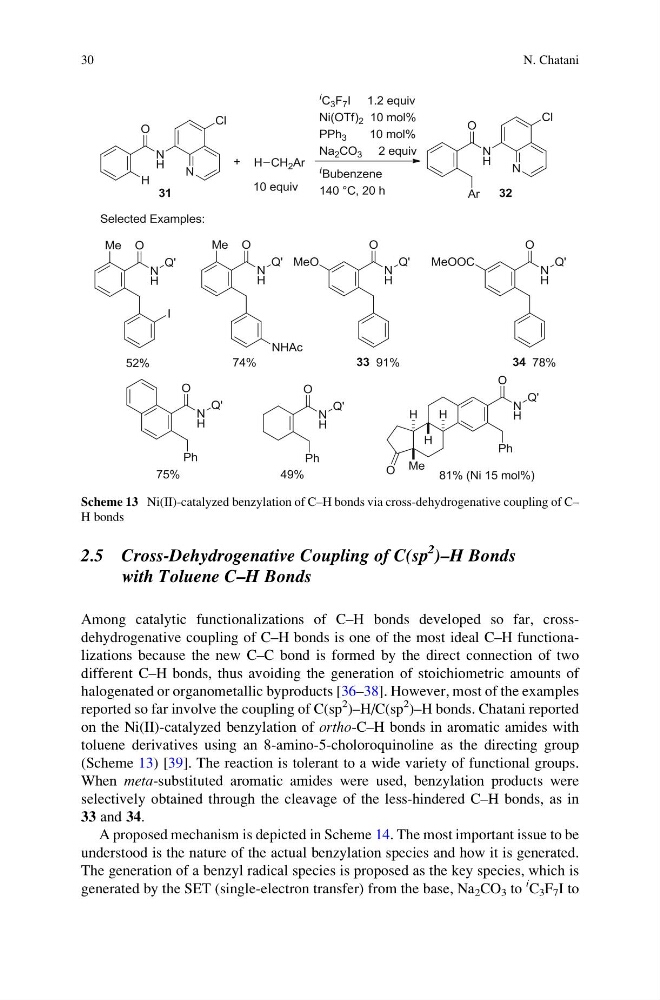
on the Ni(II)-catalyzed benzylation of ortho-C–H bonds in aromatic amides with
toluene derivatives using an 8-amino-5-choloroquinoline as the directing group
(Scheme 13) [39]. The reaction is tolerant to a wide variety of functional groups.
When meta-substituted aromatic amides were used, benzylation products were
selectively obtained through the cleavage of the less-hindered C–H bonds, as in
33 and 34.
A proposed mechanism is depicted in Scheme 14. The most important issue to be
understood is the nature of the actual benzylation species and how it is generated.
The generation of a benzyl radical species is proposed as the key species, which is
generated by the SET (single-electron transfer) from the base, Na 2 CO 3 to
i
C 3 F 7 I to
Scheme 13 Ni(II)-catalyzed benzylation of C–H bonds via cross-dehydrogenative coupling of C–
H bonds
30
N. Chatani
2
)–H Bonds
with Toluene C–H Bonds
Among catalytic functionalizations of C–H bonds developed so far, crossdehydrogenative coupling of C–H bonds is one of the most ideal C–H functionalizations because the new C–C bond is formed by the direct connection of two
different C–H bonds, thus avoiding the generation of stoichiometric amounts of
halogenated or organometallic byproducts [36–38]. However, most of the examples
reported so far involve the coupling of C(sp
2 )–H/C(sp
2 )–H bonds. Chatani reported
on the Ni(II)-catalyzed benzylation of ortho-C–H bonds in aromatic amides with
toluene derivatives using an 8-amino-5-choloroquinoline as the directing group
(Scheme 13) [39]. The reaction is tolerant to a wide variety of functional groups.
When meta-substituted aromatic amides were used, benzylation products were
selectively obtained through the cleavage of the less-hindered C–H bonds, as in
33 and 34.
A proposed mechanism is depicted in Scheme 14. The most important issue to be
understood is the nature of the actual benzylation species and how it is generated.
The generation of a benzyl radical species is proposed as the key species, which is
generated by the SET (single-electron transfer) from the base, Na 2 CO 3 to
i
C 3 F 7 I to
Scheme 13 Ni(II)-catalyzed benzylation of C–H bonds via cross-dehydrogenative coupling of C–
H bonds
30
N. Chatani