

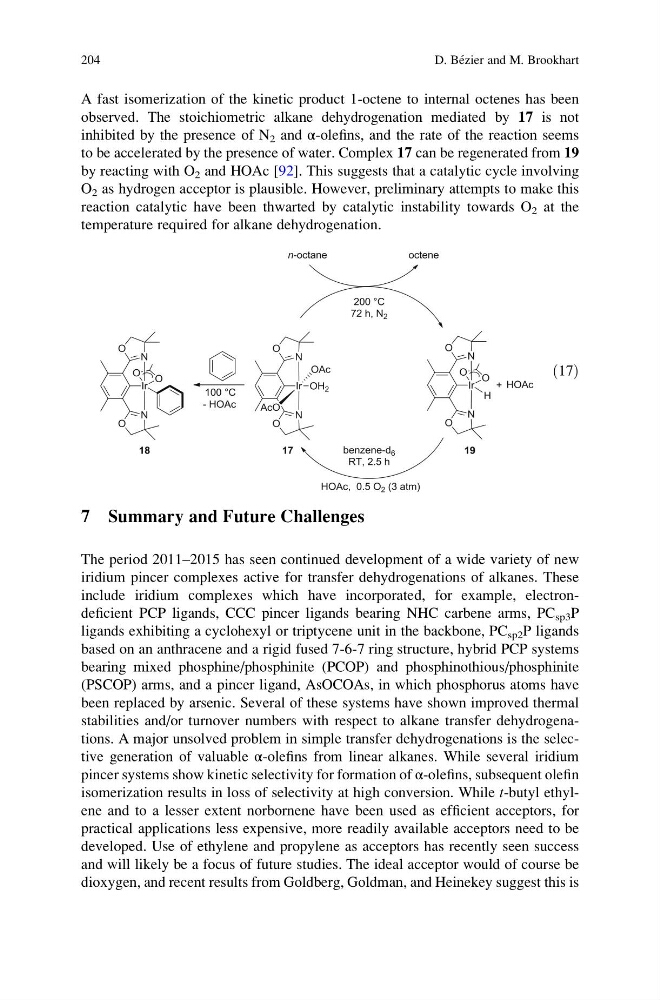
A fast isomerization of the kinetic product 1-octene to internal octenes has been
observed. The stoichiometric alkane dehydrogenation mediated by 17 is not
inhibited by the presence of N 2 and α-olefins, and the rate of the reaction seems
to be accelerated by the presence of water. Complex 17 can be regenerated from 19
by reacting with O 2 and HOAc [92]. This suggests that a catalytic cycle involving
O 2 as hydrogen acceptor is plausible. However, preliminary attempts to make this
reaction catalytic have been thwarted by catalytic instability towards O 2 at the
temperature required for alkane dehydrogenation.
ð17Þ
7 Summary and Future Challenges
The period 2011–2015 has seen continued development of a wide variety of new
iridium pincer complexes active for transfer dehydrogenations of alkanes. These
include iridium complexes which have incorporated, for example, electrondeficient PCP ligands, CCC pincer ligands bearing NHC carbene arms, PC sp3 P
ligands exhibiting a cyclohexyl or triptycene unit in the backbone, PC sp2 P ligands
based on an anthracene and a rigid fused 7-6-7 ring structure, hybrid PCP systems
bearing mixed phosphine/phosphinite (PCOP) and phosphinothious/phosphinite
(PSCOP) arms, and a pincer ligand, AsOCOAs, in which phosphorus atoms have
been replaced by arsenic. Several of these systems have shown improved thermal
stabilities and/or turnover numbers with respect to alkane transfer dehydrogenations. A major unsolved problem in simple transfer dehydrogenations is the selective generation of valuable α-olefins from linear alkanes. While several iridium
pincer systems show kinetic selectivity for formation of α-olefins, subsequent olefin
isomerization results in loss of selectivity at high conversion. While t-butyl ethylene and to a lesser extent norbornene have been used as efficient acceptors, for
practical applications less expensive, more readily available acceptors need to be
developed. Use of ethylene and propylene as acceptors has recently seen success
and will likely be a focus of future studies. The ideal acceptor would of course be
dioxygen, and recent results from Goldberg, Goldman, and Heinekey suggest this is
204
D. Be ´zier and M. Brookhart
observed. The stoichiometric alkane dehydrogenation mediated by 17 is not
inhibited by the presence of N 2 and α-olefins, and the rate of the reaction seems
to be accelerated by the presence of water. Complex 17 can be regenerated from 19
by reacting with O 2 and HOAc [92]. This suggests that a catalytic cycle involving
O 2 as hydrogen acceptor is plausible. However, preliminary attempts to make this
reaction catalytic have been thwarted by catalytic instability towards O 2 at the
temperature required for alkane dehydrogenation.
ð17Þ
7 Summary and Future Challenges
The period 2011–2015 has seen continued development of a wide variety of new
iridium pincer complexes active for transfer dehydrogenations of alkanes. These
include iridium complexes which have incorporated, for example, electrondeficient PCP ligands, CCC pincer ligands bearing NHC carbene arms, PC sp3 P
ligands exhibiting a cyclohexyl or triptycene unit in the backbone, PC sp2 P ligands
based on an anthracene and a rigid fused 7-6-7 ring structure, hybrid PCP systems
bearing mixed phosphine/phosphinite (PCOP) and phosphinothious/phosphinite
(PSCOP) arms, and a pincer ligand, AsOCOAs, in which phosphorus atoms have
been replaced by arsenic. Several of these systems have shown improved thermal
stabilities and/or turnover numbers with respect to alkane transfer dehydrogenations. A major unsolved problem in simple transfer dehydrogenations is the selective generation of valuable α-olefins from linear alkanes. While several iridium
pincer systems show kinetic selectivity for formation of α-olefins, subsequent olefin
isomerization results in loss of selectivity at high conversion. While t-butyl ethylene and to a lesser extent norbornene have been used as efficient acceptors, for
practical applications less expensive, more readily available acceptors need to be
developed. Use of ethylene and propylene as acceptors has recently seen success
and will likely be a focus of future studies. The ideal acceptor would of course be
dioxygen, and recent results from Goldberg, Goldman, and Heinekey suggest this is
204
D. Be ´zier and M. Brookhart