

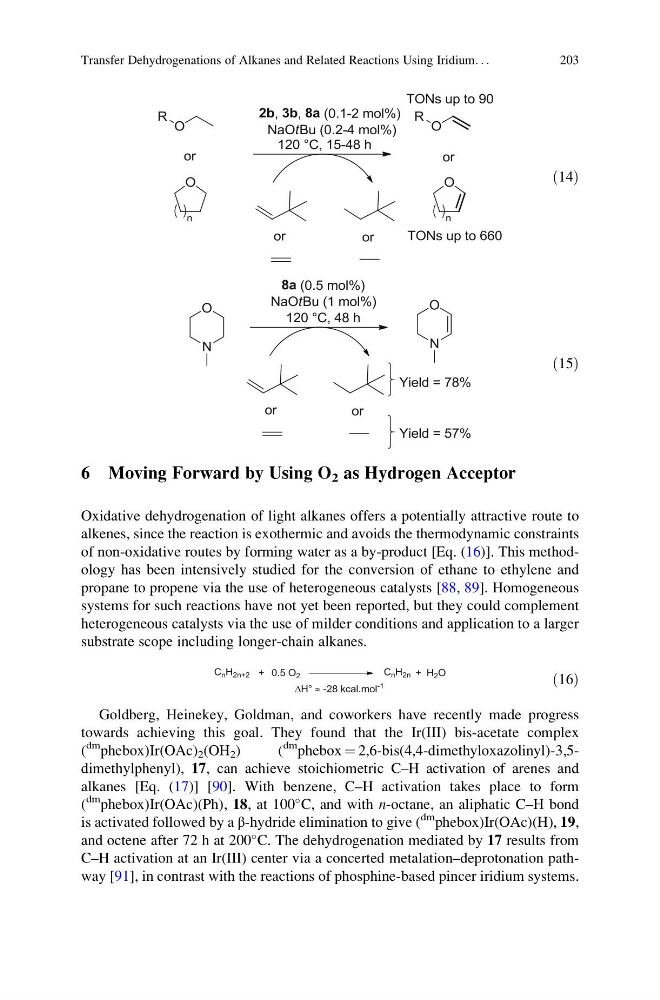
ð14Þ
ð15Þ
6 Moving Forward by Using O 2 as Hydrogen Acceptor
Oxidative dehydrogenation of light alkanes offers a potentially attractive route to
alkenes, since the reaction is exothermic and avoids the thermodynamic constraints
of non-oxidative routes by forming water as a by-product [Eq. (16)]. This methodology has been intensively studied for the conversion of ethane to ethylene and
propane to propene via the use of heterogeneous catalysts [88, 89]. Homogeneous
systems for such reactions have not yet been reported, but they could complement
heterogeneous catalysts via the use of milder conditions and application to a larger
substrate scope including longer-chain alkanes.
ð16Þ
Goldberg, Heinekey, Goldman, and coworkers have recently made progress
towards achieving this goal. They found that the Ir(III) bis-acetate complex
(
dm phebox)Ir(OAc) 2 (OH 2 )
(
dm phebox ¼ 2,6-bis(4,4-dimethyloxazolinyl)-3,5dimethylphenyl), 17, can achieve stoichiometric C–H activation of arenes and
alkanes [Eq. (17)] [90]. With benzene, C–H activation takes place to form
(
dm phebox)Ir(OAc)(Ph), 18, at 100
C, and with n-octane, an aliphatic C–H bond
is activated followed by a β-hydride elimination to give (
dm phebox)Ir(OAc)(H), 19,
and octene after 72 h at 200
C. The dehydrogenation mediated by 17 results from
C–H activation at an Ir(III) center via a concerted metalation–deprotonation pathway [91], in contrast with the reactions of phosphine-based pincer iridium systems.
Transfer Dehydrogenations of Alkanes and Related Reactions Using Iridium. . .
203
ð15Þ
6 Moving Forward by Using O 2 as Hydrogen Acceptor
Oxidative dehydrogenation of light alkanes offers a potentially attractive route to
alkenes, since the reaction is exothermic and avoids the thermodynamic constraints
of non-oxidative routes by forming water as a by-product [Eq. (16)]. This methodology has been intensively studied for the conversion of ethane to ethylene and
propane to propene via the use of heterogeneous catalysts [88, 89]. Homogeneous
systems for such reactions have not yet been reported, but they could complement
heterogeneous catalysts via the use of milder conditions and application to a larger
substrate scope including longer-chain alkanes.
ð16Þ
Goldberg, Heinekey, Goldman, and coworkers have recently made progress
towards achieving this goal. They found that the Ir(III) bis-acetate complex
(
dm phebox)Ir(OAc) 2 (OH 2 )
(
dm phebox ¼ 2,6-bis(4,4-dimethyloxazolinyl)-3,5dimethylphenyl), 17, can achieve stoichiometric C–H activation of arenes and
alkanes [Eq. (17)] [90]. With benzene, C–H activation takes place to form
(
dm phebox)Ir(OAc)(Ph), 18, at 100
C, and with n-octane, an aliphatic C–H bond
is activated followed by a β-hydride elimination to give (
dm phebox)Ir(OAc)(H), 19,
and octene after 72 h at 200
C. The dehydrogenation mediated by 17 results from
C–H activation at an Ir(III) center via a concerted metalation–deprotonation pathway [91], in contrast with the reactions of phosphine-based pincer iridium systems.
Transfer Dehydrogenations of Alkanes and Related Reactions Using Iridium. . .
203