

and solvent, 5 mol% [Tp
(CF3)2
]Ag(THF) 1 as catalyst (Scheme 1), and ethyl
diazoacetate (EDA) as a carbene source, the desired carbene insertion products
were observed with moderate to excellent yield (41–88%, Scheme 3). All primary,
secondary, and tertiary sp
3 C–H bonds of alkanes worked well in this transformation. The regioselectivity for the carbene insertion was favored at the primary and
secondary sites. However, cyclic ethers were not suitable substrates and showed
low activity, presumably due to highly coordinating ability of cyclic ethers.
Pe ´rez’s group has focused on modification of tris(pyrazolyl)borate silver complexes for several years. In 2005, Pe ´rez and coworkers developed a highly active
silver catalyst [Tp
Br3 Ag] 2 (Me 2 CO) 2 for the transformation of sp
3 C–H bond of
alkanes with carbene species (Scheme 3) [20]. Compared to silver catalyst 1, the
substitution of ligand in silver catalysts 2 was changed from CF 3 (catalyst 1) to Br
(catalyst 2) and showed higher efficiency of carbene insertion into sp
3 C–H bonds
of various alkanes with EDA. However, the drawback of these silver catalysts is the
high catalyst loading (5%) with quite a low turnover numbers. Thus, efficient silver
complexes for this transformation were still highly appealing.
After developing the promising catalyst 2, Pe ´rez and coworkers further reported
a new silver complex with perfluorinated tris(pyrazolyl)borate ligand [F 21 -
Tp
4Bo,3CF3 ]Ag(Me 2 CO) 3, which can catalyze carbene insertion into sp
3 C–H
bond of alkanes with EDA [21]. A variety of alkanes and cycloalkanes were
evaluated in the reaction (Scheme 3). Compared to catalyst 1 and 2, the similar
results were achieved with catalyst 3, while with a low catalyst loading (0.5%) and
high turnover numbers.
In 2011, Asensio, Etienne, Pe ´rez, and coworkers reported a first example of
carbene insertion into methane sp
3 C–H bond by silver catalysts (Scheme 4)
[22]. The reaction was performed using Tp
X Ag (silver complexes 2, 3, 4) as the
catalysts and ethyl diazoacetate as a carbene source. ScCO 2 as the solvent was the
key for the success of this transformation. Although silver catalyst was only
sparingly soluble in mixture of methane/scCO 2 , silver complexes 3 or 4 gave
approximately 7% desired insertion product, respectively, whereas complex 2 led
to a trace amount of product. Nineteen percent yield of ethyl propionate was
obtained after the optimization of conditions. Ethane and n-pentane also underwent
this transformation in scCO 2 . Additionally, in 2014, Pe ´rez and coworkers also
developed a catalytic method for functionalization of methane and light alkanes
with EDA in scCO 2 based with these fluorinated silver complexes (catalysts 3–
7) [23].
Later on, more fluorinated silver complexes (catalysts 5–7) were developed by
Pe ´rez and coworkers [24]. Most of those complexes efficiently catalyzed carbene
N 2
CO 2 (L-Men)
N
O
O
N
O
O
CO 2 (L-Men)
H
AgSbF 6 , L*
N
O
O
CO 2 (L-Men)
DDQ
44%, d.r. = 2.7:1
THF
N
O
Ph
N
O
Ph
L*
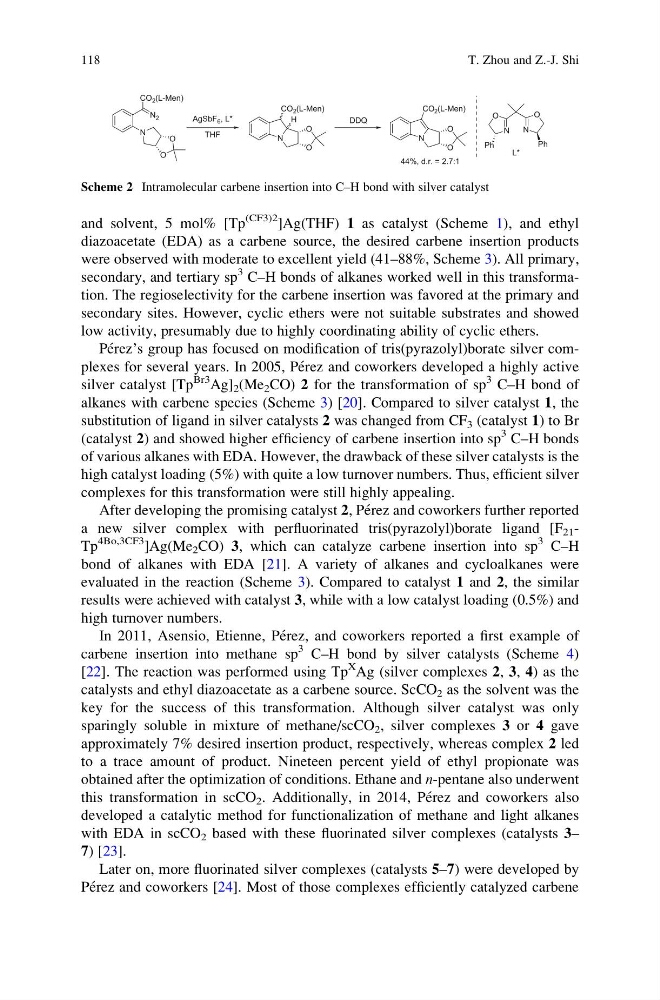
Scheme 2 Intramolecular carbene insertion into C–H bond with silver catalyst
118
T. Zhou and Z.-J. Shi
(CF3)2
]Ag(THF) 1 as catalyst (Scheme 1), and ethyl
diazoacetate (EDA) as a carbene source, the desired carbene insertion products
were observed with moderate to excellent yield (41–88%, Scheme 3). All primary,
secondary, and tertiary sp
3 C–H bonds of alkanes worked well in this transformation. The regioselectivity for the carbene insertion was favored at the primary and
secondary sites. However, cyclic ethers were not suitable substrates and showed
low activity, presumably due to highly coordinating ability of cyclic ethers.
Pe ´rez’s group has focused on modification of tris(pyrazolyl)borate silver complexes for several years. In 2005, Pe ´rez and coworkers developed a highly active
silver catalyst [Tp
Br3 Ag] 2 (Me 2 CO) 2 for the transformation of sp
3 C–H bond of
alkanes with carbene species (Scheme 3) [20]. Compared to silver catalyst 1, the
substitution of ligand in silver catalysts 2 was changed from CF 3 (catalyst 1) to Br
(catalyst 2) and showed higher efficiency of carbene insertion into sp
3 C–H bonds
of various alkanes with EDA. However, the drawback of these silver catalysts is the
high catalyst loading (5%) with quite a low turnover numbers. Thus, efficient silver
complexes for this transformation were still highly appealing.
After developing the promising catalyst 2, Pe ´rez and coworkers further reported
a new silver complex with perfluorinated tris(pyrazolyl)borate ligand [F 21 -
Tp
4Bo,3CF3 ]Ag(Me 2 CO) 3, which can catalyze carbene insertion into sp
3 C–H
bond of alkanes with EDA [21]. A variety of alkanes and cycloalkanes were
evaluated in the reaction (Scheme 3). Compared to catalyst 1 and 2, the similar
results were achieved with catalyst 3, while with a low catalyst loading (0.5%) and
high turnover numbers.
In 2011, Asensio, Etienne, Pe ´rez, and coworkers reported a first example of
carbene insertion into methane sp
3 C–H bond by silver catalysts (Scheme 4)
[22]. The reaction was performed using Tp
X Ag (silver complexes 2, 3, 4) as the
catalysts and ethyl diazoacetate as a carbene source. ScCO 2 as the solvent was the
key for the success of this transformation. Although silver catalyst was only
sparingly soluble in mixture of methane/scCO 2 , silver complexes 3 or 4 gave
approximately 7% desired insertion product, respectively, whereas complex 2 led
to a trace amount of product. Nineteen percent yield of ethyl propionate was
obtained after the optimization of conditions. Ethane and n-pentane also underwent
this transformation in scCO 2 . Additionally, in 2014, Pe ´rez and coworkers also
developed a catalytic method for functionalization of methane and light alkanes
with EDA in scCO 2 based with these fluorinated silver complexes (catalysts 3–
7) [23].
Later on, more fluorinated silver complexes (catalysts 5–7) were developed by
Pe ´rez and coworkers [24]. Most of those complexes efficiently catalyzed carbene
N 2
CO 2 (L-Men)
N
O
O
N
O
O
CO 2 (L-Men)
H
AgSbF 6 , L*
N
O
O
CO 2 (L-Men)
DDQ
44%, d.r. = 2.7:1
THF
N
O
Ph
N
O
Ph
L*
Scheme 2 Intramolecular carbene insertion into C–H bond with silver catalyst
118
T. Zhou and Z.-J. Shi