

42
M. P. Evstigneev and A. V. Shestopalova
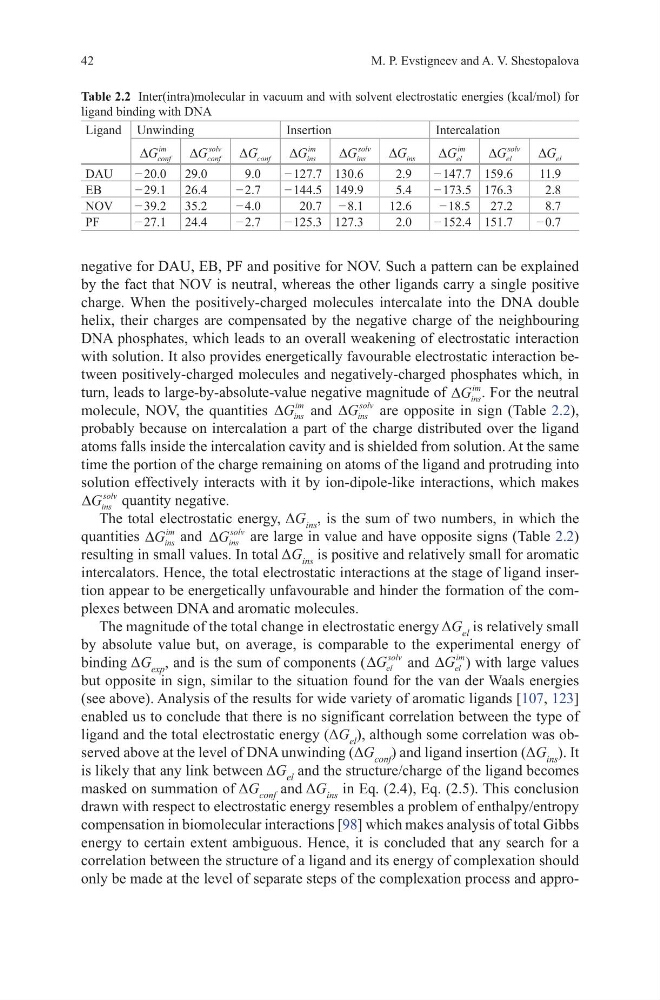
negative for DAU, EB, PF and positive for NOV. Such a pattern can be explained
by the fact that NOV is neutral, whereas the other ligands carry a single positive
charge. When the positively-charged molecules intercalate into the DNA double
helix, their charges are compensated by the negative charge of the neighbouring
DNA phosphates, which leads to an overall weakening of electrostatic interaction
with solution. It also provides energetically favourable electrostatic interaction between positively-charged molecules and negatively-charged phosphates which, in
turn, leads to large-by-absolute-value negative magnitude of ∆G ins
im
. For the neutral
molecule, NOV, the quantities ∆G ins
im
and ∆G ins
solv
are opposite in sign (Table 2.2),
probably because on intercalation a part of the charge distributed over the ligand
atoms falls inside the intercalation cavity and is shielded from solution. At the same
time the portion of the charge remaining on atoms of the ligand and protruding into
solution effectively interacts with it by ion-dipole-like interactions, which makes
∆G ins
solv
quantity negative.
The total electrostatic energy, ΔG ins , is the sum of two numbers, in which the
quantities ∆G ins
im
and ∆G ins
solv
are large in value and have opposite signs (Table 2.2)
resulting in small values. In total ΔG ins is positive and relatively small for aromatic
intercalators. Hence, the total electrostatic interactions at the stage of ligand insertion appear to be energetically unfavourable and hinder the formation of the complexes between DNA and aromatic molecules.
The magnitude of the total change in electrostatic energy ΔG el is relatively small
by absolute value but, on average, is comparable to the experimental energy of
binding ΔG exp , and is the sum of components (∆G el
solv
and ∆G el
im
) with large values
but opposite in sign, similar to the situation found for the van der Waals energies
(see above). Analysis of the results for wide variety of aromatic ligands [107, 123]
enabled us to conclude that there is no significant correlation between the type of
ligand and the total electrostatic energy (ΔG el ), although some correlation was observed above at the level of DNA unwinding (ΔG conf ) and ligand insertion (ΔG ins ). It
is likely that any link between ΔG el and the structure/charge of the ligand becomes
masked on summation of ΔG conf and ΔG ins in Eq. (2.4), Eq. (2.5). This conclusion
drawn with respect to electrostatic energy resembles a problem of enthalpy/entropy
compensation in biomolecular interactions [98] which makes analysis of total Gibbs
energy to certain extent ambiguous. Hence, it is concluded that any search for a
correlation between the structure of a ligand and its energy of complexation should
only be made at the level of separate steps of the complexation process and approTable 2.2 Inter(intra)molecular in vacuum and with solvent electrostatic energies (kcal/mol) for
ligand binding with DNA
Ligand Unwinding
Insertion
Intercalation
∆G conf
im
∆G conf
solv
∆G conf ∆G ins
im
∆G ins
solv
∆G ins
∆G el
im
∆G el
solv
∆G el
DAU
− 20.0 29.0
9.0
− 127.7 130.6
2.9
− 147.7 159.6
11.9
EB
− 29.1 26.4
− 2.7
− 144.5 149.9
5.4
− 173.5 176.3
2.8
NOV
− 39.2 35.2
− 4.0
20.7 − 8.1
12.6
− 18.5
27.2
8.7
PF
− 27.1 24.4
− 2.7
− 125.3 127.3
2.0
− 152.4 151.7
− 0.7
M. P. Evstigneev and A. V. Shestopalova
negative for DAU, EB, PF and positive for NOV. Such a pattern can be explained
by the fact that NOV is neutral, whereas the other ligands carry a single positive
charge. When the positively-charged molecules intercalate into the DNA double
helix, their charges are compensated by the negative charge of the neighbouring
DNA phosphates, which leads to an overall weakening of electrostatic interaction
with solution. It also provides energetically favourable electrostatic interaction between positively-charged molecules and negatively-charged phosphates which, in
turn, leads to large-by-absolute-value negative magnitude of ∆G ins
im
. For the neutral
molecule, NOV, the quantities ∆G ins
im
and ∆G ins
solv
are opposite in sign (Table 2.2),
probably because on intercalation a part of the charge distributed over the ligand
atoms falls inside the intercalation cavity and is shielded from solution. At the same
time the portion of the charge remaining on atoms of the ligand and protruding into
solution effectively interacts with it by ion-dipole-like interactions, which makes
∆G ins
solv
quantity negative.
The total electrostatic energy, ΔG ins , is the sum of two numbers, in which the
quantities ∆G ins
im
and ∆G ins
solv
are large in value and have opposite signs (Table 2.2)
resulting in small values. In total ΔG ins is positive and relatively small for aromatic
intercalators. Hence, the total electrostatic interactions at the stage of ligand insertion appear to be energetically unfavourable and hinder the formation of the complexes between DNA and aromatic molecules.
The magnitude of the total change in electrostatic energy ΔG el is relatively small
by absolute value but, on average, is comparable to the experimental energy of
binding ΔG exp , and is the sum of components (∆G el
solv
and ∆G el
im
) with large values
but opposite in sign, similar to the situation found for the van der Waals energies
(see above). Analysis of the results for wide variety of aromatic ligands [107, 123]
enabled us to conclude that there is no significant correlation between the type of
ligand and the total electrostatic energy (ΔG el ), although some correlation was observed above at the level of DNA unwinding (ΔG conf ) and ligand insertion (ΔG ins ). It
is likely that any link between ΔG el and the structure/charge of the ligand becomes
masked on summation of ΔG conf and ΔG ins in Eq. (2.4), Eq. (2.5). This conclusion
drawn with respect to electrostatic energy resembles a problem of enthalpy/entropy
compensation in biomolecular interactions [98] which makes analysis of total Gibbs
energy to certain extent ambiguous. Hence, it is concluded that any search for a
correlation between the structure of a ligand and its energy of complexation should
only be made at the level of separate steps of the complexation process and approTable 2.2 Inter(intra)molecular in vacuum and with solvent electrostatic energies (kcal/mol) for
ligand binding with DNA
Ligand Unwinding
Insertion
Intercalation
∆G conf
im
∆G conf
solv
∆G conf ∆G ins
im
∆G ins
solv
∆G ins
∆G el
im
∆G el
solv
∆G el
DAU
− 20.0 29.0
9.0
− 127.7 130.6
2.9
− 147.7 159.6
11.9
EB
− 29.1 26.4
− 2.7
− 144.5 149.9
5.4
− 173.5 176.3
2.8
NOV
− 39.2 35.2
− 4.0
20.7 − 8.1
12.6
− 18.5
27.2
8.7
PF
− 27.1 24.4
− 2.7
− 125.3 127.3
2.0
− 152.4 151.7
− 0.7