

41
disfavour complex formation as it depends on the interplay between the intermolecular interactions and the interactions with solvent.
The total VDW energy of binding, ∆G vdw , is the sum of two large numbers,
∆
∆
G
G
vdW
im
vdW
solv
+
, of opposite sign, which results in a small net energy effect and
leads to the conclusion that VDW interactions do not play a significant role in ligand-DNA binding. This is correct in terms of overall binding but not in terms of
stabilization of the complexes. The portion of the total VDW energy of ligand binding,
ins
G
∆ , discussed above, which really contributes to stabilization of the complex,
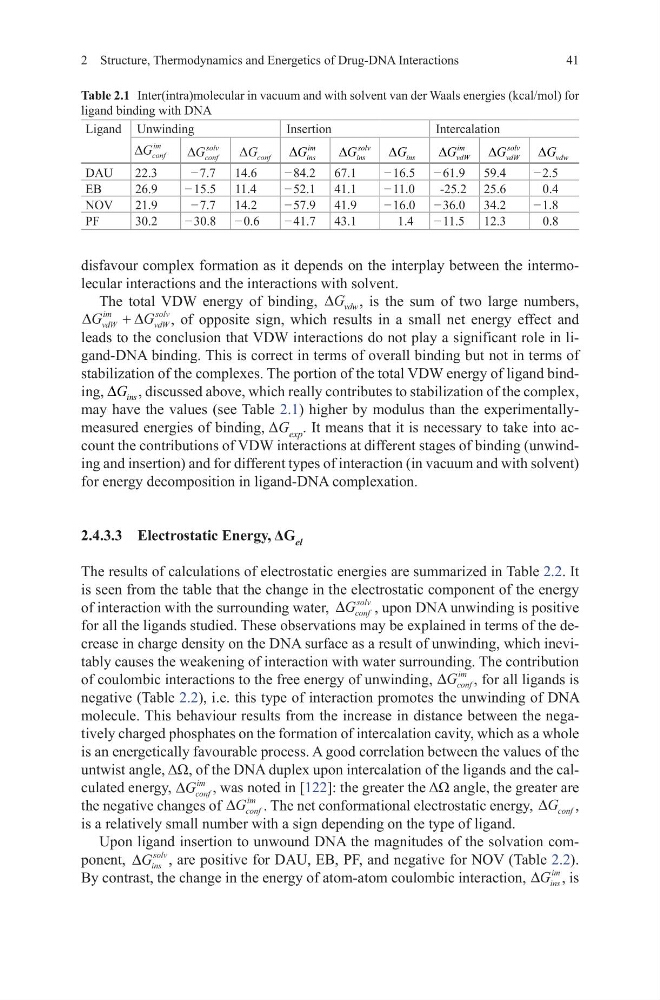
may have the values (see Table 2.1) higher by modulus than the experimentallymeasured energies of binding, ΔG exp . It means that it is necessary to take into account the contributions of VDW interactions at different stages of binding (unwinding and insertion) and for different types of interaction (in vacuum and with solvent)
for energy decomposition in ligand-DNA complexation.
2.4.3.3 Electrostatic Energy, ΔG el
The results of calculations of electrostatic energies are summarized in Table 2.2. It
is seen from the table that the change in the electrostatic component of the energy
of interaction with the surrounding water, ∆G conf
solv
, upon DNA unwinding is positive
for all the ligands studied. These observations may be explained in terms of the decrease in charge density on the DNA surface as a result of unwinding, which inevitably causes the weakening of interaction with water surrounding. The contribution
of coulombic interactions to the free energy of unwinding, ∆G conf
im
, for all ligands is
negative (Table 2.2), i.e. this type of interaction promotes the unwinding of DNA
molecule. This behaviour results from the increase in distance between the negatively charged phosphates on the formation of intercalation cavity, which as a whole
is an energetically favourable process. A good correlation between the values of the
untwist angle, ΔΩ, of the DNA duplex upon intercalation of the ligands and the calculated energy, ∆G conf
im
, was noted in [122]: the greater the ΔΩ angle, the greater are
the negative changes of ∆G conf
im
. The net conformational electrostatic energy, ∆G conf ,
is a relatively small number with a sign depending on the type of ligand.
Upon ligand insertion to unwound DNA the magnitudes of the solvation component, ∆G ins
solv
, are positive for DAU, EB, PF, and negative for NOV (Table 2.2).
By contrast, the change in the energy of atom-atom coulombic interaction, ∆G ins
im
, is
Table 2.1 Inter(intra)molecular in vacuum and with solvent van der Waals energies (kcal/mol) for
ligand binding with DNA
Ligand Unwinding
Insertion
Intercalation
∆G conf
solv
∆G conf
im
ins
G
∆
solv
ins
G
∆
ins
G
∆
im
vdW
G
∆
solv
vdW
G
∆
vdw
G
∆
DAU
22.3
− 7.7 14.6
− 84.2 67.1
− 16.5 − 61.9 59.4
− 2.5
EB
26.9
− 15.5 11.4
− 52.1 41.1
− 11.0
-25.2 25.6
0.4
NOV
21.9
− 7.7 14.2
− 57.9 41.9
− 16.0 − 36.0 34.2
− 1.8
PF
30.2
− 30.8 − 0.6
− 41.7 43.1
1.4
− 11.5
12.3
0.8
∆G conf
im
2 Structure, Thermodynamics and Energetics of Drug-DNA Interactions
disfavour complex formation as it depends on the interplay between the intermolecular interactions and the interactions with solvent.
The total VDW energy of binding, ∆G vdw , is the sum of two large numbers,
∆
∆
G
G
vdW
im
vdW
solv
+
, of opposite sign, which results in a small net energy effect and
leads to the conclusion that VDW interactions do not play a significant role in ligand-DNA binding. This is correct in terms of overall binding but not in terms of
stabilization of the complexes. The portion of the total VDW energy of ligand binding,
ins
G
∆ , discussed above, which really contributes to stabilization of the complex,
may have the values (see Table 2.1) higher by modulus than the experimentallymeasured energies of binding, ΔG exp . It means that it is necessary to take into account the contributions of VDW interactions at different stages of binding (unwinding and insertion) and for different types of interaction (in vacuum and with solvent)
for energy decomposition in ligand-DNA complexation.
2.4.3.3 Electrostatic Energy, ΔG el
The results of calculations of electrostatic energies are summarized in Table 2.2. It
is seen from the table that the change in the electrostatic component of the energy
of interaction with the surrounding water, ∆G conf
solv
, upon DNA unwinding is positive
for all the ligands studied. These observations may be explained in terms of the decrease in charge density on the DNA surface as a result of unwinding, which inevitably causes the weakening of interaction with water surrounding. The contribution
of coulombic interactions to the free energy of unwinding, ∆G conf
im
, for all ligands is
negative (Table 2.2), i.e. this type of interaction promotes the unwinding of DNA
molecule. This behaviour results from the increase in distance between the negatively charged phosphates on the formation of intercalation cavity, which as a whole
is an energetically favourable process. A good correlation between the values of the
untwist angle, ΔΩ, of the DNA duplex upon intercalation of the ligands and the calculated energy, ∆G conf
im
, was noted in [122]: the greater the ΔΩ angle, the greater are
the negative changes of ∆G conf
im
. The net conformational electrostatic energy, ∆G conf ,
is a relatively small number with a sign depending on the type of ligand.
Upon ligand insertion to unwound DNA the magnitudes of the solvation component, ∆G ins
solv
, are positive for DAU, EB, PF, and negative for NOV (Table 2.2).
By contrast, the change in the energy of atom-atom coulombic interaction, ∆G ins
im
, is
Table 2.1 Inter(intra)molecular in vacuum and with solvent van der Waals energies (kcal/mol) for
ligand binding with DNA
Ligand Unwinding
Insertion
Intercalation
∆G conf
solv
∆G conf
im
ins
G
∆
solv
ins
G
∆
ins
G
∆
im
vdW
G
∆
solv
vdW
G
∆
vdw
G
∆
DAU
22.3
− 7.7 14.6
− 84.2 67.1
− 16.5 − 61.9 59.4
− 2.5
EB
26.9
− 15.5 11.4
− 52.1 41.1
− 11.0
-25.2 25.6
0.4
NOV
21.9
− 7.7 14.2
− 57.9 41.9
− 16.0 − 36.0 34.2
− 1.8
PF
30.2
− 30.8 − 0.6
− 41.7 43.1
1.4
− 11.5
12.3
0.8
∆G conf
im
2 Structure, Thermodynamics and Energetics of Drug-DNA Interactions