

488
N. Ya. Golovenko et al.
entirely suitable for qualitative rapid evaluations of the elimination half-life of benzodiazepine drugs.
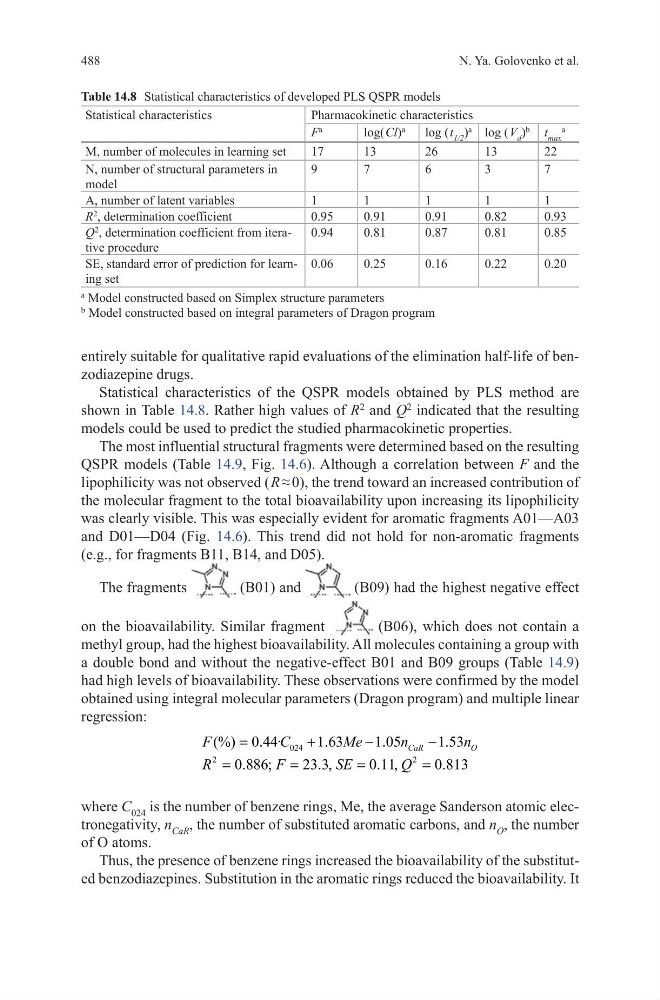
Statistical characteristics of the QSPR models obtained by PLS method are
shown in Table 14.8. Rather high values of R
2
and Q
2
indicated that the resulting
models could be used to predict the studied pharmacokinetic properties.
The most influential structural fragments were determined based on the resulting
QSPR models (Table 14.9, Fig. 14.6). Although a correlation between F and the
lipophilicity was not observed ( R ≈ 0), the trend toward an increased contribution of
the molecular fragment to the total bioavailability upon increasing its lipophilicity
was clearly visible. This was especially evident for aromatic fragments A01—A03
and D01—D04 (Fig. 14.6). This trend did not hold for non-aromatic fragments
(e.g., for fragments B11, B14, and D05).
The fragments
(B01) and
(B09) had the highest negative effect
on the bioavailability. Similar fragment
(B06), which does not contain a
methyl group, had the highest bioavailability. All molecules containing a group with
a double bond and without the negative-effect B01 and B09 groups (Table 14.9)
had high levels of bioavailability. These observations were confirmed by the model
obtained using integral molecular parameters (Dragon program) and multiple linear
regression:
where C 024 is the number of benzene rings, Me, the average Sanderson atomic electronegativity, n CaR , the number of substituted aromatic carbons, and n O , the number
of O atoms.
Thus, the presence of benzene rings increased the bioavailability of the substituted benzodiazepines. Substitution in the aromatic rings reduced the bioavailability. It
024
2
2
(%) 0.44·
1.63
1.05
1.53
0.886;
23.3,
0.11,
0.813
=
+
-
-
=
=
=
=
CaR
O
F
C
Me
n
n
R
F
SE
Q
Table 14.8 Statistical characteristics of developed PLS QSPR models
Statistical characteristics
Pharmacokinetic characteristics
F
a
log( Cl)
a
log ( t 1/2 )
a
log ( V d )
b
t max
a
M, number of molecules in learning set
17
13
26
13
22
N, number of structural parameters in
model
9
7
6
3
7
A, number of latent variables
1
1
1
1
1
R
2
, determination coefficient
0.95
0.91
0.91
0.82
0.93
Q
2
, determination coefficient from iterative procedure
0.94
0.81
0.87
0.81
0.85
SE, standard error of prediction for learning set
0.06
0.25
0.16
0.22
0.20
a
Model constructed based on Simplex structure parameters
b
Model constructed based on integral parameters of Dragon program
N. Ya. Golovenko et al.
entirely suitable for qualitative rapid evaluations of the elimination half-life of benzodiazepine drugs.
Statistical characteristics of the QSPR models obtained by PLS method are
shown in Table 14.8. Rather high values of R
2
and Q
2
indicated that the resulting
models could be used to predict the studied pharmacokinetic properties.
The most influential structural fragments were determined based on the resulting
QSPR models (Table 14.9, Fig. 14.6). Although a correlation between F and the
lipophilicity was not observed ( R ≈ 0), the trend toward an increased contribution of
the molecular fragment to the total bioavailability upon increasing its lipophilicity
was clearly visible. This was especially evident for aromatic fragments A01—A03
and D01—D04 (Fig. 14.6). This trend did not hold for non-aromatic fragments
(e.g., for fragments B11, B14, and D05).
The fragments
(B01) and
(B09) had the highest negative effect
on the bioavailability. Similar fragment
(B06), which does not contain a
methyl group, had the highest bioavailability. All molecules containing a group with
a double bond and without the negative-effect B01 and B09 groups (Table 14.9)
had high levels of bioavailability. These observations were confirmed by the model
obtained using integral molecular parameters (Dragon program) and multiple linear
regression:
where C 024 is the number of benzene rings, Me, the average Sanderson atomic electronegativity, n CaR , the number of substituted aromatic carbons, and n O , the number
of O atoms.
Thus, the presence of benzene rings increased the bioavailability of the substituted benzodiazepines. Substitution in the aromatic rings reduced the bioavailability. It
024
2
2
(%) 0.44·
1.63
1.05
1.53
0.886;
23.3,
0.11,
0.813
=
+
-
-
=
=
=
=
CaR
O
F
C
Me
n
n
R
F
SE
Q
Table 14.8 Statistical characteristics of developed PLS QSPR models
Statistical characteristics
Pharmacokinetic characteristics
F
a
log( Cl)
a
log ( t 1/2 )
a
log ( V d )
b
t max
a
M, number of molecules in learning set
17
13
26
13
22
N, number of structural parameters in
model
9
7
6
3
7
A, number of latent variables
1
1
1
1
1
R
2
, determination coefficient
0.95
0.91
0.91
0.82
0.93
Q
2
, determination coefficient from iterative procedure
0.94
0.81
0.87
0.81
0.85
SE, standard error of prediction for learning set
0.06
0.25
0.16
0.22
0.20
a
Model constructed based on Simplex structure parameters
b
Model constructed based on integral parameters of Dragon program