

478
N. Ya. Golovenko et al.
speed of gastric emptying; induction/inhibition of other drugs or food; interactions
with other drugs (antacids, alcohol, nicotine), interaction with some food products
(grapefruit juice, pomelo, cranberry juice); transport proteins, substrates for transporters (e.g., P-glycoprotein); the state of the gastrointestinal tract, its function and
morphology.
Thus, drugs that give the error in predicting can be divided into the following
groups:
a. during their absorption transporters play the active role and they have certain
targets (class 1-Bumetanide, Cefradine, Diflunisal, Folic acid, Levetiracetam,
Loracarbef, Pramipexole)
b. are intensively subjected to metabolism and have the appropriate targets (class
1-Amobarbital, Anastrozole, Сlofibratum, Clonazepam, Cyproterone, Dapsone,
Dofetilide, Dolasetron, Donepezil, Ethosuximide, Felbamate, Galantamine,
Glimepiride, Hexobarbitalum, Linezolid, Methimazole, Midodrine, Nevirapine,
Oxaprozin, Pentobarbital, Phenprocoumon, Phenylpropanolamine, Primakvin,
Pseudoephedrine, Tamsulosin, Tiagabine, Tocainide, Zonisamide; class 2-Busulfan, Etofyllinum)
c. have targets (class 1-Diazoxide, Indapamide, Minoxidil, Penbutolol, Pheniramine, Practolol, Rimantadine, Roxatidine, Sotalol, Trihexyphenidyl; class
2-Butabarbital)
d. all the factors have a place (class 1-Acetazolamide, Bezafibrate, Clonidine,
Corticosterone, Cyclopenlhiazide, Doxycycline, Etodolac, Gemfibrozil, Hydrocortisone, Imatinib, Lamotrigine, Liothyronine, Phenylbutazone, Probenecid,
Reboxetine, Rosiglitazone, Sertraline)
e. have other factors that affect the bioavailability (class 1-Acipimoks, Amosulalol,
Antipyrinum, Betaxolol, Cicaplast, Cycloprolol, Chloroquine, Fenspiride, Flupirtine, Gestrinone, Digoxin, Isosorbide mononitrate, Letrozole, Lorazepam,
Nicorandil, Pirprofen, Rilmenidine, Sulfadimezin, Tianeptine, Trapidil, Treosulfan; class 2-Renicin, Rizatriptan, Sulfadimidine)
Thus, the method of Random Forest is a quite promising tool for preliminary analysis for activity (bioavailability) of potential medicinal agents. However, there is a
significant effect of various physiological factors that reduce the bioavailability of
drugs prior to their entering the systemic blood circulation, and these factors are
difficult to determine by modeling, as it requires additional experimental studies.
In our view, this method is well for predicting the bioavailability of low molecular
weight compounds, absorption of which occurs by simple diffusion.
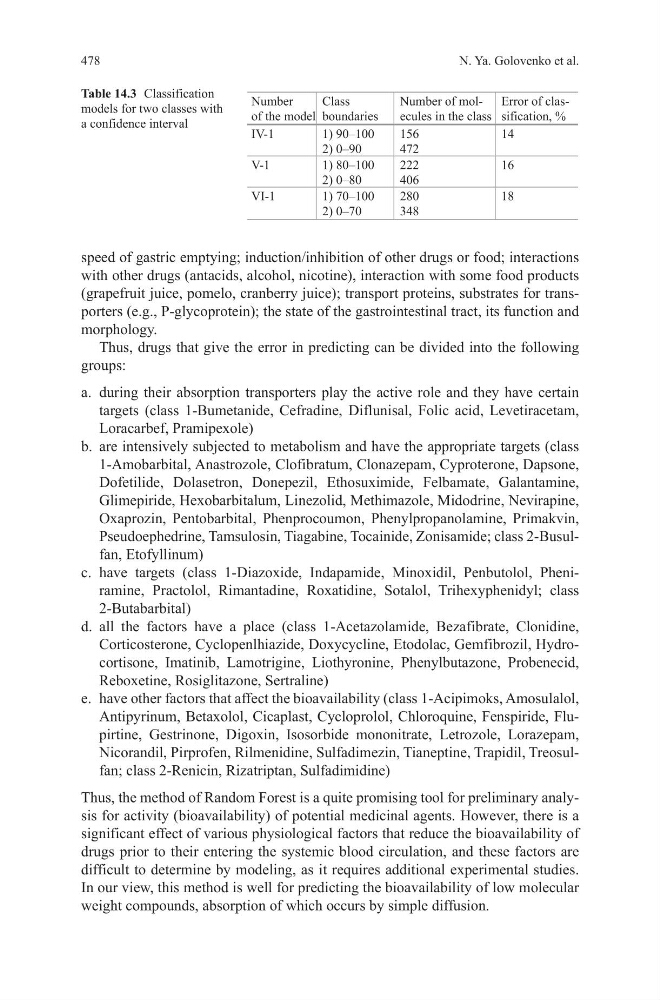
Number
of the model
Class
boundaries
Number of molecules in the class
Error of classification, %
IV-1
1) 90–100
2) 0–90
156
472
14
V-1
1) 80–100
2) 0–80
222
406
16
VI-1
1) 70–100
2) 0–70
280
348
18
Table 14.3 Classification
models for two classes with
a confidence interval
N. Ya. Golovenko et al.
speed of gastric emptying; induction/inhibition of other drugs or food; interactions
with other drugs (antacids, alcohol, nicotine), interaction with some food products
(grapefruit juice, pomelo, cranberry juice); transport proteins, substrates for transporters (e.g., P-glycoprotein); the state of the gastrointestinal tract, its function and
morphology.
Thus, drugs that give the error in predicting can be divided into the following
groups:
a. during their absorption transporters play the active role and they have certain
targets (class 1-Bumetanide, Cefradine, Diflunisal, Folic acid, Levetiracetam,
Loracarbef, Pramipexole)
b. are intensively subjected to metabolism and have the appropriate targets (class
1-Amobarbital, Anastrozole, Сlofibratum, Clonazepam, Cyproterone, Dapsone,
Dofetilide, Dolasetron, Donepezil, Ethosuximide, Felbamate, Galantamine,
Glimepiride, Hexobarbitalum, Linezolid, Methimazole, Midodrine, Nevirapine,
Oxaprozin, Pentobarbital, Phenprocoumon, Phenylpropanolamine, Primakvin,
Pseudoephedrine, Tamsulosin, Tiagabine, Tocainide, Zonisamide; class 2-Busulfan, Etofyllinum)
c. have targets (class 1-Diazoxide, Indapamide, Minoxidil, Penbutolol, Pheniramine, Practolol, Rimantadine, Roxatidine, Sotalol, Trihexyphenidyl; class
2-Butabarbital)
d. all the factors have a place (class 1-Acetazolamide, Bezafibrate, Clonidine,
Corticosterone, Cyclopenlhiazide, Doxycycline, Etodolac, Gemfibrozil, Hydrocortisone, Imatinib, Lamotrigine, Liothyronine, Phenylbutazone, Probenecid,
Reboxetine, Rosiglitazone, Sertraline)
e. have other factors that affect the bioavailability (class 1-Acipimoks, Amosulalol,
Antipyrinum, Betaxolol, Cicaplast, Cycloprolol, Chloroquine, Fenspiride, Flupirtine, Gestrinone, Digoxin, Isosorbide mononitrate, Letrozole, Lorazepam,
Nicorandil, Pirprofen, Rilmenidine, Sulfadimezin, Tianeptine, Trapidil, Treosulfan; class 2-Renicin, Rizatriptan, Sulfadimidine)
Thus, the method of Random Forest is a quite promising tool for preliminary analysis for activity (bioavailability) of potential medicinal agents. However, there is a
significant effect of various physiological factors that reduce the bioavailability of
drugs prior to their entering the systemic blood circulation, and these factors are
difficult to determine by modeling, as it requires additional experimental studies.
In our view, this method is well for predicting the bioavailability of low molecular
weight compounds, absorption of which occurs by simple diffusion.
Number
of the model
Class
boundaries
Number of molecules in the class
Error of classification, %
IV-1
1) 90–100
2) 0–90
156
472
14
V-1
1) 80–100
2) 0–80
222
406
16
VI-1
1) 70–100
2) 0–70
280
348
18
Table 14.3 Classification
models for two classes with
a confidence interval