

477
14 Quantitative Structure-Property Relationship Analysis …
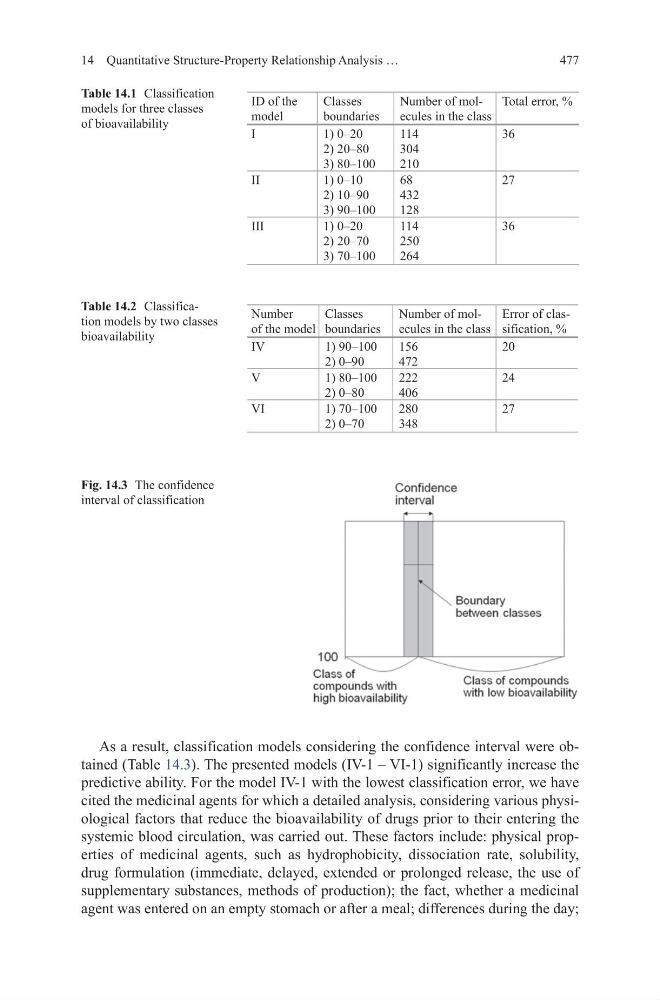
As a result, classification models considering the confidence interval were obtained (Table 14.3). The presented models (IV-1 – VI-1) significantly increase the
predictive ability. For the model IV-1 with the lowest classification error, we have
cited the medicinal agents for which a detailed analysis, considering various physiological factors that reduce the bioavailability of drugs prior to their entering the
systemic blood circulation, was carried out. These factors include: physical properties of medicinal agents, such as hydrophobicity, dissociation rate, solubility,
drug formulation (immediate, delayed, extended or prolonged release, the use of
supplementary substances, methods of production); the fact, whether a medicinal
agent was entered on an empty stomach or after a meal; differences during the day;
ID of the
model
Classes
boundaries
Number of molecules in the class
Total error, %
І
1) 0–20
2) 20–80
3) 80–100
114
304
210
36
II
1) 0–10
2) 10–90
3) 90–100
68
432
128
27
III
1) 0–20
2) 20–70
3) 70–100
114
250
264
36
Table 14.1 Classification
models for three classes
of bioavailability
Number
of the model
Classes
boundaries
Number of molecules in the class
Error of classification, %
ІV
1) 90–100
2) 0–90
156
472
20
V
1) 80–100
2) 0–80
222
406
24
VІ
1) 70–100
2) 0–70
280
348
27
Table 14.2 Classification models by two classes
bioavailability
Fig. 14.3 The confidence
interval of classification
14 Quantitative Structure-Property Relationship Analysis …
As a result, classification models considering the confidence interval were obtained (Table 14.3). The presented models (IV-1 – VI-1) significantly increase the
predictive ability. For the model IV-1 with the lowest classification error, we have
cited the medicinal agents for which a detailed analysis, considering various physiological factors that reduce the bioavailability of drugs prior to their entering the
systemic blood circulation, was carried out. These factors include: physical properties of medicinal agents, such as hydrophobicity, dissociation rate, solubility,
drug formulation (immediate, delayed, extended or prolonged release, the use of
supplementary substances, methods of production); the fact, whether a medicinal
agent was entered on an empty stomach or after a meal; differences during the day;
ID of the
model
Classes
boundaries
Number of molecules in the class
Total error, %
І
1) 0–20
2) 20–80
3) 80–100
114
304
210
36
II
1) 0–10
2) 10–90
3) 90–100
68
432
128
27
III
1) 0–20
2) 20–70
3) 70–100
114
250
264
36
Table 14.1 Classification
models for three classes
of bioavailability
Number
of the model
Classes
boundaries
Number of molecules in the class
Error of classification, %
ІV
1) 90–100
2) 0–90
156
472
20
V
1) 80–100
2) 0–80
222
406
24
VІ
1) 70–100
2) 0–70
280
348
27
Table 14.2 Classification models by two classes
bioavailability
Fig. 14.3 The confidence
interval of classification