

463
14 Quantitative Structure-Property Relationship Analysis …
bonding functionalities, particle size, and crystal form), physiological (GI blood
flow, GI pH, gastric emptying, GI transit time, and absorption mechanisms), and
factors related to the dosage form (tablet, capsule, solution, suspension, emulsion, or
gel) [1–4]. Despite this complexity, the work of the various authors [8–10] revealed
that the fundamental events controlling oral drug absorption are the permeability of
the drug through the GI membrane and the solubility/dissolution of the drug dose in
the GI milieu. In the solid oral dosage form active pharmaceutical ingredient (API)
is characterized by the following interrelated processes occurring in GI: (a) tablet
degradation and release of solid particles of API; (b) solubilization of solid particles
in a liquid medium ( C s ) of GI; (c) penetration of API molecules from an intestinal
liquid through an immobile layer (coated mucosal surface) to mucosal surface; (d)
transfer of API molecules from the liquid medium into the mucosal layer; (e) penetration (P eff or P app ) of API from the mucosal layer into systemic blood circulation.
The P eff and P app values are alternative parameters of F (fraction absorption). P eff
is an effective permeability of organotypic models, P app is apparent permeability
determined in vitro [11, 12].
Key parameters are characterized in the BCS by three dimensionless numbers:
absorption number ( A n ), dissolution number ( D n ), and dose number ( D 0 ). These
numbers take into account both physico-chemical and physiological parameters and
are fundamental to the oral absorption process based on these properties. Amidon
et al. [1, 13] proposed biopharmaceutic classification system (BCS), which in present times is serving as a guide for regulatory and industrial purposes. This concept
exploring dose number, dissolution number, and absorption number of an orally
administered drug clearly dictates its systemic availability. These three numbers
are associated with a number of multifaceted hurdles, which include: (a) physicochemical properties of the molecule (solubility/dissolution); (b) stability of drug in
GI environment (acid degradation); (c) enzymatic stability in GI lumen, epithelium
and liver; (d) permeability (molecular weight, log P, H-bonding efficiency); and
(e) substrates specificity to various biological transporters and efflux systems of
intestinal epithelium.
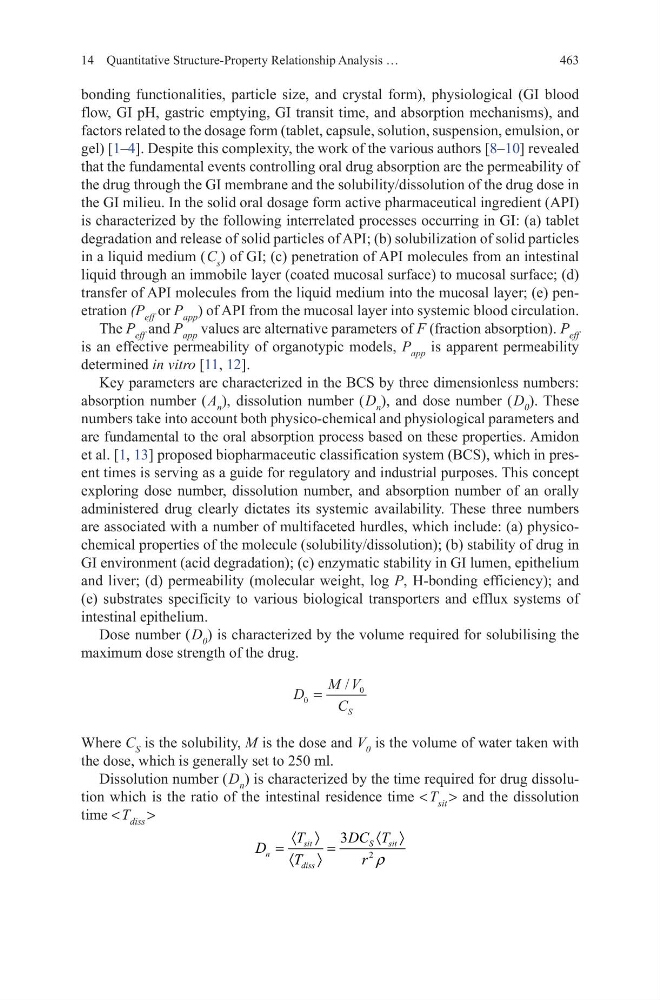
Dose number ( D 0 ) is characterized by the volume required for solubilising the
maximum dose strength of the drug.
Where C S is the solubility, M is the dose and V 0 is the volume of water taken with
the dose, which is generally set to 250 ml.
Dissolution number ( D n ) is characterized by the time required for drug dissolution which is the ratio of the intestinal residence time < T sit > and the dissolution
time < T diss >
D
M V
C S
0
0
=
/
2
3
sit
S
sit
n
diss
T
DC T
D
T
r ρ
〈 〉
〈 〉
=
=
〈
〉
14 Quantitative Structure-Property Relationship Analysis …
bonding functionalities, particle size, and crystal form), physiological (GI blood
flow, GI pH, gastric emptying, GI transit time, and absorption mechanisms), and
factors related to the dosage form (tablet, capsule, solution, suspension, emulsion, or
gel) [1–4]. Despite this complexity, the work of the various authors [8–10] revealed
that the fundamental events controlling oral drug absorption are the permeability of
the drug through the GI membrane and the solubility/dissolution of the drug dose in
the GI milieu. In the solid oral dosage form active pharmaceutical ingredient (API)
is characterized by the following interrelated processes occurring in GI: (a) tablet
degradation and release of solid particles of API; (b) solubilization of solid particles
in a liquid medium ( C s ) of GI; (c) penetration of API molecules from an intestinal
liquid through an immobile layer (coated mucosal surface) to mucosal surface; (d)
transfer of API molecules from the liquid medium into the mucosal layer; (e) penetration (P eff or P app ) of API from the mucosal layer into systemic blood circulation.
The P eff and P app values are alternative parameters of F (fraction absorption). P eff
is an effective permeability of organotypic models, P app is apparent permeability
determined in vitro [11, 12].
Key parameters are characterized in the BCS by three dimensionless numbers:
absorption number ( A n ), dissolution number ( D n ), and dose number ( D 0 ). These
numbers take into account both physico-chemical and physiological parameters and
are fundamental to the oral absorption process based on these properties. Amidon
et al. [1, 13] proposed biopharmaceutic classification system (BCS), which in present times is serving as a guide for regulatory and industrial purposes. This concept
exploring dose number, dissolution number, and absorption number of an orally
administered drug clearly dictates its systemic availability. These three numbers
are associated with a number of multifaceted hurdles, which include: (a) physicochemical properties of the molecule (solubility/dissolution); (b) stability of drug in
GI environment (acid degradation); (c) enzymatic stability in GI lumen, epithelium
and liver; (d) permeability (molecular weight, log P, H-bonding efficiency); and
(e) substrates specificity to various biological transporters and efflux systems of
intestinal epithelium.
Dose number ( D 0 ) is characterized by the volume required for solubilising the
maximum dose strength of the drug.
Where C S is the solubility, M is the dose and V 0 is the volume of water taken with
the dose, which is generally set to 250 ml.
Dissolution number ( D n ) is characterized by the time required for drug dissolution which is the ratio of the intestinal residence time < T sit > and the dissolution
time < T diss >
D
M V
C S
0
0
=
/
2
3
sit
S
sit
n
diss
T
DC T
D
T
r ρ
〈 〉
〈 〉
=
=
〈
〉