

34
M. P. Evstigneev and A. V. Shestopalova
results correlate with the values of melting temperatures obtained for the drug-DNA
complexes [89].
In order to obtain more detailed information on the DNA-ActII complexation,
molecular dynamics simulation was carried out. Analysis of the molecular dynamics trajectories allows one to describe in detail the structures of the investigated
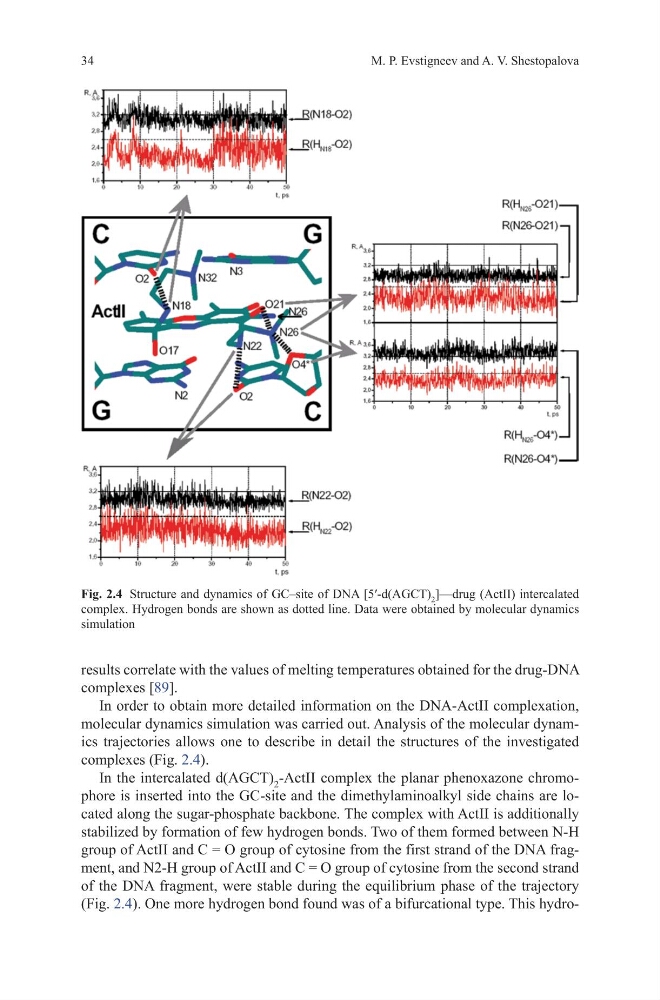
complexes (Fig. 2.4).
In the intercalated d(AGCT) 2 -ActII complex the planar phenoxazone chromophore is inserted into the GC-site and the dimethylaminoalkyl side chains are located along the sugar-phosphate backbone. The complex with ActII is additionally
stabilized by formation of few hydrogen bonds. Two of them formed between N-H
group of ActII and C = O group of cytosine from the first strand of the DNA fragment, and N2-H group of ActII and C = O group of cytosine from the second strand
of the DNA fragment, were stable during the equilibrium phase of the trajectory
(Fig. 2.4). One more hydrogen bond found was of a bifurcational type. This hydroFig. 2.4 Structure and dynamics of GC–site of DNA [5′-d(AGCT) 2 ]—drug (ActII) intercalated
complex. Hydrogen bonds are shown as dotted line. Data were obtained by molecular dynamics
simulation
M. P. Evstigneev and A. V. Shestopalova
results correlate with the values of melting temperatures obtained for the drug-DNA
complexes [89].
In order to obtain more detailed information on the DNA-ActII complexation,
molecular dynamics simulation was carried out. Analysis of the molecular dynamics trajectories allows one to describe in detail the structures of the investigated
complexes (Fig. 2.4).
In the intercalated d(AGCT) 2 -ActII complex the planar phenoxazone chromophore is inserted into the GC-site and the dimethylaminoalkyl side chains are located along the sugar-phosphate backbone. The complex with ActII is additionally
stabilized by formation of few hydrogen bonds. Two of them formed between N-H
group of ActII and C = O group of cytosine from the first strand of the DNA fragment, and N2-H group of ActII and C = O group of cytosine from the second strand
of the DNA fragment, were stable during the equilibrium phase of the trajectory
(Fig. 2.4). One more hydrogen bond found was of a bifurcational type. This hydroFig. 2.4 Structure and dynamics of GC–site of DNA [5′-d(AGCT) 2 ]—drug (ActII) intercalated
complex. Hydrogen bonds are shown as dotted line. Data were obtained by molecular dynamics
simulation