

452
I. I. Baskin and N. I. Zhokhova
Due to the ability to apply methods of functional analysis, continuous molecular
fields can be tailored for solving many different tasks in chemoinformatics. Consider, for example, prediction of physico-chemical properties in diverse datasets. In
this case, “natural alignment” corresponds to the uniform probability of molecules
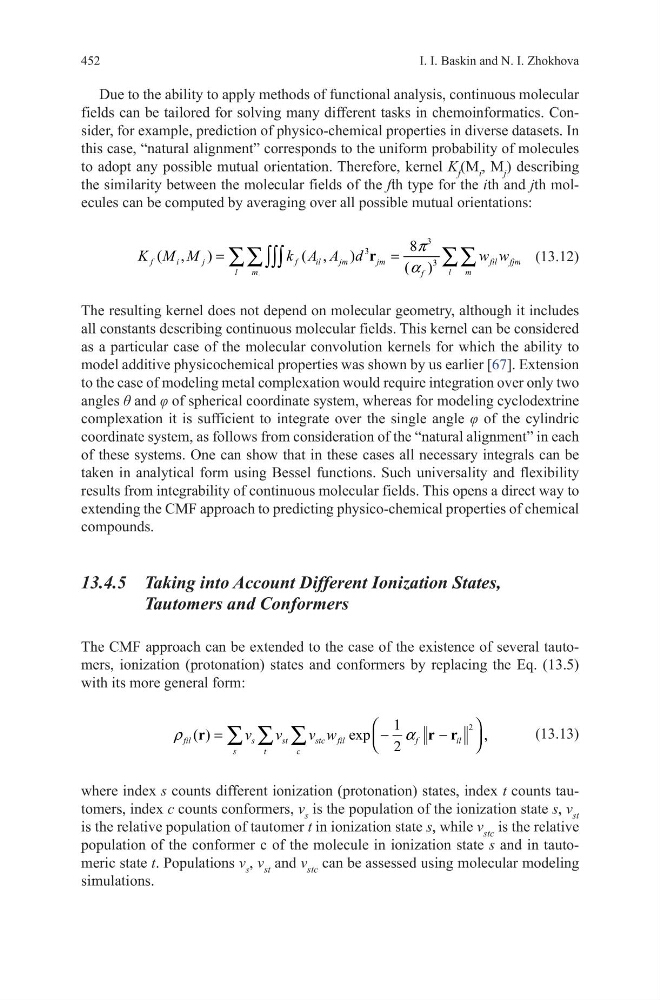
to adopt any possible mutual orientation. Therefore, kernel K f (M i , M j ) describing
the similarity between the molecular fields of the fth type for the ith and jth molecules can be computed by averaging over all possible mutual orientations:
(13.12)
The resulting kernel does not depend on molecular geometry, although it includes
all constants describing continuous molecular fields. This kernel can be considered
as a particular case of the molecular convolution kernels for which the ability to
model additive physicochemical properties was shown by us earlier [67]. Extension
to the case of modeling metal complexation would require integration over only two
angles θ and φ of spherical coordinate system, whereas for modeling cyclodextrine
complexation it is sufficient to integrate over the single angle φ of the cylindric
coordinate system, as follows from consideration of the “natural alignment” in each
of these systems. One can show that in these cases all necessary integrals can be
taken in analytical form using Bessel functions. Such universality and flexibility
results from integrability of continuous molecular fields. This opens a direct way to
extending the CMF approach to predicting physico-chemical properties of chemical
compounds.
13.4.5 Taking into Account Different Ionization States,
Tautomers and Conformers
The CMF approach can be extended to the case of the existence of several tautomers, ionization (protonation) states and conformers by replacing the Eq. (13.5)
with its more general form:
(13.13)
where index s counts different ionization (protonation) states, index t counts tautomers, index c counts conformers, v s is the population of the ionization state s, v st
is the relative population of tautomer t in ionization state s, while v stc is the relative
population of the conformer c of the molecule in ionization state s and in tautomeric state t. Populations v s , v st and v stc can be assessed using molecular modeling
simulations.
3
3
3
8
( ,
)
( ,
)
( )
f
i
j
f
il
jm
jm
fil fjm
l
m
l
m
f
K M M
k A A d
w w
π
α
=
=
∑∑
∑∑
∫∫∫
r
2
1
( )
exp
,
2
fil
s
st
stc fil
f
il
s
t
c
v
v
v w
ρ
α
=
-
-
∑ ∑ ∑
r
r r
I. I. Baskin and N. I. Zhokhova
Due to the ability to apply methods of functional analysis, continuous molecular
fields can be tailored for solving many different tasks in chemoinformatics. Consider, for example, prediction of physico-chemical properties in diverse datasets. In
this case, “natural alignment” corresponds to the uniform probability of molecules
to adopt any possible mutual orientation. Therefore, kernel K f (M i , M j ) describing
the similarity between the molecular fields of the fth type for the ith and jth molecules can be computed by averaging over all possible mutual orientations:
(13.12)
The resulting kernel does not depend on molecular geometry, although it includes
all constants describing continuous molecular fields. This kernel can be considered
as a particular case of the molecular convolution kernels for which the ability to
model additive physicochemical properties was shown by us earlier [67]. Extension
to the case of modeling metal complexation would require integration over only two
angles θ and φ of spherical coordinate system, whereas for modeling cyclodextrine
complexation it is sufficient to integrate over the single angle φ of the cylindric
coordinate system, as follows from consideration of the “natural alignment” in each
of these systems. One can show that in these cases all necessary integrals can be
taken in analytical form using Bessel functions. Such universality and flexibility
results from integrability of continuous molecular fields. This opens a direct way to
extending the CMF approach to predicting physico-chemical properties of chemical
compounds.
13.4.5 Taking into Account Different Ionization States,
Tautomers and Conformers
The CMF approach can be extended to the case of the existence of several tautomers, ionization (protonation) states and conformers by replacing the Eq. (13.5)
with its more general form:
(13.13)
where index s counts different ionization (protonation) states, index t counts tautomers, index c counts conformers, v s is the population of the ionization state s, v st
is the relative population of tautomer t in ionization state s, while v stc is the relative
population of the conformer c of the molecule in ionization state s and in tautomeric state t. Populations v s , v st and v stc can be assessed using molecular modeling
simulations.
3
3
3
8
( ,
)
( ,
)
( )
f
i
j
f
il
jm
jm
fil fjm
l
m
l
m
f
K M M
k A A d
w w
π
α
=
=
∑∑
∑∑
∫∫∫
r
2
1
( )
exp
,
2
fil
s
st
stc fil
f
il
s
t
c
v
v
v w
ρ
α
=
-
-
∑ ∑ ∑
r
r r