

451
13 Continuous Molecular Fields Approach Applied to Structure-Activity Modeling
13.4.3 Taking into Account Molecular Flexibility
A universal way of tackling the problem of molecular flexibility was suggested in
paper [65] for kernel-based methods. It consists in averaging kernels over all conformations for each molecule. This approach is however computationally feasible
only for very small number of conformations per molecule. Indeed, consideration
of only 20 conformations for each molecule results in the necessity to consider 400
pairs of conformations in order to fill each cell in kernel matrix. In addition to huge
computational burden, this approach does not solve the problem of alignment and
therefore applicable only for alignment-free approaches.
The CMF approach can offer an alternative solution to this problem. Instead of
using discrete sets of “representative” conformations, one can consider for each
molecule an infinite number of conformations organized into a continuous manifold, so-called “conformational space”. This provides the ability to apply functional
data analysis not only to molecular fields but also to molecular geometry in a consistent way. Such “conformational space” can be described by means of some probability density function ( pdf) in 3N-dimensional Euclidean space, where N is the
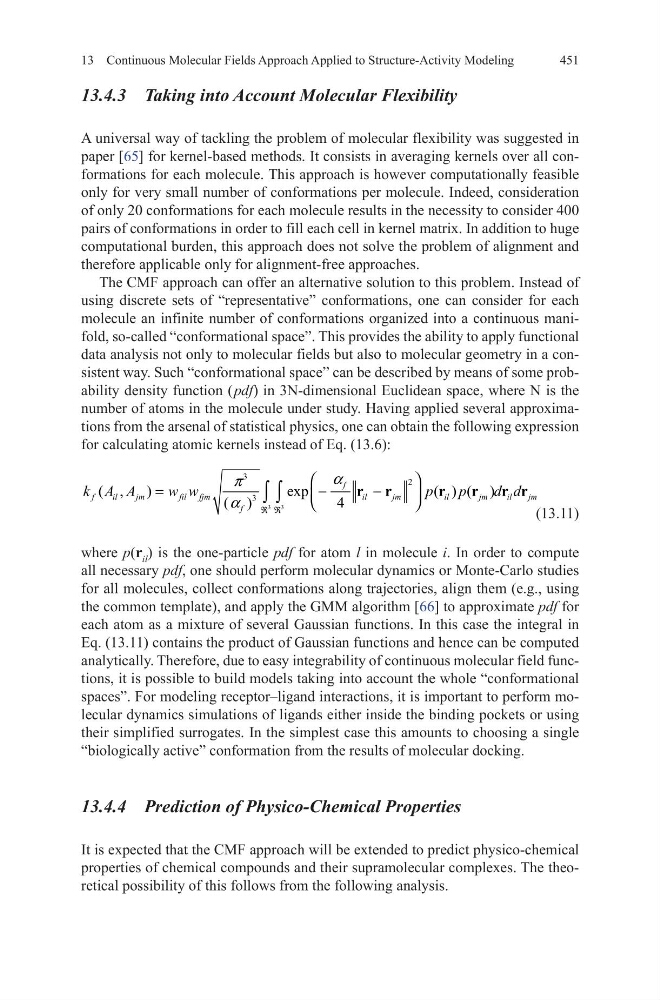
number of atoms in the molecule under study. Having applied several approximations from the arsenal of statistical physics, one can obtain the following expression
for calculating atomic kernels instead of Eq. (13.6):
(13.11)
where p(r il ) is the one-particle pdf for atom l in molecule i. In order to compute
all necessary pdf, one should perform molecular dynamics or Monte-Carlo studies
for all molecules, collect conformations along trajectories, align them (e.g., using
the common template), and apply the GMM algorithm [66] to approximate pdf for
each atom as a mixture of several Gaussian functions. In this case the integral in
Eq. (13.11) contains the product of Gaussian functions and hence can be computed
analytically. Therefore, due to easy integrability of continuous molecular field functions, it is possible to build models taking into account the whole “conformational
spaces”. For modeling receptor–ligand interactions, it is important to perform molecular dynamics simulations of ligands either inside the binding pockets or using
their simplified surrogates. In the simplest case this amounts to choosing a single
“biologically active” conformation from the results of molecular docking.
13.4.4 Prediction of Physico-Chemical Properties
It is expected that the CMF approach will be extended to predict physico-chemical
properties of chemical compounds and their supramolecular complexes. The theoretical possibility of this follows from the following analysis.
3
3
3
2
3
( ,
)
exp
( ) ( )
4
( )
f
f
il
jm
fil fjm
il
jm
il
jm
il
jm
f
k A A
w w
p
p
d d
α
π
α ℜ ℜ
=
-
-
∫ ∫
r r
r
r
r r
13 Continuous Molecular Fields Approach Applied to Structure-Activity Modeling
13.4.3 Taking into Account Molecular Flexibility
A universal way of tackling the problem of molecular flexibility was suggested in
paper [65] for kernel-based methods. It consists in averaging kernels over all conformations for each molecule. This approach is however computationally feasible
only for very small number of conformations per molecule. Indeed, consideration
of only 20 conformations for each molecule results in the necessity to consider 400
pairs of conformations in order to fill each cell in kernel matrix. In addition to huge
computational burden, this approach does not solve the problem of alignment and
therefore applicable only for alignment-free approaches.
The CMF approach can offer an alternative solution to this problem. Instead of
using discrete sets of “representative” conformations, one can consider for each
molecule an infinite number of conformations organized into a continuous manifold, so-called “conformational space”. This provides the ability to apply functional
data analysis not only to molecular fields but also to molecular geometry in a consistent way. Such “conformational space” can be described by means of some probability density function ( pdf) in 3N-dimensional Euclidean space, where N is the
number of atoms in the molecule under study. Having applied several approximations from the arsenal of statistical physics, one can obtain the following expression
for calculating atomic kernels instead of Eq. (13.6):
(13.11)
where p(r il ) is the one-particle pdf for atom l in molecule i. In order to compute
all necessary pdf, one should perform molecular dynamics or Monte-Carlo studies
for all molecules, collect conformations along trajectories, align them (e.g., using
the common template), and apply the GMM algorithm [66] to approximate pdf for
each atom as a mixture of several Gaussian functions. In this case the integral in
Eq. (13.11) contains the product of Gaussian functions and hence can be computed
analytically. Therefore, due to easy integrability of continuous molecular field functions, it is possible to build models taking into account the whole “conformational
spaces”. For modeling receptor–ligand interactions, it is important to perform molecular dynamics simulations of ligands either inside the binding pockets or using
their simplified surrogates. In the simplest case this amounts to choosing a single
“biologically active” conformation from the results of molecular docking.
13.4.4 Prediction of Physico-Chemical Properties
It is expected that the CMF approach will be extended to predict physico-chemical
properties of chemical compounds and their supramolecular complexes. The theoretical possibility of this follows from the following analysis.
3
3
3
2
3
( ,
)
exp
( ) ( )
4
( )
f
f
il
jm
fil fjm
il
jm
il
jm
il
jm
f
k A A
w w
p
p
d d
α
π
α ℜ ℜ
=
-
-
∫ ∫
r r
r
r
r r