

448
I. I. Baskin and N. I. Zhokhova
Constructing the classification model necessitates maximizing the AUC value
by optimizing the 1-SVM parameter ν and parameter α f of the CMF kernel from
Eq. (13.5). We have studied both the individual electrostatic, steric, and hydrophobic
kernels and their linear combinations. For individual kernels, two parameters have
been optimized: ν and the α f parameter corresponding to a given type of molecular
field. At the first step, the optimization algorithm was launched ten times, each time
starting from a set of random parameter values in the ranges ν ∈ [0.01; 0.80], h f ∈
[0.0001;0.3000], and α f ∈ [0.001; 1.000]. At the second step, the Nelder–Mead algorithm was used for refining the optimal parameters; the set of the best-fit parameters
obtained at the first step of optimization were used as the initial approximation.
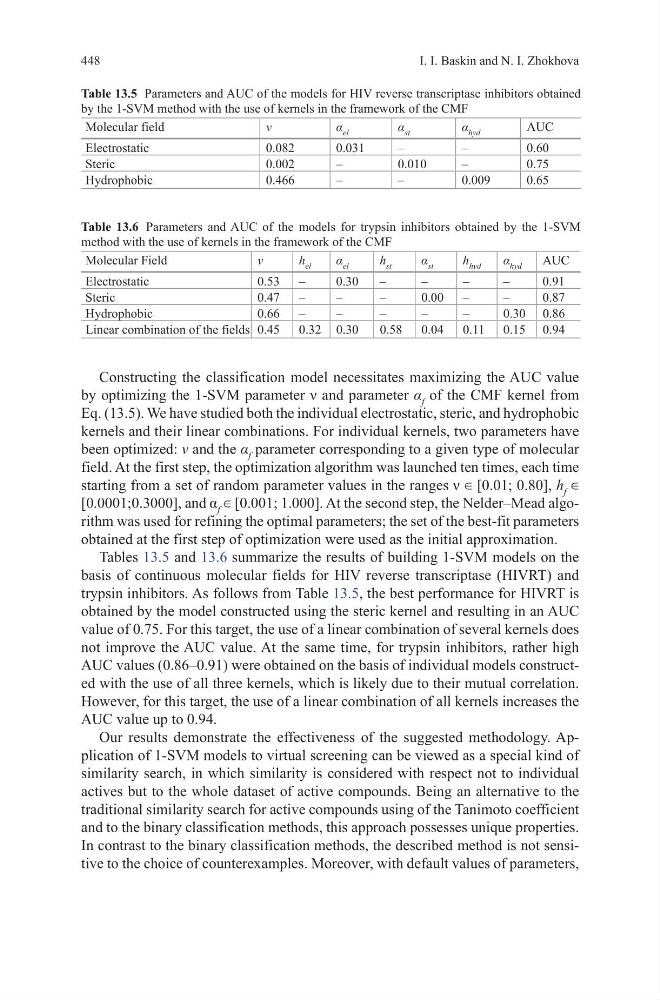
Tables 13.5 and 13.6 summarize the results of building 1-SVM models on the
basis of continuous molecular fields for HIV reverse transcriptase (HIVRT) and
trypsin inhibitors. As follows from Table 13.5, the best performance for HIVRT is
obtained by the model constructed using the steric kernel and resulting in an AUC
value of 0.75. For this target, the use of a linear combination of several kernels does
not improve the AUC value. At the same time, for trypsin inhibitors, rather high
AUC values (0.86–0.91) were obtained on the basis of individual models constructed with the use of all three kernels, which is likely due to their mutual correlation.
However, for this target, the use of a linear combination of all kernels increases the
AUC value up to 0.94.
Our results demonstrate the effectiveness of the suggested methodology. Application of 1-SVM models to virtual screening can be viewed as a special kind of
similarity search, in which similarity is considered with respect not to individual
actives but to the whole dataset of active compounds. Being an alternative to the
traditional similarity search for active compounds using of the Tanimoto coefficient
and to the binary classification methods, this approach possesses unique properties.
In contrast to the binary classification methods, the described method is not sensitive to the choice of counterexamples. Moreover, with default values of parameters,
Table 13.6 Parameters and AUC of the models for trypsin inhibitors obtained by the 1-SVM
method with the use of kernels in the framework of the CMF
Molecular Field
ν
h el
α el
h st
α st
h hyd
α hyd
AUC
Electrostatic
0.53
–
0.30
–
–
–
–
0.91
Steric
0.47
–
–
–
0.00
–
–
0.87
Hydrophobic
0.66
–
–
–
–
–
0.30 0.86
Linear combination of the fields 0.45
0.32 0.30
0.58
0.04
0.11 0.15 0.94
Table 13.5 Parameters and AUC of the models for HIV reverse transcriptase inhibitors obtained
by the 1-SVM method with the use of kernels in the framework of the CMF
Molecular field
ν
α el
α st
α hyd
AUC
Electrostatic
0.082
0.031
–
–
0.60
Steric
0.002
–
0.010
–
0.75
Hydrophobic
0.466
–
–
0.009
0.65
I. I. Baskin and N. I. Zhokhova
Constructing the classification model necessitates maximizing the AUC value
by optimizing the 1-SVM parameter ν and parameter α f of the CMF kernel from
Eq. (13.5). We have studied both the individual electrostatic, steric, and hydrophobic
kernels and their linear combinations. For individual kernels, two parameters have
been optimized: ν and the α f parameter corresponding to a given type of molecular
field. At the first step, the optimization algorithm was launched ten times, each time
starting from a set of random parameter values in the ranges ν ∈ [0.01; 0.80], h f ∈
[0.0001;0.3000], and α f ∈ [0.001; 1.000]. At the second step, the Nelder–Mead algorithm was used for refining the optimal parameters; the set of the best-fit parameters
obtained at the first step of optimization were used as the initial approximation.
Tables 13.5 and 13.6 summarize the results of building 1-SVM models on the
basis of continuous molecular fields for HIV reverse transcriptase (HIVRT) and
trypsin inhibitors. As follows from Table 13.5, the best performance for HIVRT is
obtained by the model constructed using the steric kernel and resulting in an AUC
value of 0.75. For this target, the use of a linear combination of several kernels does
not improve the AUC value. At the same time, for trypsin inhibitors, rather high
AUC values (0.86–0.91) were obtained on the basis of individual models constructed with the use of all three kernels, which is likely due to their mutual correlation.
However, for this target, the use of a linear combination of all kernels increases the
AUC value up to 0.94.
Our results demonstrate the effectiveness of the suggested methodology. Application of 1-SVM models to virtual screening can be viewed as a special kind of
similarity search, in which similarity is considered with respect not to individual
actives but to the whole dataset of active compounds. Being an alternative to the
traditional similarity search for active compounds using of the Tanimoto coefficient
and to the binary classification methods, this approach possesses unique properties.
In contrast to the binary classification methods, the described method is not sensitive to the choice of counterexamples. Moreover, with default values of parameters,
Table 13.6 Parameters and AUC of the models for trypsin inhibitors obtained by the 1-SVM
method with the use of kernels in the framework of the CMF
Molecular Field
ν
h el
α el
h st
α st
h hyd
α hyd
AUC
Electrostatic
0.53
–
0.30
–
–
–
–
0.91
Steric
0.47
–
–
–
0.00
–
–
0.87
Hydrophobic
0.66
–
–
–
–
–
0.30 0.86
Linear combination of the fields 0.45
0.32 0.30
0.58
0.04
0.11 0.15 0.94
Table 13.5 Parameters and AUC of the models for HIV reverse transcriptase inhibitors obtained
by the 1-SVM method with the use of kernels in the framework of the CMF
Molecular field
ν
α el
α st
α hyd
AUC
Electrostatic
0.082
0.031
–
–
0.60
Steric
0.002
–
0.010
–
0.75
Hydrophobic
0.466
–
–
0.009
0.65