

446
I. I. Baskin and N. I. Zhokhova
them. It builds one-class classification models by seeking for hyperplane in infinitedimensional functional Hilbert space (feature space) with maximum distance from
the coordinate origin and separating a given proportion of training examples from
it. In this case, the field of model coefficients is formed by leading cosines of the
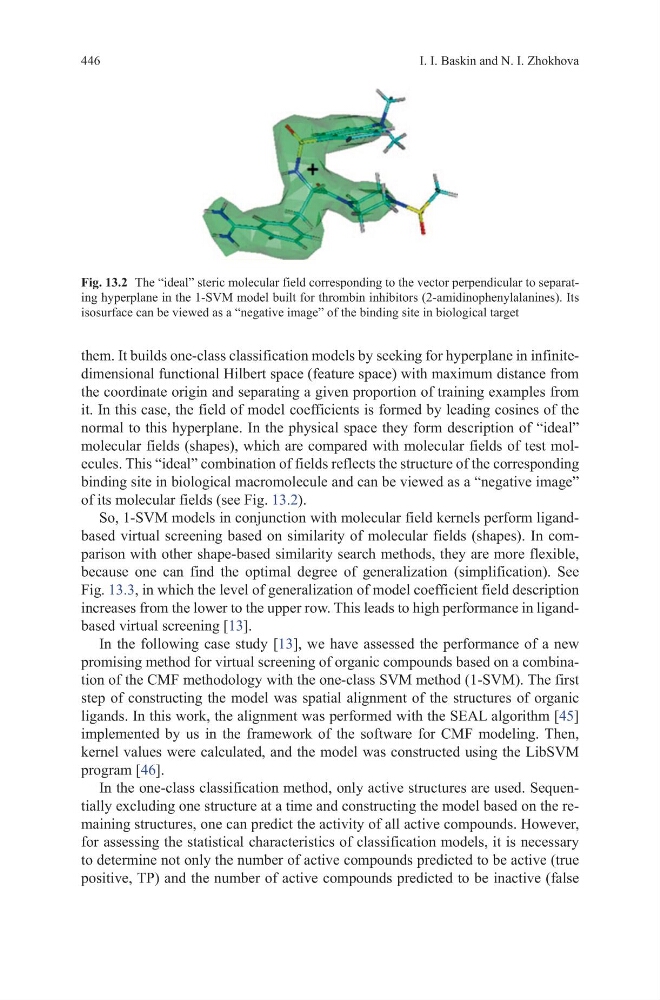
normal to this hyperplane. In the physical space they form description of “ideal”
molecular fields (shapes), which are compared with molecular fields of test molecules. This “ideal” combination of fields reflects the structure of the corresponding
binding site in biological macromolecule and can be viewed as a “negative image”
of its molecular fields (see Fig. 13.2).
So, 1-SVM models in conjunction with molecular field kernels perform ligandbased virtual screening based on similarity of molecular fields (shapes). In comparison with other shape-based similarity search methods, they are more flexible,
because one can find the optimal degree of generalization (simplification). See
Fig. 13.3, in which the level of generalization of model coefficient field description
increases from the lower to the upper row. This leads to high performance in ligandbased virtual screening [13].
In the following case study [13], we have assessed the performance of a new
promising method for virtual screening of organic compounds based on a combination of the CMF methodology with the one-class SVM method (1-SVM). The first
step of constructing the model was spatial alignment of the structures of organic
ligands. In this work, the alignment was performed with the SEAL algorithm [45]
implemented by us in the framework of the software for CMF modeling. Then,
kernel values were calculated, and the model was constructed using the LibSVM
program [46].
In the one-class classification method, only active structures are used. Sequentially excluding one structure at a time and constructing the model based on the remaining structures, one can predict the activity of all active compounds. However,
for assessing the statistical characteristics of classification models, it is necessary
to determine not only the number of active compounds predicted to be active (true
positive, TP) and the number of active compounds predicted to be inactive (false
Fig. 13.2 The “ideal” steric molecular field corresponding to the vector perpendicular to separating hyperplane in the 1-SVM model built for thrombin inhibitors (2-amidinophenylalanines). Its
isosurface can be viewed as a “negative image” of the binding site in biological target
I. I. Baskin and N. I. Zhokhova
them. It builds one-class classification models by seeking for hyperplane in infinitedimensional functional Hilbert space (feature space) with maximum distance from
the coordinate origin and separating a given proportion of training examples from
it. In this case, the field of model coefficients is formed by leading cosines of the
normal to this hyperplane. In the physical space they form description of “ideal”
molecular fields (shapes), which are compared with molecular fields of test molecules. This “ideal” combination of fields reflects the structure of the corresponding
binding site in biological macromolecule and can be viewed as a “negative image”
of its molecular fields (see Fig. 13.2).
So, 1-SVM models in conjunction with molecular field kernels perform ligandbased virtual screening based on similarity of molecular fields (shapes). In comparison with other shape-based similarity search methods, they are more flexible,
because one can find the optimal degree of generalization (simplification). See
Fig. 13.3, in which the level of generalization of model coefficient field description
increases from the lower to the upper row. This leads to high performance in ligandbased virtual screening [13].
In the following case study [13], we have assessed the performance of a new
promising method for virtual screening of organic compounds based on a combination of the CMF methodology with the one-class SVM method (1-SVM). The first
step of constructing the model was spatial alignment of the structures of organic
ligands. In this work, the alignment was performed with the SEAL algorithm [45]
implemented by us in the framework of the software for CMF modeling. Then,
kernel values were calculated, and the model was constructed using the LibSVM
program [46].
In the one-class classification method, only active structures are used. Sequentially excluding one structure at a time and constructing the model based on the remaining structures, one can predict the activity of all active compounds. However,
for assessing the statistical characteristics of classification models, it is necessary
to determine not only the number of active compounds predicted to be active (true
positive, TP) and the number of active compounds predicted to be inactive (false
Fig. 13.2 The “ideal” steric molecular field corresponding to the vector perpendicular to separating hyperplane in the 1-SVM model built for thrombin inhibitors (2-amidinophenylalanines). Its
isosurface can be viewed as a “negative image” of the binding site in biological target