

439
13 Continuous Molecular Fields Approach Applied to Structure-Activity Modeling
(13.8)
(13.9)
(13.10)
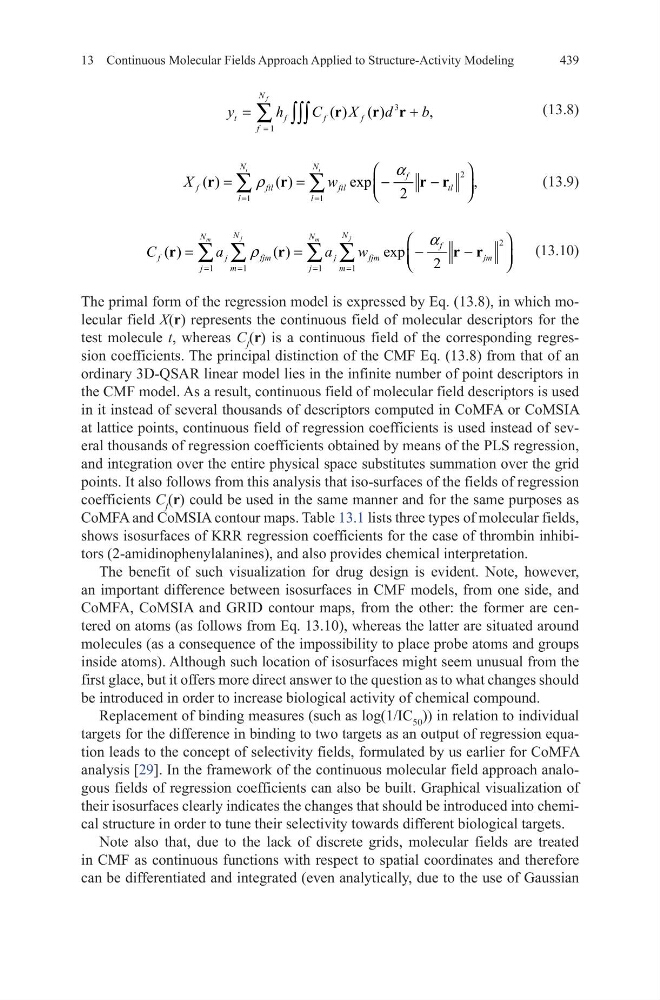
The primal form of the regression model is expressed by Eq. (13.8), in which molecular field X(r) represents the continuous field of molecular descriptors for the
test molecule t, whereas C f (r) is a continuous field of the corresponding regression coefficients. The principal distinction of the CMF Eq. (13.8) from that of an
ordinary 3D-QSAR linear model lies in the infinite number of point descriptors in
the CMF model. As a result, continuous field of molecular field descriptors is used
in it instead of several thousands of descriptors computed in CoMFA or CoMSIA
at lattice points, continuous field of regression coefficients is used instead of several thousands of regression coefficients obtained by means of the PLS regression,
and integration over the entire physical space substitutes summation over the grid
points. It also follows from this analysis that iso-surfaces of the fields of regression
coefficients C f (r) could be used in the same manner and for the same purposes as
CoMFA and CoMSIA contour maps. Table 13.1 lists three types of molecular fields,
shows isosurfaces of KRR regression coefficients for the case of thrombin inhibitors (2-amidinophenylalanines), and also provides chemical interpretation.
The benefit of such visualization for drug design is evident. Note, however,
an important difference between isosurfaces in CMF models, from one side, and
CoMFA, CoMSIA and GRID contour maps, from the other: the former are centered on atoms (as follows from Eq. 13.10), whereas the latter are situated around
molecules (as a consequence of the impossibility to place probe atoms and groups
inside atoms). Although such location of isosurfaces might seem unusual from the
first glace, but it offers more direct answer to the question as to what changes should
be introduced in order to increase biological activity of chemical compound.
Replacement of binding measures (such as log(1/IC 50 )) in relation to individual
targets for the difference in binding to two targets as an output of regression equation leads to the concept of selectivity fields, formulated by us earlier for CoMFA
analysis [29]. In the framework of the continuous molecular field approach analogous fields of regression coefficients can also be built. Graphical visualization of
their isosurfaces clearly indicates the changes that should be introduced into chemical structure in order to tune their selectivity towards different biological targets.
Note also that, due to the lack of discrete grids, molecular fields are treated
in CMF as continuous functions with respect to spatial coordinates and therefore
can be differentiated and integrated (even analytically, due to the use of Gaussian
3
1
( ) ( )
,
f
N
t
f
f
f
f
y
h
C
X
d
b
=
=
+
∑ ∫∫∫ r r r
2
1
1
( )
( )
exp
,
2
i
i
N
N
f
f
ftl
ftl
tl
l
l
X
w
α
ρ
=
=
=
=
-
-
∑
∑
r
r
r r
2
1
1
1
1
( )
( )
exp
2
j
j
m
m
N
N
N
N
f
f
j
fjm
j
fjm
jm
j
m
j
m
C
a
a
w
α
ρ
=
=
=
=
=
=
-
-
∑ ∑
∑ ∑
r
r
r r
13 Continuous Molecular Fields Approach Applied to Structure-Activity Modeling
(13.8)
(13.9)
(13.10)
The primal form of the regression model is expressed by Eq. (13.8), in which molecular field X(r) represents the continuous field of molecular descriptors for the
test molecule t, whereas C f (r) is a continuous field of the corresponding regression coefficients. The principal distinction of the CMF Eq. (13.8) from that of an
ordinary 3D-QSAR linear model lies in the infinite number of point descriptors in
the CMF model. As a result, continuous field of molecular field descriptors is used
in it instead of several thousands of descriptors computed in CoMFA or CoMSIA
at lattice points, continuous field of regression coefficients is used instead of several thousands of regression coefficients obtained by means of the PLS regression,
and integration over the entire physical space substitutes summation over the grid
points. It also follows from this analysis that iso-surfaces of the fields of regression
coefficients C f (r) could be used in the same manner and for the same purposes as
CoMFA and CoMSIA contour maps. Table 13.1 lists three types of molecular fields,
shows isosurfaces of KRR regression coefficients for the case of thrombin inhibitors (2-amidinophenylalanines), and also provides chemical interpretation.
The benefit of such visualization for drug design is evident. Note, however,
an important difference between isosurfaces in CMF models, from one side, and
CoMFA, CoMSIA and GRID contour maps, from the other: the former are centered on atoms (as follows from Eq. 13.10), whereas the latter are situated around
molecules (as a consequence of the impossibility to place probe atoms and groups
inside atoms). Although such location of isosurfaces might seem unusual from the
first glace, but it offers more direct answer to the question as to what changes should
be introduced in order to increase biological activity of chemical compound.
Replacement of binding measures (such as log(1/IC 50 )) in relation to individual
targets for the difference in binding to two targets as an output of regression equation leads to the concept of selectivity fields, formulated by us earlier for CoMFA
analysis [29]. In the framework of the continuous molecular field approach analogous fields of regression coefficients can also be built. Graphical visualization of
their isosurfaces clearly indicates the changes that should be introduced into chemical structure in order to tune their selectivity towards different biological targets.
Note also that, due to the lack of discrete grids, molecular fields are treated
in CMF as continuous functions with respect to spatial coordinates and therefore
can be differentiated and integrated (even analytically, due to the use of Gaussian
3
1
( ) ( )
,
f
N
t
f
f
f
f
y
h
C
X
d
b
=
=
+
∑ ∫∫∫ r r r
2
1
1
( )
( )
exp
,
2
i
i
N
N
f
f
ftl
ftl
tl
l
l
X
w
α
ρ
=
=
=
=
-
-
∑
∑
r
r
r r
2
1
1
1
1
( )
( )
exp
2
j
j
m
m
N
N
N
N
f
f
j
fjm
j
fjm
jm
j
m
j
m
C
a
a
w
α
ρ
=
=
=
=
=
=
-
-
∑ ∑
∑ ∑
r
r
r r