

413
12 Consensus Drug Design Using IT Microcosm
organic acids (e.g., propionic, oxalic, citric, cyclamic, adamantane-1-carboxylic,
and p-toluenesulfonic), of various metals (e.g., Na, K, Ca, Mg, Al, Bi, and Cu)
and of organic bases (e.g., ethylenediamine, benzylamine, tris, and piperazine). A
directed search for novel drugs among condensed azole derivatives (see Sect. 4)
was also performed with consideration of the salt component associated with the
main structure.
The following test was performed with the express purpose of understanding
how taking into consideration the presence of an acid residue affects the accuracy of
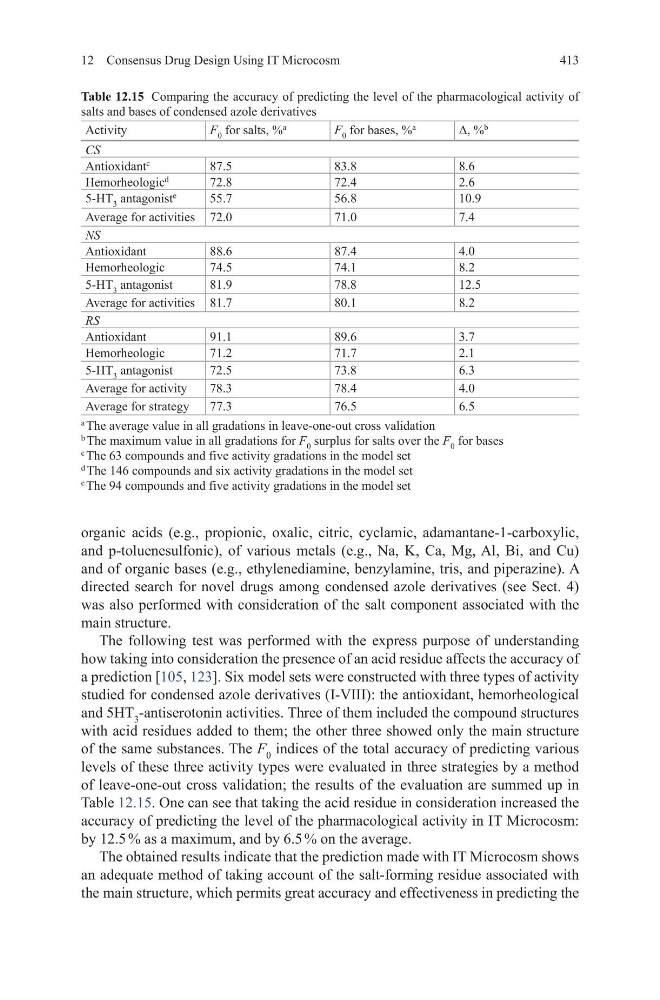
a prediction [105, 123]. Six model sets were constructed with three types of activity
studied for condensed azole derivatives (I-VIII): the antioxidant, hemorheological
and 5HT 3 -antiserotonin activities. Three of them included the compound structures
with acid residues added to them; the other three showed only the main structure
of the same substances. The F 0 indices of the total accuracy of predicting various
levels of these three activity types were evaluated in three strategies by a method
of leave-one-out cross validation; the results of the evaluation are summed up in
Table 12.15. One can see that taking the acid residue in consideration increased the
accuracy of predicting the level of the pharmacological activity in IT Microcosm:
by 12.5 % as a maximum, and by 6.5 % on the average.
The obtained results indicate that the prediction made with IT Microcosm shows
an adequate method of taking account of the salt-forming residue associated with
the main structure, which permits great accuracy and effectiveness in predicting the
Table 12.15 Comparing the accuracy of predicting the level of the pharmacological activity of
salts and bases of condensed azole derivatives
Activity
F 0 for salts, %
a
F 0 for bases, %
a
Δ, %
b
CS
Antioxidant
c
87.5
83.8
8.6
Hemorheologic
d
72.8
72.4
2.6
5-HT 3 antagonist
e
55.7
56.8
10.9
Average for activities 72.0
71.0
7.4
NS
Antioxidant
88.6
87.4
4.0
Hemorheologic
74.5
74.1
8.2
5-HT 3 antagonist
81.9
78.8
12.5
Average for activities 81.7
80.1
8.2
RS
Antioxidant
91.1
89.6
3.7
Hemorheologic
71.2
71.7
2.1
5-HT 3 antagonist
72.5
73.8
6.3
Average for activity
78.3
78.4
4.0
Average for strategy
77.3
76.5
6.5
a
The average value in all gradations in leave-one-out cross validation
b
The maximum value in all gradations for F 0 surplus for salts over the F 0 for bases
c
The 63 compounds and five activity gradations in the model set
d
The 146 compounds and six activity gradations in the model set
e
The 94 compounds and five activity gradations in the model set
12 Consensus Drug Design Using IT Microcosm
organic acids (e.g., propionic, oxalic, citric, cyclamic, adamantane-1-carboxylic,
and p-toluenesulfonic), of various metals (e.g., Na, K, Ca, Mg, Al, Bi, and Cu)
and of organic bases (e.g., ethylenediamine, benzylamine, tris, and piperazine). A
directed search for novel drugs among condensed azole derivatives (see Sect. 4)
was also performed with consideration of the salt component associated with the
main structure.
The following test was performed with the express purpose of understanding
how taking into consideration the presence of an acid residue affects the accuracy of
a prediction [105, 123]. Six model sets were constructed with three types of activity
studied for condensed azole derivatives (I-VIII): the antioxidant, hemorheological
and 5HT 3 -antiserotonin activities. Three of them included the compound structures
with acid residues added to them; the other three showed only the main structure
of the same substances. The F 0 indices of the total accuracy of predicting various
levels of these three activity types were evaluated in three strategies by a method
of leave-one-out cross validation; the results of the evaluation are summed up in
Table 12.15. One can see that taking the acid residue in consideration increased the
accuracy of predicting the level of the pharmacological activity in IT Microcosm:
by 12.5 % as a maximum, and by 6.5 % on the average.
The obtained results indicate that the prediction made with IT Microcosm shows
an adequate method of taking account of the salt-forming residue associated with
the main structure, which permits great accuracy and effectiveness in predicting the
Table 12.15 Comparing the accuracy of predicting the level of the pharmacological activity of
salts and bases of condensed azole derivatives
Activity
F 0 for salts, %
a
F 0 for bases, %
a
Δ, %
b
CS
Antioxidant
c
87.5
83.8
8.6
Hemorheologic
d
72.8
72.4
2.6
5-HT 3 antagonist
e
55.7
56.8
10.9
Average for activities 72.0
71.0
7.4
NS
Antioxidant
88.6
87.4
4.0
Hemorheologic
74.5
74.1
8.2
5-HT 3 antagonist
81.9
78.8
12.5
Average for activities 81.7
80.1
8.2
RS
Antioxidant
91.1
89.6
3.7
Hemorheologic
71.2
71.7
2.1
5-HT 3 antagonist
72.5
73.8
6.3
Average for activity
78.3
78.4
4.0
Average for strategy
77.3
76.5
6.5
a
The average value in all gradations in leave-one-out cross validation
b
The maximum value in all gradations for F 0 surplus for salts over the F 0 for bases
c
The 63 compounds and five activity gradations in the model set
d
The 146 compounds and six activity gradations in the model set
e
The 94 compounds and five activity gradations in the model set