

385
12 Consensus Drug Design Using IT Microcosm
otherwise it is classified as inactive.
The boundary conditions of the Bayesian formula are not satisfied, as a rule,
in cases of real-world training sets. The set of events may be neither complete nor
mutually exclusive, while QL descriptors of different ij types are virtually always
interdependent. Therefore, the value P C k
i (
)
∈ calculated from the training set is
not, in fact, an indicator of probability, and the aggregate of the tested compounds is
a fuzzy set. The fuzzy set A of universe Х is characterized by the membership function
:
[0, 1]
X
A
µ
→
, which places each element x X
∈ in correspondence with the
number
( )
A x
µ
from an interval [0, 1] describing the degree of membership of element x in set А [2]. The membership function in IT Microcosm expresses the degree
to which the model of the tested compound C pattern corresponds to the generalized
pattern of class k compounds with the desired activity.
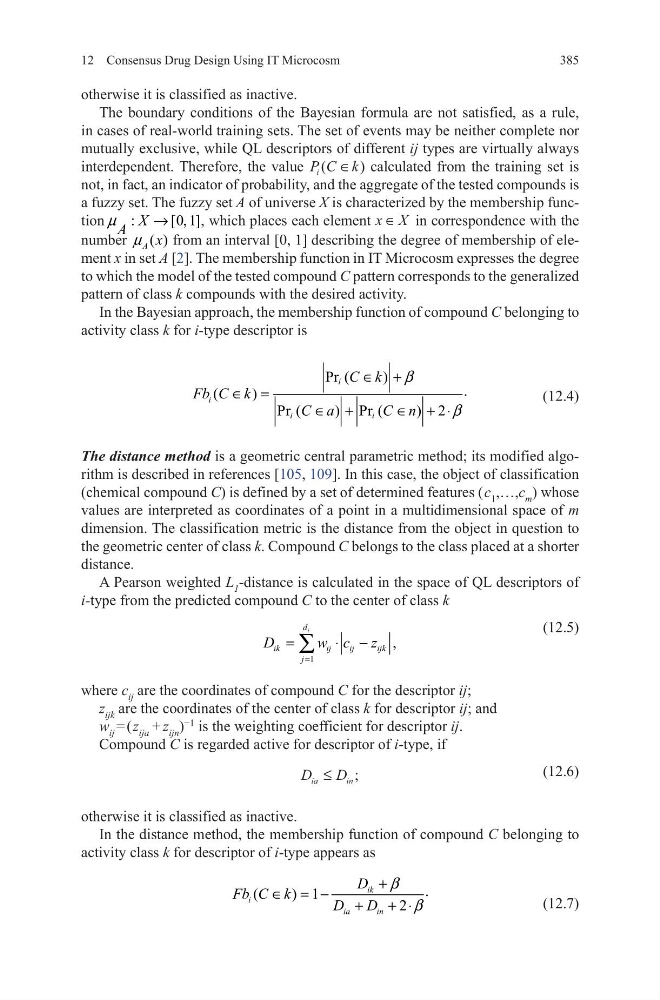
In the Bayesian approach, the membership function of compound C belonging to
activity class k for i-type descriptor is
(12.4)
The distance method is a geometric central parametric method; its modified algorithm is described in references [105, 109]. In this case, the object of classification
(chemical compound C) is defined by a set of determined features ( c 1 ,…,c m ) whose
values are interpreted as coordinates of a point in a multidimensional space of m
dimension. The classification metric is the distance from the object in question to
the geometric center of class k. Compound C belongs to the class placed at a shorter
distance.
A Pearson weighted L 1 -distance is calculated in the space of QL descriptors of
i-type from the predicted compound C to the center of class k
(12.5)
where c ij are the coordinates of compound C for the descriptor ij;
z ijk are the coordinates of the center of class k for descriptor ij; and
w ij = ( z ija + z ijn )
−1
is the weighting coefficient for descriptor ij.
Compound C is regarded active for descriptor of i-type, if
(12.6)
otherwise it is classified as inactive.
In the distance method, the membership function of compound C belonging to
activity class k for descriptor of i-type appears as
(12.7)
Pr (
)
.
(
)
Pr (
) Pr (
) 2
i
i
i
i
C k
Fb C k
C a
C n
β
β
∈ +
∈ =
∈ +
∈ + ⋅
1
,
i
d
ik
ij
ij
ijk
j
D
w c z
=
=
⋅ -
∑
D
D
ia
in
≤
;
.
(
) 1
2
ik
i
ia
in
D
Fb C k
D D
β
β
+
∈ = -
+
+ ⋅
12 Consensus Drug Design Using IT Microcosm
otherwise it is classified as inactive.
The boundary conditions of the Bayesian formula are not satisfied, as a rule,
in cases of real-world training sets. The set of events may be neither complete nor
mutually exclusive, while QL descriptors of different ij types are virtually always
interdependent. Therefore, the value P C k
i (
)
∈ calculated from the training set is
not, in fact, an indicator of probability, and the aggregate of the tested compounds is
a fuzzy set. The fuzzy set A of universe Х is characterized by the membership function
:
[0, 1]
X
A
µ
→
, which places each element x X
∈ in correspondence with the
number
( )
A x
µ
from an interval [0, 1] describing the degree of membership of element x in set А [2]. The membership function in IT Microcosm expresses the degree
to which the model of the tested compound C pattern corresponds to the generalized
pattern of class k compounds with the desired activity.
In the Bayesian approach, the membership function of compound C belonging to
activity class k for i-type descriptor is
(12.4)
The distance method is a geometric central parametric method; its modified algorithm is described in references [105, 109]. In this case, the object of classification
(chemical compound C) is defined by a set of determined features ( c 1 ,…,c m ) whose
values are interpreted as coordinates of a point in a multidimensional space of m
dimension. The classification metric is the distance from the object in question to
the geometric center of class k. Compound C belongs to the class placed at a shorter
distance.
A Pearson weighted L 1 -distance is calculated in the space of QL descriptors of
i-type from the predicted compound C to the center of class k
(12.5)
where c ij are the coordinates of compound C for the descriptor ij;
z ijk are the coordinates of the center of class k for descriptor ij; and
w ij = ( z ija + z ijn )
−1
is the weighting coefficient for descriptor ij.
Compound C is regarded active for descriptor of i-type, if
(12.6)
otherwise it is classified as inactive.
In the distance method, the membership function of compound C belonging to
activity class k for descriptor of i-type appears as
(12.7)
Pr (
)
.
(
)
Pr (
) Pr (
) 2
i
i
i
i
C k
Fb C k
C a
C n
β
β
∈ +
∈ =
∈ +
∈ + ⋅
1
,
i
d
ik
ij
ij
ijk
j
D
w c z
=
=
⋅ -
∑
D
D
ia
in
≤
;
.
(
) 1
2
ik
i
ia
in
D
Fb C k
D D
β
β
+
∈ = -
+
+ ⋅