

384
P. M. Vassiliev et al.
types). All four methods are essentially different in the way that their decision rule
is constructed. This suggests that a spectrum of 44 prediction estimates gives a
fairly accurate idea of the various specifics of a generalized pattern of active/inactive compound class, which hereafter allows for a reliable evaluation of the total
activity of the predicted compound [102, 105, 109].
We will now introduce the following designations:
i
QL descriptor type, i = 1,…, 11;
j
type of i-type descriptor in QL matrix, j = 1,…, d i ;
d i number of types of unique descriptors of i-type in QL matrix;
ij j
th
descriptor of i-type;
a active compound class;
n inactive compound class;
k compound class, k = a, n;
N the number of compounds in a training set;
β 0.001– unbiasedness parameter.
The Bayesian approach is one of the probabilistic central parametric classification
methods; it is based on the consistent application of the classic Bayes equation (also
known as “the naïve Bayes classifier”) for conditional probability [34] to construct
a decision rule; a modified algorithm is explained in references [105, 109, 121]. In
this approach, a chemical compound C, which can be specified by a set of probability features ( c 1 ,…,c m ) whose random values are distributed through all classes
of objects, is the object of recognition. The features are interpreted as independent
random variables of an m-dimensional random variable. The classification metric is
an a posteriori probability that the object in question belongs to class k. Compound
C is assigned to the class where the probability of membership is the highest.
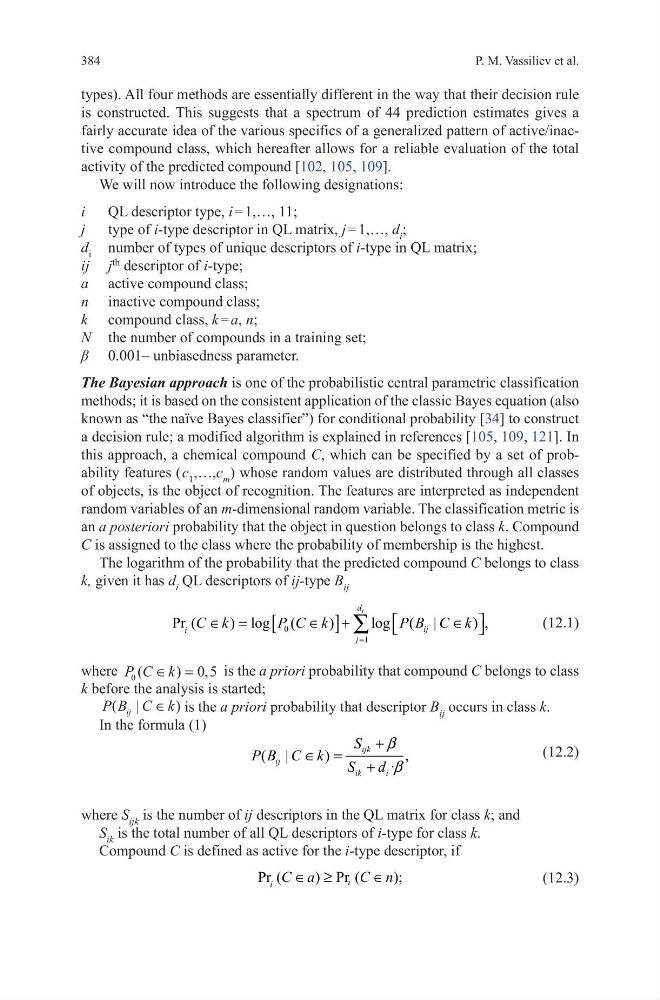
The logarithm of the probability that the predicted compound C belongs to class
k, given it has d i QL descriptors of ij-type B ij
(12.1)
where P C k
0
0 5
(
)
,
∈ =
is the a priori probability that compound C belongs to class
k before the analysis is started;
P B C k
ij
( |
)
∈ is the a priori probability that descriptor B ij occurs in class k.
In the formula (1)
(12.2)
where S ijk is the number of ij descriptors in the QL matrix for class k; and
S ik is the total number of all QL descriptors of i-type for class k.
Compound C is defined as active for the i-type descriptor, if
(12.3)
[
]
0
1
Pr (
) log (
)
log ( |
) ,
i
d
ij
i
j
C k
P C k
P B C k
=
∈ =
∈ +
∈
∑
( |
)
,
·
ijk
ij
ik
i
S
P B C k
S
d
β
β
+
∈ =
+
Pr (
) Pr (
);
i
i
C a
C n
∈ ≥
∈
P. M. Vassiliev et al.
types). All four methods are essentially different in the way that their decision rule
is constructed. This suggests that a spectrum of 44 prediction estimates gives a
fairly accurate idea of the various specifics of a generalized pattern of active/inactive compound class, which hereafter allows for a reliable evaluation of the total
activity of the predicted compound [102, 105, 109].
We will now introduce the following designations:
i
QL descriptor type, i = 1,…, 11;
j
type of i-type descriptor in QL matrix, j = 1,…, d i ;
d i number of types of unique descriptors of i-type in QL matrix;
ij j
th
descriptor of i-type;
a active compound class;
n inactive compound class;
k compound class, k = a, n;
N the number of compounds in a training set;
β 0.001– unbiasedness parameter.
The Bayesian approach is one of the probabilistic central parametric classification
methods; it is based on the consistent application of the classic Bayes equation (also
known as “the naïve Bayes classifier”) for conditional probability [34] to construct
a decision rule; a modified algorithm is explained in references [105, 109, 121]. In
this approach, a chemical compound C, which can be specified by a set of probability features ( c 1 ,…,c m ) whose random values are distributed through all classes
of objects, is the object of recognition. The features are interpreted as independent
random variables of an m-dimensional random variable. The classification metric is
an a posteriori probability that the object in question belongs to class k. Compound
C is assigned to the class where the probability of membership is the highest.
The logarithm of the probability that the predicted compound C belongs to class
k, given it has d i QL descriptors of ij-type B ij
(12.1)
where P C k
0
0 5
(
)
,
∈ =
is the a priori probability that compound C belongs to class
k before the analysis is started;
P B C k
ij
( |
)
∈ is the a priori probability that descriptor B ij occurs in class k.
In the formula (1)
(12.2)
where S ijk is the number of ij descriptors in the QL matrix for class k; and
S ik is the total number of all QL descriptors of i-type for class k.
Compound C is defined as active for the i-type descriptor, if
(12.3)
[
]
0
1
Pr (
) log (
)
log ( |
) ,
i
d
ij
i
j
C k
P C k
P B C k
=
∈ =
∈ +
∈
∑
( |
)
,
·
ijk
ij
ik
i
S
P B C k
S
d
β
β
+
∈ =
+
Pr (
) Pr (
);
i
i
C a
C n
∈ ≥
∈