

355
11 Computational Toxicology in Drug Discovery: Opportunities and Limitations
the competition with their binding center, which lead to increase in concentrations
of the drugs in blood and cause adverse and toxic effects. It is considered that the
clinically significant binding of drugs with plasma proteins is 95 %. [75]. Currently,
several studies of the plasma proteins binding predictions were performed [76, 77].
QSAR models for assessment of the plasma proteins binding are provided by Accelrys, Simulation Plus Inc., ACD/Labs, PreADMET, Optibrium.
Metabolic change of one drug by another is one of the most significant causes for
drug-drug interactions. Thus, the study of drug interactions with enzymes involved
in their metabolism is very popular. There are four types of adverse drug reactions
arising from influence on metabolic pathways of drugs.
1. Inhibition of the enzyme increases toxicity of the drug compound, which is a
substrate of this enzyme. Most drugs are metabolized into inactive or less active
metabolites by the liver and intestine enzymes. Inhibition of metabolism can
increase the compound concentration and, consequently, enhance its effect. If
the increasing of concentration is significant, it may cause toxicity. It is one of
the most common and important interaction mechanisms of drug compounds
in the clinic. The limited number of cytochrome P450 isoforms is involved in
metabolism of drugs. Thus, competition between two drugs for these isoforms
is possible. For example, inhibitors of CYP1A2 (cytochrome P450 isoform)
may increase the risk of toxicity for clozepine and theophylline. Inhibitors of
CYP2A9 may cause toxicity of phenytoin, tolbutamide and oral anticoagulants
(e.g. warfarin). Inhibitors of CYP3A4 (e.g., phenytoin) increase the risk of toxicity of many drugs, including carbamazepine, ciclosporin, lovastatin, protease
inhibitors, rifabutin, simvastatin and vinca alkaloids.
2. Enzyme inhibition reduces a therapeutic effect of the drug compound, an active
form of which is produced by metabolism of an initially inactive or low active
compound (prodrug). Inhibition of prodrug metabolism may reduce the amount
of active forms and hence reduce the therapeutic effect. For example, analgesic
and toxic effects of codeine occur as a result of its transformation into morphine by CYP2D6. Thus, CYP2D6 inhibitors can reduce the therapeutic effect
of codeine.
3. The enzyme induction reduces therapeutic effects of its substrates. Some drugs,
which are enzyme inductors, are able to increase the activity of drug metabolizing enzymes, which lead to reduce the therapeutic effect of other drugs. For
example, the most common enzyme inducers are aminoglutethimide, barbituActivity name
N
AUC, %
Urate transporter 1 inhibitor
29
97.9
Vesicle monoamine transporter 2 inhibitor
13
100.0
Vesicle monoamine transporter inhibitor
14
99.6
Vesicular acetylcholine transporter inhibitor
75
99.8
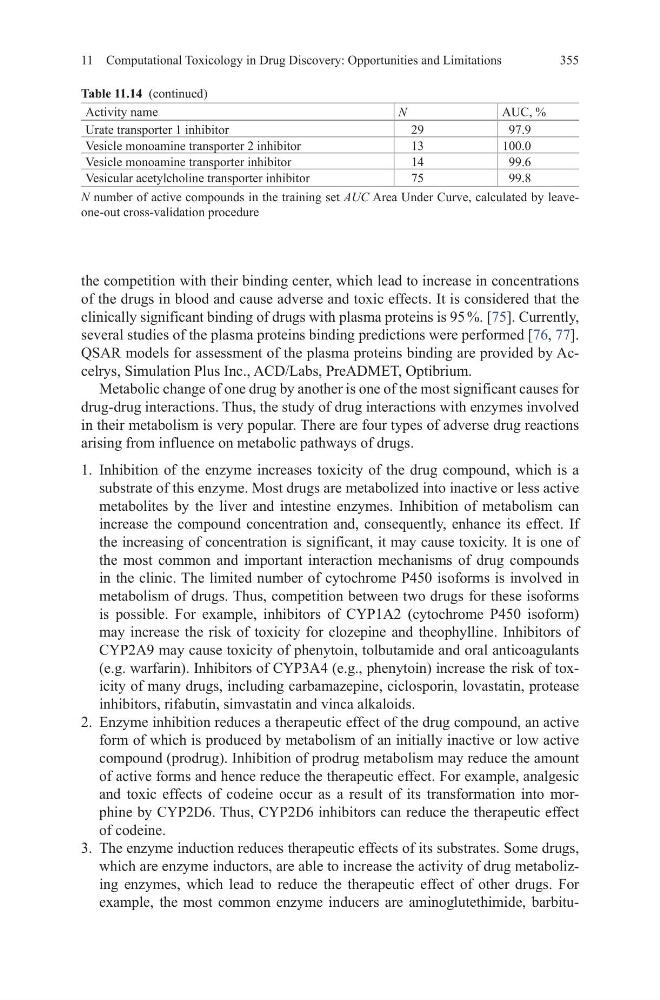
N number of active compounds in the training set AUC Area Under Curve, calculated by leaveone-out cross-validation procedure
Table 11.14 (continued)
11 Computational Toxicology in Drug Discovery: Opportunities and Limitations
the competition with their binding center, which lead to increase in concentrations
of the drugs in blood and cause adverse and toxic effects. It is considered that the
clinically significant binding of drugs with plasma proteins is 95 %. [75]. Currently,
several studies of the plasma proteins binding predictions were performed [76, 77].
QSAR models for assessment of the plasma proteins binding are provided by Accelrys, Simulation Plus Inc., ACD/Labs, PreADMET, Optibrium.
Metabolic change of one drug by another is one of the most significant causes for
drug-drug interactions. Thus, the study of drug interactions with enzymes involved
in their metabolism is very popular. There are four types of adverse drug reactions
arising from influence on metabolic pathways of drugs.
1. Inhibition of the enzyme increases toxicity of the drug compound, which is a
substrate of this enzyme. Most drugs are metabolized into inactive or less active
metabolites by the liver and intestine enzymes. Inhibition of metabolism can
increase the compound concentration and, consequently, enhance its effect. If
the increasing of concentration is significant, it may cause toxicity. It is one of
the most common and important interaction mechanisms of drug compounds
in the clinic. The limited number of cytochrome P450 isoforms is involved in
metabolism of drugs. Thus, competition between two drugs for these isoforms
is possible. For example, inhibitors of CYP1A2 (cytochrome P450 isoform)
may increase the risk of toxicity for clozepine and theophylline. Inhibitors of
CYP2A9 may cause toxicity of phenytoin, tolbutamide and oral anticoagulants
(e.g. warfarin). Inhibitors of CYP3A4 (e.g., phenytoin) increase the risk of toxicity of many drugs, including carbamazepine, ciclosporin, lovastatin, protease
inhibitors, rifabutin, simvastatin and vinca alkaloids.
2. Enzyme inhibition reduces a therapeutic effect of the drug compound, an active
form of which is produced by metabolism of an initially inactive or low active
compound (prodrug). Inhibition of prodrug metabolism may reduce the amount
of active forms and hence reduce the therapeutic effect. For example, analgesic
and toxic effects of codeine occur as a result of its transformation into morphine by CYP2D6. Thus, CYP2D6 inhibitors can reduce the therapeutic effect
of codeine.
3. The enzyme induction reduces therapeutic effects of its substrates. Some drugs,
which are enzyme inductors, are able to increase the activity of drug metabolizing enzymes, which lead to reduce the therapeutic effect of other drugs. For
example, the most common enzyme inducers are aminoglutethimide, barbituActivity name
N
AUC, %
Urate transporter 1 inhibitor
29
97.9
Vesicle monoamine transporter 2 inhibitor
13
100.0
Vesicle monoamine transporter inhibitor
14
99.6
Vesicular acetylcholine transporter inhibitor
75
99.8
N number of active compounds in the training set AUC Area Under Curve, calculated by leaveone-out cross-validation procedure
Table 11.14 (continued)