

S. Okovytyy
318
1,8-biphenyldiole catalyzes reaction in greater extent as it could be expected from
Brønsted dependence [35, 36]. Similar influence of bidentate phenols has been also
shown in some experimental investigations devoted to interaction of phenyl glycidyl ether with diethylamine [79], and for Diels-Alder reaction with α,β-unsaturated
ketones and aldehydes [80].
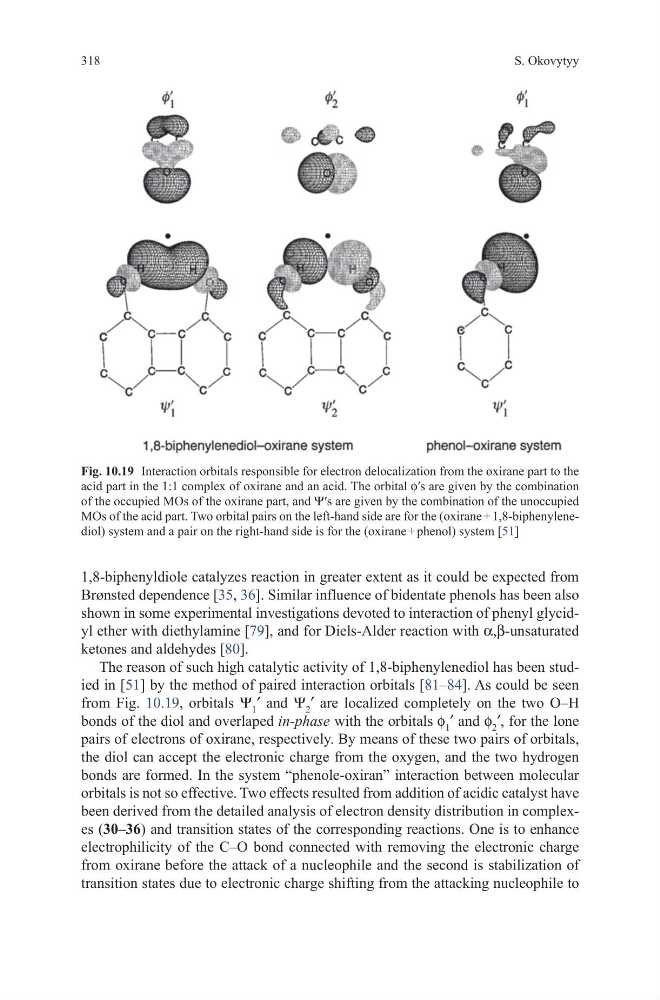
The reason of such high catalytic activity of 1,8-biphenylenediol has been studied in [51] by the method of paired interaction orbitals [81–84]. As could be seen
from Fig. 10.19, orbitals Ψ 1 ′ and Ψ 2 ′ are localized completely on the two O–H
bonds of the diol and overlaped in-phase with the orbitals φ 1 ′ and φ 2 ′, for the lone
pairs of electrons of oxirane, respectively. By means of these two pairs of orbitals,
the diol can accept the electronic charge from the oxygen, and the two hydrogen
bonds are formed. In the system “phenole-oxiran” interaction between molecular
orbitals is not so effective. Two effects resulted from addition of acidic catalyst have
been derived from the detailed analysis of electron density distribution in complexes (30–36) and transition states of the corresponding reactions. One is to enhance
electrophilicity of the C–O bond connected with removing the electronic charge
from oxirane before the attack of a nucleophile and the second is stabilization of
transition states due to electronic charge shifting from the attacking nucleophile to
Fig. 10.19 Interaction orbitals responsible for electron delocalization from the oxirane part to the
acid part in the 1:1 complex of oxirane and an acid. The orbital φ′s are given by the combination
of the occupied MOs of the oxirane part, and Ψ′s are given by the combination of the unoccupied
MOs of the acid part. Two orbital pairs on the left-hand side are for the (oxirane + 1,8-biphenylenediol) system and a pair on the right-hand side is for the (oxirane + phenol) system [51]
318
1,8-biphenyldiole catalyzes reaction in greater extent as it could be expected from
Brønsted dependence [35, 36]. Similar influence of bidentate phenols has been also
shown in some experimental investigations devoted to interaction of phenyl glycidyl ether with diethylamine [79], and for Diels-Alder reaction with α,β-unsaturated
ketones and aldehydes [80].
The reason of such high catalytic activity of 1,8-biphenylenediol has been studied in [51] by the method of paired interaction orbitals [81–84]. As could be seen
from Fig. 10.19, orbitals Ψ 1 ′ and Ψ 2 ′ are localized completely on the two O–H
bonds of the diol and overlaped in-phase with the orbitals φ 1 ′ and φ 2 ′, for the lone
pairs of electrons of oxirane, respectively. By means of these two pairs of orbitals,
the diol can accept the electronic charge from the oxygen, and the two hydrogen
bonds are formed. In the system “phenole-oxiran” interaction between molecular
orbitals is not so effective. Two effects resulted from addition of acidic catalyst have
been derived from the detailed analysis of electron density distribution in complexes (30–36) and transition states of the corresponding reactions. One is to enhance
electrophilicity of the C–O bond connected with removing the electronic charge
from oxirane before the attack of a nucleophile and the second is stabilization of
transition states due to electronic charge shifting from the attacking nucleophile to
Fig. 10.19 Interaction orbitals responsible for electron delocalization from the oxirane part to the
acid part in the 1:1 complex of oxirane and an acid. The orbital φ′s are given by the combination
of the occupied MOs of the oxirane part, and Ψ′s are given by the combination of the unoccupied
MOs of the acid part. Two orbital pairs on the left-hand side are for the (oxirane + 1,8-biphenylenediol) system and a pair on the right-hand side is for the (oxirane + phenol) system [51]