

317
In case of partially saturated systems the compounds (28, 29), do not appear as
stable species on the MP2/6-31G(d) potential energy surface. The approach of proton leads to spontaneous ring opening via C a –O and C b –O bond breaking for compounds (28) and (29), respectively [75]. Formation of carbonium ion intermediates
also has been shown for monomolecular transformation of fluorooxirane [73], chlorooxirane [76], and styrene oxide [77].
Investigation of kinetic particularities of epoxide interaction with carboxylic acids [62–64, 78] showed that proton transfer with formation of protonated epoxide
takes place only in case of reaction with strong acids such as trifluoroacetic acid.
Interaction with relatively weak dichloroacetic acid leads to formation of complex
without proton transfer and involvement of the second molecule of acid is required
for epoxide ring opening which corresponds to experimentally determined second
order of reaction [63].
2
+$
2
+
$
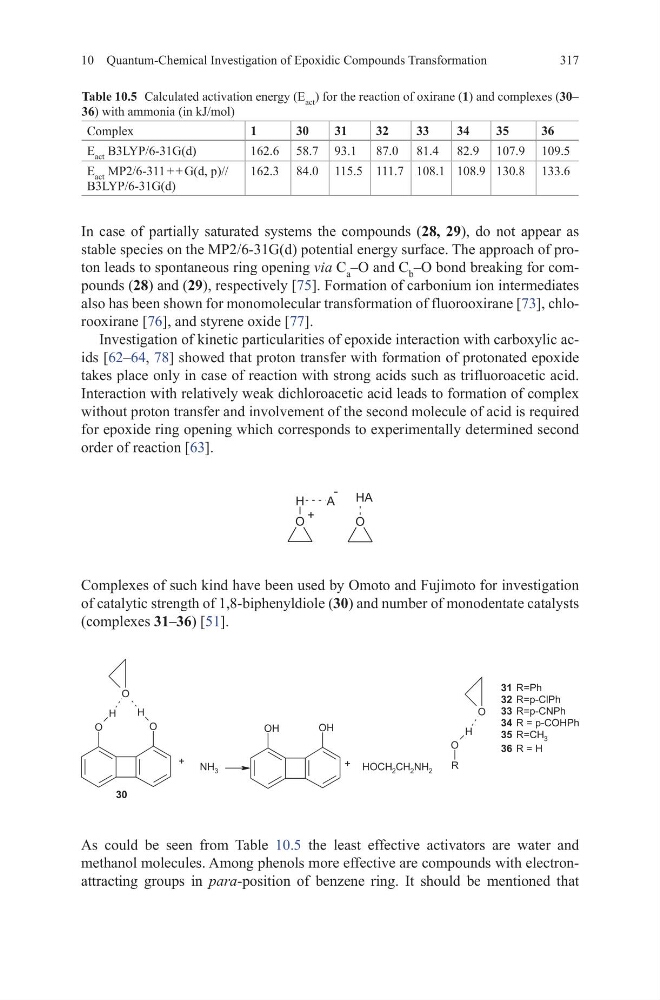
Complexes of such kind have been used by Omoto and Fujimoto for investigation
of catalytic strength of 1,8-biphenyldiole (30) and number of monodentate catalysts
(complexes 31–36) [51].
2
2
+
+
2
2+
2+
2
+
2
5
1+
+2&+ &+ 1+
5 3K
5 S&O3K
5 S&13K
5 S&2+3K
5 &+
5 +
As could be seen from Table 10.5 the least effective activators are water and
methanol molecules. Among phenols more effective are compounds with electronattracting groups in para-position of benzene ring. It should be mentioned that
Table 10.5 Calculated activation energy (Е act ) for the reaction of oxirane (1) and complexes (30–
36) with ammonia (in kJ/mol)
Complex
1
30
31
32
33
34
35
36
Е act B3LYP/6-31G(d)
162.6 58.7 93.1
87.0 81.4 82.9 107.9 109.5
Е act MP2/6-311 + + G(d, p)//
B3LYP/6-31G(d)
162.3 84.0 115.5 111.7 108.1 108.9 130.8 133.6
10 Quantum-Chemical Investigation of Epoxidic Compounds Transformation
In case of partially saturated systems the compounds (28, 29), do not appear as
stable species on the MP2/6-31G(d) potential energy surface. The approach of proton leads to spontaneous ring opening via C a –O and C b –O bond breaking for compounds (28) and (29), respectively [75]. Formation of carbonium ion intermediates
also has been shown for monomolecular transformation of fluorooxirane [73], chlorooxirane [76], and styrene oxide [77].
Investigation of kinetic particularities of epoxide interaction with carboxylic acids [62–64, 78] showed that proton transfer with formation of protonated epoxide
takes place only in case of reaction with strong acids such as trifluoroacetic acid.
Interaction with relatively weak dichloroacetic acid leads to formation of complex
without proton transfer and involvement of the second molecule of acid is required
for epoxide ring opening which corresponds to experimentally determined second
order of reaction [63].
2
+$
2
+
$
Complexes of such kind have been used by Omoto and Fujimoto for investigation
of catalytic strength of 1,8-biphenyldiole (30) and number of monodentate catalysts
(complexes 31–36) [51].
2
2
+
+
2
2+
2+
2
+
2
5
1+
+2&+ &+ 1+
5 3K
5 S&O3K
5 S&13K
5 S&2+3K
5 &+
5 +
As could be seen from Table 10.5 the least effective activators are water and
methanol molecules. Among phenols more effective are compounds with electronattracting groups in para-position of benzene ring. It should be mentioned that
Table 10.5 Calculated activation energy (Е act ) for the reaction of oxirane (1) and complexes (30–
36) with ammonia (in kJ/mol)
Complex
1
30
31
32
33
34
35
36
Е act B3LYP/6-31G(d)
162.6 58.7 93.1
87.0 81.4 82.9 107.9 109.5
Е act MP2/6-311 + + G(d, p)//
B3LYP/6-31G(d)
162.3 84.0 115.5 111.7 108.1 108.9 130.8 133.6
10 Quantum-Chemical Investigation of Epoxidic Compounds Transformation