

S. Okovytyy
306
2+
2
2
+
+
+
2
2
+
+
+
20H
Their inhibition potency of peptides and peptidomimetics is usually characterized
by two inhibition constants (Eq. 10.2, minimal two-step mechanism for irreversible
enzyme inhibition where E = enzyme, I = inhibitor, EI = noncovalent enzyme-inhibitor complex, E–I = inactivated enzyme): the dissociation constant Ki, characterizing
the preliminary reversible complexation step, and the first-order rate constant of
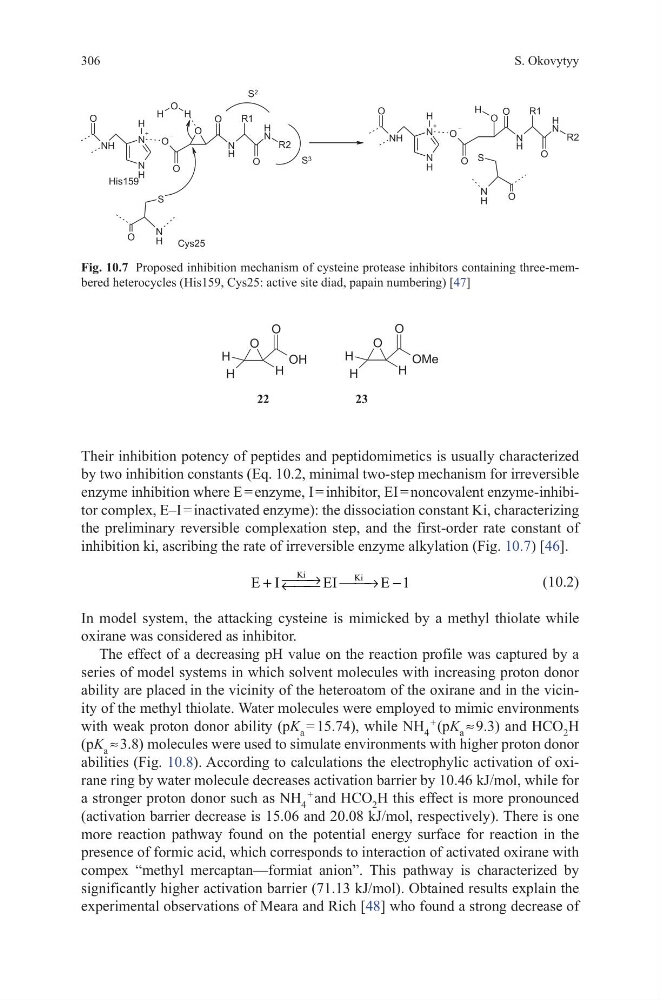
inhibition ki, ascribing the rate of irreversible enzyme alkylation (Fig. 10.7) [46].
(10.2)
In model system, the attacking cysteine is mimicked by a methyl thiolate while
oxirane was considered as inhibitor.
The effect of a decreasing pH value on the reaction profile was captured by a
series of model systems in which solvent molecules with increasing proton donor
ability are placed in the vicinity of the heteroatom of the oxirane and in the vicinity of the methyl thiolate. Water molecules were employed to mimic environments
with weak proton donor ability (pK a = 15.74), while NH 4
+
(pK a ≈ 9.3) and HCO 2 H
(pK a ≈ 3.8) molecules were used to simulate environments with higher proton donor
abilities (Fig. 10.8). According to calculations the electrophylic activation of oxirane ring by water molecule decreases activation barrier by 10.46 kJ/mol, while for
a stronger proton donor such as NH 4
+
and HCO 2 H this effect is more pronounced
(activation barrier decrease is 15.06 and 20.08 kJ/mol, respectively). There is one
more reaction pathway found on the potential energy surface for reaction in the
presence of formic acid, which corresponds to interaction of activated oxirane with
compex “methyl mercaptan—formiat anion”. This pathway is characterized by
significantly higher activation barrier (71.13 kJ/mol). Obtained results explain the
experimental observations of Meara and Rich [48] who found a strong decrease of
Ki
Ki
E I
EI
E 1
→
+
→ -
←
1
+
1
2
2
2
1+
2
1
+
1
+
2
5
2
5
+
+
2 +
1
+
2
6
1
+
1
2
2
2
1+
2
+
1
+
1
+
2
5
2
5
+
1
+
2
6
+LV
&\V
6
6
Fig. 10.7 Proposed inhibition mechanism of cysteine protease inhibitors containing three-membered heterocycles (His159, Cys25: active site diad, papain numbering) [47]
306
2+
2
2
+
+
+
2
2
+
+
+
20H
Their inhibition potency of peptides and peptidomimetics is usually characterized
by two inhibition constants (Eq. 10.2, minimal two-step mechanism for irreversible
enzyme inhibition where E = enzyme, I = inhibitor, EI = noncovalent enzyme-inhibitor complex, E–I = inactivated enzyme): the dissociation constant Ki, characterizing
the preliminary reversible complexation step, and the first-order rate constant of
inhibition ki, ascribing the rate of irreversible enzyme alkylation (Fig. 10.7) [46].
(10.2)
In model system, the attacking cysteine is mimicked by a methyl thiolate while
oxirane was considered as inhibitor.
The effect of a decreasing pH value on the reaction profile was captured by a
series of model systems in which solvent molecules with increasing proton donor
ability are placed in the vicinity of the heteroatom of the oxirane and in the vicinity of the methyl thiolate. Water molecules were employed to mimic environments
with weak proton donor ability (pK a = 15.74), while NH 4
+
(pK a ≈ 9.3) and HCO 2 H
(pK a ≈ 3.8) molecules were used to simulate environments with higher proton donor
abilities (Fig. 10.8). According to calculations the electrophylic activation of oxirane ring by water molecule decreases activation barrier by 10.46 kJ/mol, while for
a stronger proton donor such as NH 4
+
and HCO 2 H this effect is more pronounced
(activation barrier decrease is 15.06 and 20.08 kJ/mol, respectively). There is one
more reaction pathway found on the potential energy surface for reaction in the
presence of formic acid, which corresponds to interaction of activated oxirane with
compex “methyl mercaptan—formiat anion”. This pathway is characterized by
significantly higher activation barrier (71.13 kJ/mol). Obtained results explain the
experimental observations of Meara and Rich [48] who found a strong decrease of
Ki
Ki
E I
EI
E 1
→
+
→ -
←
1
+
1
2
2
2
1+
2
1
+
1
+
2
5
2
5
+
+
2 +
1
+
2
6
1
+
1
2
2
2
1+
2
+
1
+
1
+
2
5
2
5
+
1
+
2
6
+LV
&\V
6
6
Fig. 10.7 Proposed inhibition mechanism of cysteine protease inhibitors containing three-membered heterocycles (His159, Cys25: active site diad, papain numbering) [47]