

305
In the row of conformationally flexible spirooxiranes (14–16) conformers with
pseudo equatorial orientation of methylene group (conformer A) possess higher
reactivity. Worthwhile mentioning, that no one calculated parameter of initial epoxides as well as in vacuo ∆Н
≠
values, does not correlate with experimental kinetic
results [44].
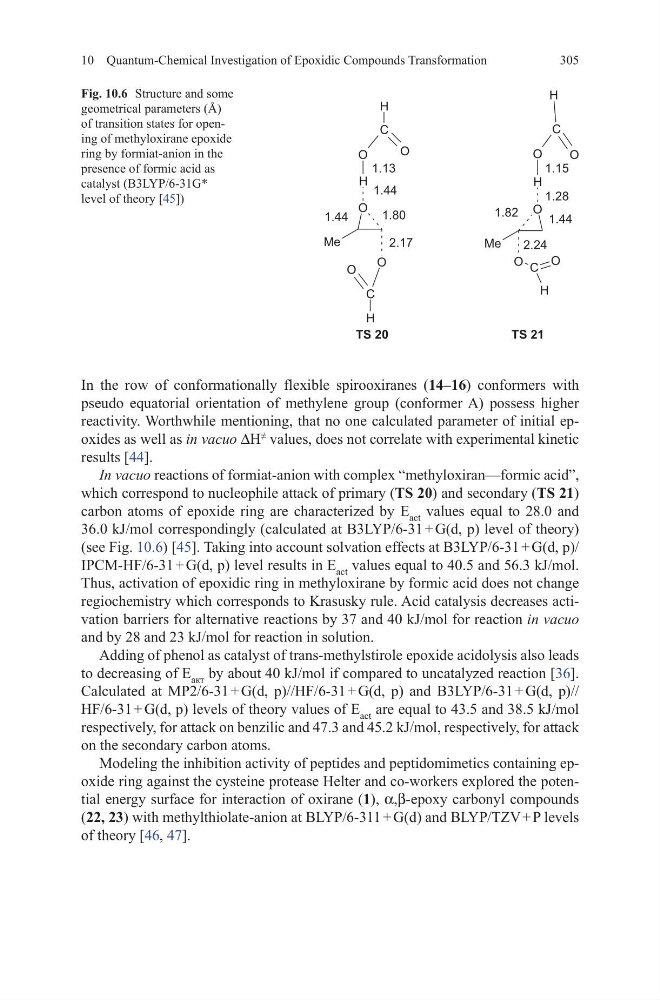
In vacuo reactions of formiat-anion with complex “methyloxiran—formic acid”,
which correspond to nucleophile attack of primary (TS 20) and secondary (TS 21)
carbon atoms of epoxide ring are characterized by E act values equal to 28.0 and
36.0 kJ/mol correspondingly (calculated at B3LYP/6-31 + G(d, p) level of theory)
(see Fig. 10.6) [45]. Taking into account solvation effects at B3LYP/6-31 + G(d, p)/
IPCM-HF/6-31 + G(d, p) level results in Е act values equal to 40.5 and 56.3 kJ/mol.
Thus, activation of epoxidic ring in methyloxirane by formic acid does not change
regiochemistry which corresponds to Krasusky rule. Acid catalysis decreases activation barriers for alternative reactions by 37 and 40 kJ/mol for reaction in vacuo
and by 28 and 23 kJ/mol for reaction in solution.
Adding of phenol as catalyst of trans-methylstirole epoxide acidolysis also leads
to decreasing of Е акт by about 40 kJ/mol if compared to uncatalyzed reaction [36].
Calculated at MP2/6-31 + G(d, p)//HF/6-31 + G(d, p) and B3LYP/6-31 + G(d, p)//
HF/6-31 + G(d, p) levels of theory values of Е act are equal to 43.5 and 38.5 kJ/mol
respectively, for attack on benzilic and 47.3 and 45.2 kJ/mol, respectively, for attack
on the secondary carbon atoms.
Modeling the inhibition activity of peptides and peptidomimetics containing epoxide ring against the cysteine protease Helter and co-workers explored the potential energy surface for interaction of oxirane (1), α,β-epoxy carbonyl compounds
(22, 23) with methylthiolate-anion at BLYP/6-311 + G(d) and BLYP/TZV + P levels
of theory [46, 47].
O
C
H
O
O
Me
H
O
C
H
O
O
Me
H
O
C
H
O
O C
H
O
TS 20
TS 21
2.17
1.80
1.44
1.13
1.44
2.24
1.44
1.82
1.28
1.15
Fig. 10.6 Structure and some
geometrical parameters (Å)
of transition states for opening of methyloxirane epoxide
ring by formiat-anion in the
presence of formic acid as
catalyst (B3LYP/6-31G*
level of theory [45])
10 Quantum-Chemical Investigation of Epoxidic Compounds Transformation
In the row of conformationally flexible spirooxiranes (14–16) conformers with
pseudo equatorial orientation of methylene group (conformer A) possess higher
reactivity. Worthwhile mentioning, that no one calculated parameter of initial epoxides as well as in vacuo ∆Н
≠
values, does not correlate with experimental kinetic
results [44].
In vacuo reactions of formiat-anion with complex “methyloxiran—formic acid”,
which correspond to nucleophile attack of primary (TS 20) and secondary (TS 21)
carbon atoms of epoxide ring are characterized by E act values equal to 28.0 and
36.0 kJ/mol correspondingly (calculated at B3LYP/6-31 + G(d, p) level of theory)
(see Fig. 10.6) [45]. Taking into account solvation effects at B3LYP/6-31 + G(d, p)/
IPCM-HF/6-31 + G(d, p) level results in Е act values equal to 40.5 and 56.3 kJ/mol.
Thus, activation of epoxidic ring in methyloxirane by formic acid does not change
regiochemistry which corresponds to Krasusky rule. Acid catalysis decreases activation barriers for alternative reactions by 37 and 40 kJ/mol for reaction in vacuo
and by 28 and 23 kJ/mol for reaction in solution.
Adding of phenol as catalyst of trans-methylstirole epoxide acidolysis also leads
to decreasing of Е акт by about 40 kJ/mol if compared to uncatalyzed reaction [36].
Calculated at MP2/6-31 + G(d, p)//HF/6-31 + G(d, p) and B3LYP/6-31 + G(d, p)//
HF/6-31 + G(d, p) levels of theory values of Е act are equal to 43.5 and 38.5 kJ/mol
respectively, for attack on benzilic and 47.3 and 45.2 kJ/mol, respectively, for attack
on the secondary carbon atoms.
Modeling the inhibition activity of peptides and peptidomimetics containing epoxide ring against the cysteine protease Helter and co-workers explored the potential energy surface for interaction of oxirane (1), α,β-epoxy carbonyl compounds
(22, 23) with methylthiolate-anion at BLYP/6-311 + G(d) and BLYP/TZV + P levels
of theory [46, 47].
O
C
H
O
O
Me
H
O
C
H
O
O
Me
H
O
C
H
O
O C
H
O
TS 20
TS 21
2.17
1.80
1.44
1.13
1.44
2.24
1.44
1.82
1.28
1.15
Fig. 10.6 Structure and some
geometrical parameters (Å)
of transition states for opening of methyloxirane epoxide
ring by formiat-anion in the
presence of formic acid as
catalyst (B3LYP/6-31G*
level of theory [45])
10 Quantum-Chemical Investigation of Epoxidic Compounds Transformation