

297
10 Quantum-Chemical Investigation of Epoxidic Compounds Transformation
One of the first theoretical study of the nucleophilic bimolecular ring-opening of
ethylene oxide has been performed by Fujimoto and co-workers using semiempirical approach as an example of oxirane (1) interaction with hydride ion [25]. It has
been shown that oxirane contributes to the interaction not only LUMO but also next
unoccupied molecular orbital. The authors also stated the preference of reaction
with inversion of epoxide carbon atom. Later on ab initio study (at the HF/3-21G
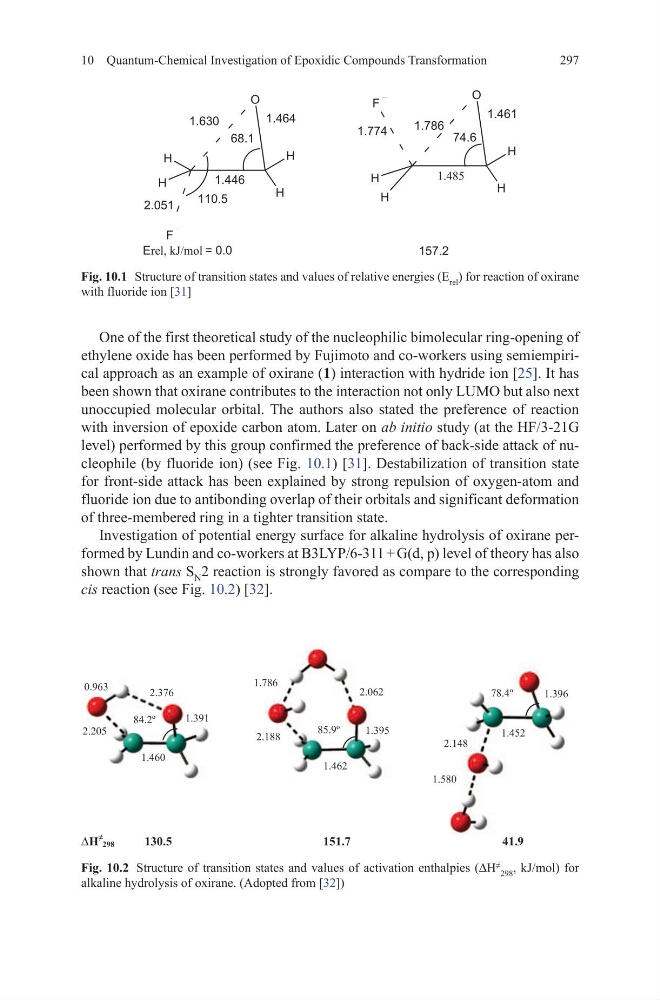
level) performed by this group confirmed the preference of back-side attack of nucleophile (by fluoride ion) (see Fig. 10.1) [31]. Destabilization of transition state
for front-side attack has been explained by strong repulsion of oxygen-atom and
fluoride ion due to antibonding overlap of their orbitals and significant deformation
of three-membered ring in a tighter transition state.
Investigation of potential energy surface for alkaline hydrolysis of oxirane performed by Lundin and co-workers at B3LYP/6-311 + G(d, p) level of theory has also
shown that trans S N 2 reaction is strongly favored as compare to the corresponding
cis reaction (see Fig. 10.2) [32].
∆+
Fig. 10.2 Structure of transition states and values of activation enthalpies (∆H
≠
298
, kJ/mol) for
alkaline hydrolysis of oxirane. (Adopted from [32])
2
)
+
+
+
+
2
)
+
+
+
+
(UHON-PRO
Fig. 10.1 Structure of transition states and values of relative energies (E rel ) for reaction of oxirane
with fluoride ion [31]
10 Quantum-Chemical Investigation of Epoxidic Compounds Transformation
One of the first theoretical study of the nucleophilic bimolecular ring-opening of
ethylene oxide has been performed by Fujimoto and co-workers using semiempirical approach as an example of oxirane (1) interaction with hydride ion [25]. It has
been shown that oxirane contributes to the interaction not only LUMO but also next
unoccupied molecular orbital. The authors also stated the preference of reaction
with inversion of epoxide carbon atom. Later on ab initio study (at the HF/3-21G
level) performed by this group confirmed the preference of back-side attack of nucleophile (by fluoride ion) (see Fig. 10.1) [31]. Destabilization of transition state
for front-side attack has been explained by strong repulsion of oxygen-atom and
fluoride ion due to antibonding overlap of their orbitals and significant deformation
of three-membered ring in a tighter transition state.
Investigation of potential energy surface for alkaline hydrolysis of oxirane performed by Lundin and co-workers at B3LYP/6-311 + G(d, p) level of theory has also
shown that trans S N 2 reaction is strongly favored as compare to the corresponding
cis reaction (see Fig. 10.2) [32].
∆+
Fig. 10.2 Structure of transition states and values of activation enthalpies (∆H
≠
298
, kJ/mol) for
alkaline hydrolysis of oxirane. (Adopted from [32])
2
)
+
+
+
+
2
)
+
+
+
+
(UHON-PRO
Fig. 10.1 Structure of transition states and values of relative energies (E rel ) for reaction of oxirane
with fluoride ion [31]