

S. Okovytyy
296
&+ &+
&+
1X
2+
&+ &+ &
2
+
2
+&
&+ &+
&+
2
1X
&+ &+
&+
2
+
1X 6 1 OLNH
a+
6 1
(
1X
+1X
Reactions of epoxides are not restricted by in vitro transformations but also have
medical relevance since epoxides can be formed via endogenous biochemical pathways or oxidation of xenobiotics, for example, by cytochrome P450 [11–13]. This
process is important in drug metabolism, as epoxides formed during the oxidation
of drug molecules [14] can undergo ring opening in vivo by biological nucleophiles,
such as DNA/RNA bases [15, 16], causing damage to cells. Another direction of
epoxides transformation vital for organisms is hydrolysis facilitated by epoxide
hydrolase (EH) [15, 16]. Epoxides that are poor EH substrates tend to be highly
carcinogenic [17, 18]. Thus in vivo toxicity of epoxides stated to be correlated with
their alkylation rate [19–23].
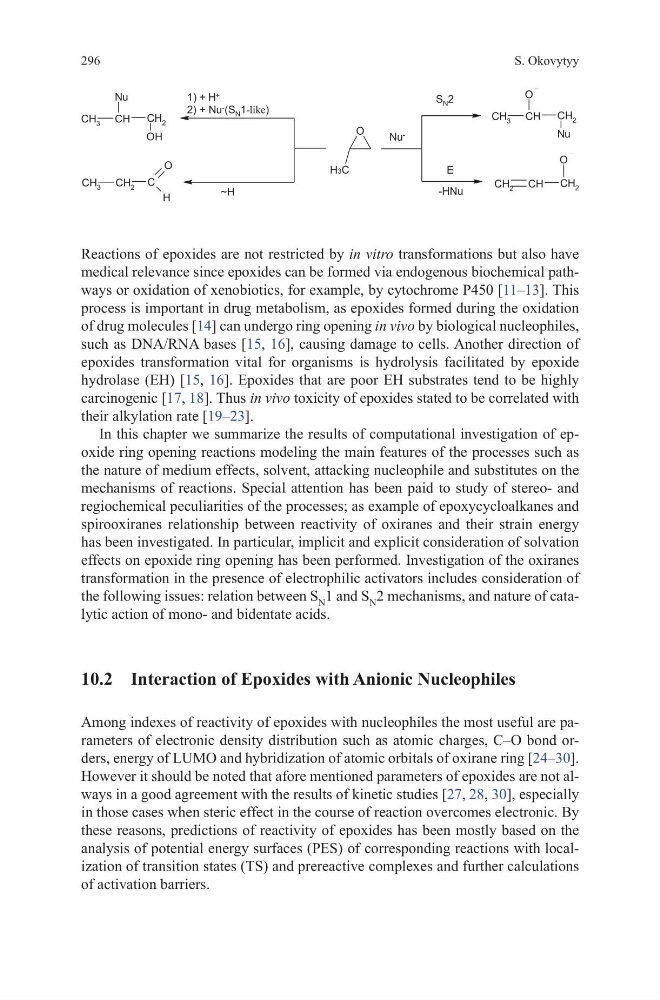
In this chapter we summarize the results of computational investigation of epoxide ring opening reactions modeling the main features of the processes such as
the nature of medium effects, solvent, attacking nucleophile and substitutes on the
mechanisms of reactions. Special attention has been paid to study of stereo- and
regiochemical peculiarities of the processes; as example of epoxycycloalkanes and
spirooxiranes relationship between reactivity of oxiranes and their strain energy
has been investigated. In particular, implicit and explicit consideration of solvation
effects on epoxide ring opening has been performed. Investigation of the oxiranes
transformation in the presence of electrophilic activators includes consideration of
the following issues: relation between S N 1 and S N 2 mechanisms, and nature of catalytic action of mono- and bidentate acids.
10.2 Interaction of Epoxides with Anionic Nucleophiles
Among indexes of reactivity of epoxides with nucleophiles the most useful are parameters of electronic density distribution such as atomic charges, C–O bond orders, energy of LUMO and hybridization of atomic orbitals of oxirane ring [24–30].
However it should be noted that afore mentioned parameters of epoxides are not always in a good agreement with the results of kinetic studies [27, 28, 30], especially
in those cases when steric effect in the course of reaction overcomes electronic. By
these reasons, predictions of reactivity of epoxides has been mostly based on the
analysis of potential energy surfaces (PES) of corresponding reactions with localization of transition states (TS) and prereactive complexes and further calculations
of activation barriers.
296
&+ &+
&+
1X
2+
&+ &+ &
2
+
2
+&
&+ &+
&+
2
1X
&+ &+
&+
2
+
1X 6 1 OLNH
a+
6 1
(
1X
+1X
Reactions of epoxides are not restricted by in vitro transformations but also have
medical relevance since epoxides can be formed via endogenous biochemical pathways or oxidation of xenobiotics, for example, by cytochrome P450 [11–13]. This
process is important in drug metabolism, as epoxides formed during the oxidation
of drug molecules [14] can undergo ring opening in vivo by biological nucleophiles,
such as DNA/RNA bases [15, 16], causing damage to cells. Another direction of
epoxides transformation vital for organisms is hydrolysis facilitated by epoxide
hydrolase (EH) [15, 16]. Epoxides that are poor EH substrates tend to be highly
carcinogenic [17, 18]. Thus in vivo toxicity of epoxides stated to be correlated with
their alkylation rate [19–23].
In this chapter we summarize the results of computational investigation of epoxide ring opening reactions modeling the main features of the processes such as
the nature of medium effects, solvent, attacking nucleophile and substitutes on the
mechanisms of reactions. Special attention has been paid to study of stereo- and
regiochemical peculiarities of the processes; as example of epoxycycloalkanes and
spirooxiranes relationship between reactivity of oxiranes and their strain energy
has been investigated. In particular, implicit and explicit consideration of solvation
effects on epoxide ring opening has been performed. Investigation of the oxiranes
transformation in the presence of electrophilic activators includes consideration of
the following issues: relation between S N 1 and S N 2 mechanisms, and nature of catalytic action of mono- and bidentate acids.
10.2 Interaction of Epoxides with Anionic Nucleophiles
Among indexes of reactivity of epoxides with nucleophiles the most useful are parameters of electronic density distribution such as atomic charges, C–O bond orders, energy of LUMO and hybridization of atomic orbitals of oxirane ring [24–30].
However it should be noted that afore mentioned parameters of epoxides are not always in a good agreement with the results of kinetic studies [27, 28, 30], especially
in those cases when steric effect in the course of reaction overcomes electronic. By
these reasons, predictions of reactivity of epoxides has been mostly based on the
analysis of potential energy surfaces (PES) of corresponding reactions with localization of transition states (TS) and prereactive complexes and further calculations
of activation barriers.