

288
D. Toczek et al.
bility, interaction energies, nature of interactions, dissociation energy, its correlation with complex constants, the contribution of oxygen atoms to interaction due to
their different chemical nature, and the influence of solvent model on all mentioned
parameters. Beside searching the active site to bind metal cations, relevant observations constitute conformation changes between complexed and non-complexed
structures (deformation energy). Hancock and Hegetschweiler [21] by using molecular mechanics calculations proved, above mentioned, Angyal postulates. Using inositols, as compounds structurally similar to sugars, they have presented the
correlation between the preferred arrangement of binding and size of metal ionic
radius. Because metal ions cannot be readily described by semi-empirical or classical molecular dynamics methods [50], the density functional methods (DFT) [51]
are widespread for interaction energy investigations [52]. Moreover, when needed,
DFT methods can be easily extended to higher level ab initio methods such as Second-order Møller-Plesset Perturbation Theory (MP2) [53] or the coupled-cluster
singles and doubles model (CCSD) [54]. Zheng et al. were investigating interactions between metal cations and inositols by applying the DFT functional. Similar
to Hancock and Hegetschweiler, they also used cis-inositols to find possible binding
site for Be
2 +
, Mg
2 +
, Ca
2 +
and Li
+
ions. The computations confirm previous expectations. Additionally, they studied β-d-glucose–calcium complexes and the results
show that there are five possible active sites which can bind calcium cation—four
bidendate structures and one tridendate. The strongest interaction was observed for
structure, which binds the calcium ion by anomeric oxygen atoms, hydroxymethyl
and O-ring oxygen atoms [55]. Wong et al. [56] carried out similar studies for mannose complexes with a calcium cation. Their results further indicated several active sites to bind metal cations. Moreover, these two papers unanimously inferred
that the stability of complexes and the strength of interactions increase with an increasing coordination number. Our calculations of glucose–Ca complexes confirm
those inferences and additionally we obtained four coordinated structures, which
according to expectations has the higher interaction energy. Glucose adopts skewboat—
O
S 2 conformation, in this four coordinated complex [57]. The result suggests
that metal ions could induce conformational interconversions. In 2007 Fabian [58]
presented results, which indicated that metal binding might cause the shift of the
conformation equilibrium to normally less preferable conformation.
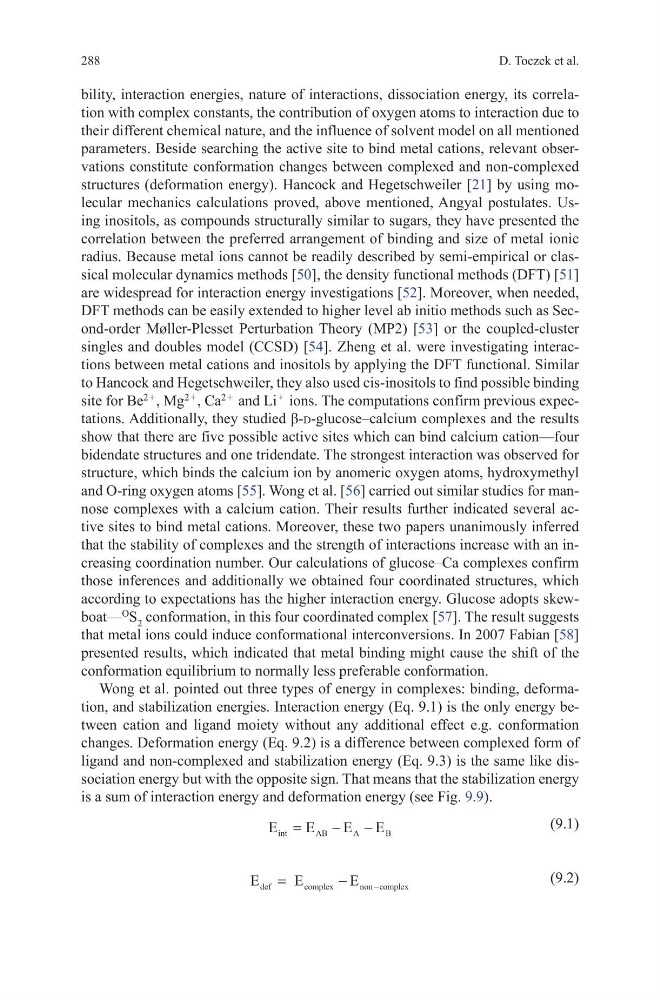
Wong et al. pointed out three types of energy in complexes: binding, deformation, and stabilization energies. Interaction energy (Eq. 9.1) is the only energy between cation and ligand moiety without any additional effect e.g. conformation
changes. Deformation energy (Eq. 9.2) is a difference between complexed form of
ligand and non-complexed and stabilization energy (Eq. 9.3) is the same like dissociation energy but with the opposite sign. That means that the stabilization energy
is a sum of interaction energy and deformation energy (see Fig. 9.9).
(9.1)
(9.2)
E
E
E
E
int
A B
A
B
=
−
−
E
E
E
def
c omplex
non complex
=
−
−
D. Toczek et al.
bility, interaction energies, nature of interactions, dissociation energy, its correlation with complex constants, the contribution of oxygen atoms to interaction due to
their different chemical nature, and the influence of solvent model on all mentioned
parameters. Beside searching the active site to bind metal cations, relevant observations constitute conformation changes between complexed and non-complexed
structures (deformation energy). Hancock and Hegetschweiler [21] by using molecular mechanics calculations proved, above mentioned, Angyal postulates. Using inositols, as compounds structurally similar to sugars, they have presented the
correlation between the preferred arrangement of binding and size of metal ionic
radius. Because metal ions cannot be readily described by semi-empirical or classical molecular dynamics methods [50], the density functional methods (DFT) [51]
are widespread for interaction energy investigations [52]. Moreover, when needed,
DFT methods can be easily extended to higher level ab initio methods such as Second-order Møller-Plesset Perturbation Theory (MP2) [53] or the coupled-cluster
singles and doubles model (CCSD) [54]. Zheng et al. were investigating interactions between metal cations and inositols by applying the DFT functional. Similar
to Hancock and Hegetschweiler, they also used cis-inositols to find possible binding
site for Be
2 +
, Mg
2 +
, Ca
2 +
and Li
+
ions. The computations confirm previous expectations. Additionally, they studied β-d-glucose–calcium complexes and the results
show that there are five possible active sites which can bind calcium cation—four
bidendate structures and one tridendate. The strongest interaction was observed for
structure, which binds the calcium ion by anomeric oxygen atoms, hydroxymethyl
and O-ring oxygen atoms [55]. Wong et al. [56] carried out similar studies for mannose complexes with a calcium cation. Their results further indicated several active sites to bind metal cations. Moreover, these two papers unanimously inferred
that the stability of complexes and the strength of interactions increase with an increasing coordination number. Our calculations of glucose–Ca complexes confirm
those inferences and additionally we obtained four coordinated structures, which
according to expectations has the higher interaction energy. Glucose adopts skewboat—
O
S 2 conformation, in this four coordinated complex [57]. The result suggests
that metal ions could induce conformational interconversions. In 2007 Fabian [58]
presented results, which indicated that metal binding might cause the shift of the
conformation equilibrium to normally less preferable conformation.
Wong et al. pointed out three types of energy in complexes: binding, deformation, and stabilization energies. Interaction energy (Eq. 9.1) is the only energy between cation and ligand moiety without any additional effect e.g. conformation
changes. Deformation energy (Eq. 9.2) is a difference between complexed form of
ligand and non-complexed and stabilization energy (Eq. 9.3) is the same like dissociation energy but with the opposite sign. That means that the stabilization energy
is a sum of interaction energy and deformation energy (see Fig. 9.9).
(9.1)
(9.2)
E
E
E
E
int
A B
A
B
=
−
−
E
E
E
def
c omplex
non complex
=
−
−