

285
9 Polyphenol Glycosides as Potential Remedies in Kidney …
hydroxyanthraquinone and their glycosides were compared. The presence of sugar
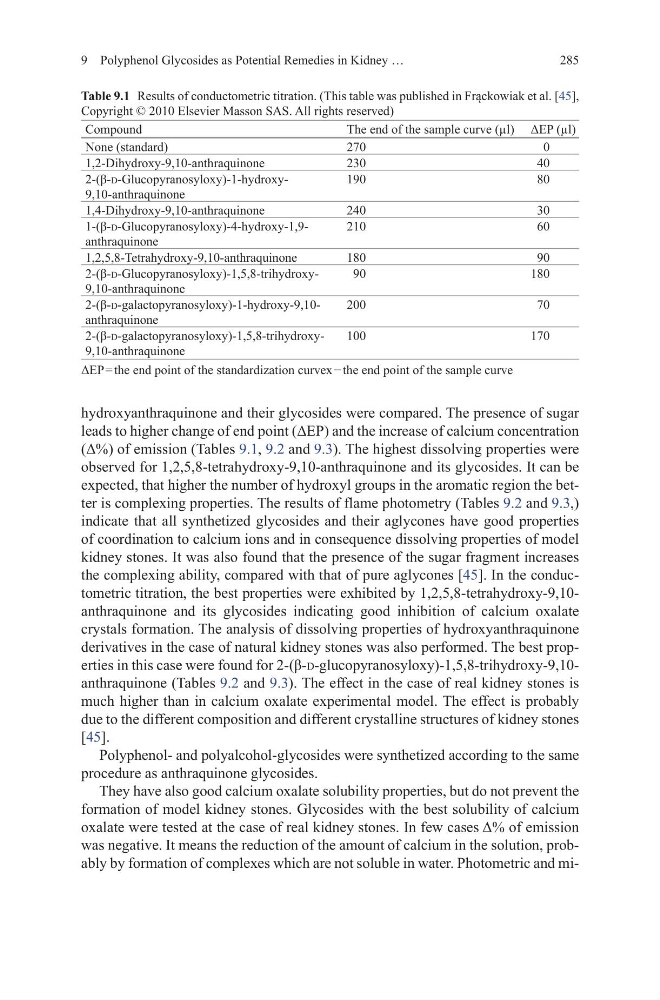
leads to higher change of end point (ΔEP) and the increase of calcium concentration
(Δ%) of emission (Tables 9.1, 9.2 and 9.3). The highest dissolving properties were
observed for 1,2,5,8-tetrahydroxy-9,10-anthraquinone and its glycosides. It can be
expected, that higher the number of hydroxyl groups in the aromatic region the better is complexing properties. The results of flame photometry (Tables 9.2 and 9.3,)
indicate that all synthetized glycosides and their aglycones have good properties
of coordination to calcium ions and in consequence dissolving properties of model
kidney stones. It was also found that the presence of the sugar fragment increases
the complexing ability, compared with that of pure aglycones [45]. In the conductometric titration, the best properties were exhibited by 1,2,5,8-tetrahydroxy-9,10anthraquinone and its glycosides indicating good inhibition of calcium oxalate
crystals formation. The analysis of dissolving properties of hydroxyanthraquinone
derivatives in the case of natural kidney stones was also performed. The best properties in this case were found for 2-(β-d-glucopyranosyloxy)-1,5,8-trihydroxy-9,10anthraquinone (Tables 9.2 and 9.3). The effect in the case of real kidney stones is
much higher than in calcium oxalate experimental model. The effect is probably
due to the different composition and different crystalline structures of kidney stones
[45].
Polyphenol- and polyalcohol-glycosides were synthetized according to the same
procedure as anthraquinone glycosides.
They have also good calcium oxalate solubility properties, but do not prevent the
formation of model kidney stones. Glycosides with the best solubility of calcium
oxalate were tested at the case of real kidney stones. In few cases Δ% of emission
was negative. It means the reduction of the amount of calcium in the solution, probably by formation of complexes which are not soluble in water. Photometric and miTable 9.1 Results of conductometric titration. (This table was published in Frąckowiak et al. [45],
Copyright © 2010 Elsevier Masson SAS. All rights reserved)
Compound
The end of the sample curve (µl) ΔEP (µl)
None (standard)
270
0
1,2-Dihydroxy-9,10-anthraquinone
230
40
2-(β-d-Glucopyranosyloxy)-1-hydroxy9,10-anthraquinone
190
80
1,4-Dihydroxy-9,10-anthraquinone
240
30
1-(β-d-Glucopyranosyloxy)-4-hydroxy-1,9anthraquinone
210
60
1,2,5,8-Tetrahydroxy-9,10-anthraquinone
180
90
2-(β-d-Glucopyranosyloxy)-1,5,8-trihydroxy9,10-anthraquinone
90
180
2-(β-d-galactopyranosyloxy)-1-hydroxy-9,10anthraquinone
200
70
2-(β-d-galactopyranosyloxy)-1,5,8-trihydroxy9,10-anthraquinone
100
170
ΔEP = the end point of the standardization curvex − the end point of the sample curve
9 Polyphenol Glycosides as Potential Remedies in Kidney …
hydroxyanthraquinone and their glycosides were compared. The presence of sugar
leads to higher change of end point (ΔEP) and the increase of calcium concentration
(Δ%) of emission (Tables 9.1, 9.2 and 9.3). The highest dissolving properties were
observed for 1,2,5,8-tetrahydroxy-9,10-anthraquinone and its glycosides. It can be
expected, that higher the number of hydroxyl groups in the aromatic region the better is complexing properties. The results of flame photometry (Tables 9.2 and 9.3,)
indicate that all synthetized glycosides and their aglycones have good properties
of coordination to calcium ions and in consequence dissolving properties of model
kidney stones. It was also found that the presence of the sugar fragment increases
the complexing ability, compared with that of pure aglycones [45]. In the conductometric titration, the best properties were exhibited by 1,2,5,8-tetrahydroxy-9,10anthraquinone and its glycosides indicating good inhibition of calcium oxalate
crystals formation. The analysis of dissolving properties of hydroxyanthraquinone
derivatives in the case of natural kidney stones was also performed. The best properties in this case were found for 2-(β-d-glucopyranosyloxy)-1,5,8-trihydroxy-9,10anthraquinone (Tables 9.2 and 9.3). The effect in the case of real kidney stones is
much higher than in calcium oxalate experimental model. The effect is probably
due to the different composition and different crystalline structures of kidney stones
[45].
Polyphenol- and polyalcohol-glycosides were synthetized according to the same
procedure as anthraquinone glycosides.
They have also good calcium oxalate solubility properties, but do not prevent the
formation of model kidney stones. Glycosides with the best solubility of calcium
oxalate were tested at the case of real kidney stones. In few cases Δ% of emission
was negative. It means the reduction of the amount of calcium in the solution, probably by formation of complexes which are not soluble in water. Photometric and miTable 9.1 Results of conductometric titration. (This table was published in Frąckowiak et al. [45],
Copyright © 2010 Elsevier Masson SAS. All rights reserved)
Compound
The end of the sample curve (µl) ΔEP (µl)
None (standard)
270
0
1,2-Dihydroxy-9,10-anthraquinone
230
40
2-(β-d-Glucopyranosyloxy)-1-hydroxy9,10-anthraquinone
190
80
1,4-Dihydroxy-9,10-anthraquinone
240
30
1-(β-d-Glucopyranosyloxy)-4-hydroxy-1,9anthraquinone
210
60
1,2,5,8-Tetrahydroxy-9,10-anthraquinone
180
90
2-(β-d-Glucopyranosyloxy)-1,5,8-trihydroxy9,10-anthraquinone
90
180
2-(β-d-galactopyranosyloxy)-1-hydroxy-9,10anthraquinone
200
70
2-(β-d-galactopyranosyloxy)-1,5,8-trihydroxy9,10-anthraquinone
100
170
ΔEP = the end point of the standardization curvex − the end point of the sample curve