

280
D. Toczek et al.
Another interesting structure of open chain carbohydrate derivative is presented
by the galactitol complex with calcium. Galactitol—1,2,3,4,5,6 heksahydroxyhexane is the metabolite of galactose. It lacks the carbonyl group and so it has an the
open chain structure. It forms the complex in which the galacitol binds through its
four hydroxyl groups to two calcium ions as shown on fig below (Fig. 9.7) [34].
Galactitol in this case is bidentate ligand also, despite that 1,2,3 as well as 4,5,6 hydroxyl groups can arrange in a way to form tridentate ligand with preferred threo–
threo geometry.
There is one structure which is worth of analysis despite it is not a neutral polysaccharide. Alginates, b-d-mannopyranosyluronic acids are polysaccharides which
form gels with calcium ions. Calcium ion binds to two neighboring molecules of
uronic acid to five oxygen atoms: two from hydroxyl oxygens, one from ring oxygen, one from glycosidic oxygen and one oxygen atom from the carboxylic group
[17]. More about the structure of alginate gels can be found in Agulhon et al. [35]
paper, in which using density functional calculations the interactions were investigated between diuronate units and some divalent cations.
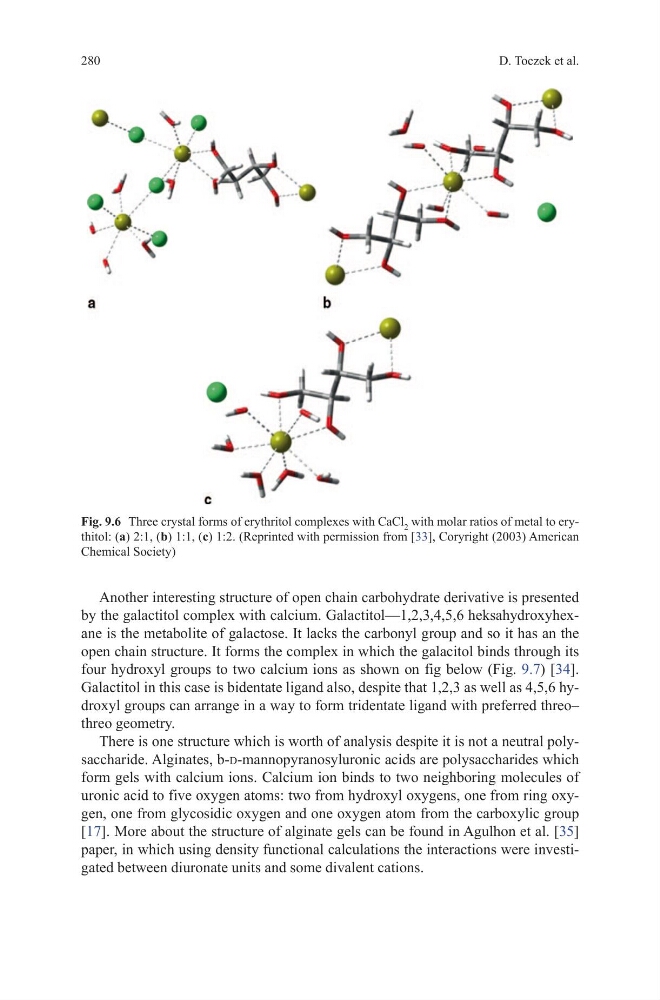
Fig. 9.6 Three crystal forms of erythritol complexes with CaCl 2 with molar ratios of metal to erythitol: (a) 2:1, (b) 1:1, (c) 1:2. (Reprinted with permission from [33], Coryright (2003) American
Chemical Society)
D. Toczek et al.
Another interesting structure of open chain carbohydrate derivative is presented
by the galactitol complex with calcium. Galactitol—1,2,3,4,5,6 heksahydroxyhexane is the metabolite of galactose. It lacks the carbonyl group and so it has an the
open chain structure. It forms the complex in which the galacitol binds through its
four hydroxyl groups to two calcium ions as shown on fig below (Fig. 9.7) [34].
Galactitol in this case is bidentate ligand also, despite that 1,2,3 as well as 4,5,6 hydroxyl groups can arrange in a way to form tridentate ligand with preferred threo–
threo geometry.
There is one structure which is worth of analysis despite it is not a neutral polysaccharide. Alginates, b-d-mannopyranosyluronic acids are polysaccharides which
form gels with calcium ions. Calcium ion binds to two neighboring molecules of
uronic acid to five oxygen atoms: two from hydroxyl oxygens, one from ring oxygen, one from glycosidic oxygen and one oxygen atom from the carboxylic group
[17]. More about the structure of alginate gels can be found in Agulhon et al. [35]
paper, in which using density functional calculations the interactions were investigated between diuronate units and some divalent cations.
Fig. 9.6 Three crystal forms of erythritol complexes with CaCl 2 with molar ratios of metal to erythitol: (a) 2:1, (b) 1:1, (c) 1:2. (Reprinted with permission from [33], Coryright (2003) American
Chemical Society)