

251
8 Molecular Dynamics Simulations of Lipid Bilayers with Incorporated Peptides
[84]). This value is shorter than hydrophobic thickness of the bilayer in a gel state
(3.44 for DPPC and 3.2 nm for DMPC), but longer for BLM in a liquid-crystalline
state (2.85 nm for DPPC and 2.62 nm for DMPC) [85]. Therefore we have analyzed the geometry of the systems in both gel and LC phases. Two examples of
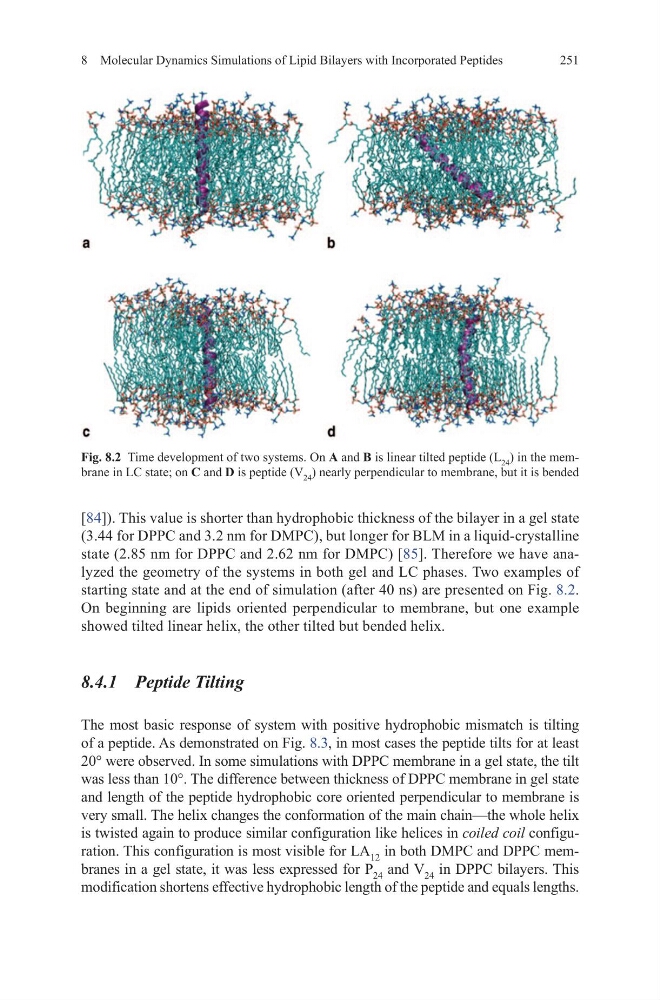
starting state and at the end of simulation (after 40 ns) are presented on Fig. 8.2.
On beginning are lipids oriented perpendicular to membrane, but one example
showed tilted linear helix, the other tilted but bended helix.
8.4.1 Peptide Tilting
The most basic response of system with positive hydrophobic mismatch is tilting
of a peptide. As demonstrated on Fig. 8.3, in most cases the peptide tilts for at least
20° were observed. In some simulations with DPPC membrane in a gel state, the tilt
was less than 10°. The difference between thickness of DPPC membrane in gel state
and length of the peptide hydrophobic core oriented perpendicular to membrane is
very small. The helix changes the conformation of the main chain—the whole helix
is twisted again to produce similar configuration like helices in coiled coil configuration. This configuration is most visible for LA 12 in both DMPC and DPPC membranes in a gel state, it was less expressed for P 24 and V 24 in DPPC bilayers. This
modification shortens effective hydrophobic length of the peptide and equals lengths.
Fig. 8.2 Time development of two systems. On A and B is linear tilted peptide (L 24 ) in the membrane in LC state; on C and D is peptide (V 24 ) nearly perpendicular to membrane, but it is bended
8 Molecular Dynamics Simulations of Lipid Bilayers with Incorporated Peptides
[84]). This value is shorter than hydrophobic thickness of the bilayer in a gel state
(3.44 for DPPC and 3.2 nm for DMPC), but longer for BLM in a liquid-crystalline
state (2.85 nm for DPPC and 2.62 nm for DMPC) [85]. Therefore we have analyzed the geometry of the systems in both gel and LC phases. Two examples of
starting state and at the end of simulation (after 40 ns) are presented on Fig. 8.2.
On beginning are lipids oriented perpendicular to membrane, but one example
showed tilted linear helix, the other tilted but bended helix.
8.4.1 Peptide Tilting
The most basic response of system with positive hydrophobic mismatch is tilting
of a peptide. As demonstrated on Fig. 8.3, in most cases the peptide tilts for at least
20° were observed. In some simulations with DPPC membrane in a gel state, the tilt
was less than 10°. The difference between thickness of DPPC membrane in gel state
and length of the peptide hydrophobic core oriented perpendicular to membrane is
very small. The helix changes the conformation of the main chain—the whole helix
is twisted again to produce similar configuration like helices in coiled coil configuration. This configuration is most visible for LA 12 in both DMPC and DPPC membranes in a gel state, it was less expressed for P 24 and V 24 in DPPC bilayers. This
modification shortens effective hydrophobic length of the peptide and equals lengths.
Fig. 8.2 Time development of two systems. On A and B is linear tilted peptide (L 24 ) in the membrane in LC state; on C and D is peptide (V 24 ) nearly perpendicular to membrane, but it is bended