

9
1 Hybrid QM/MM Methods: Treating Electronic Phenomena …
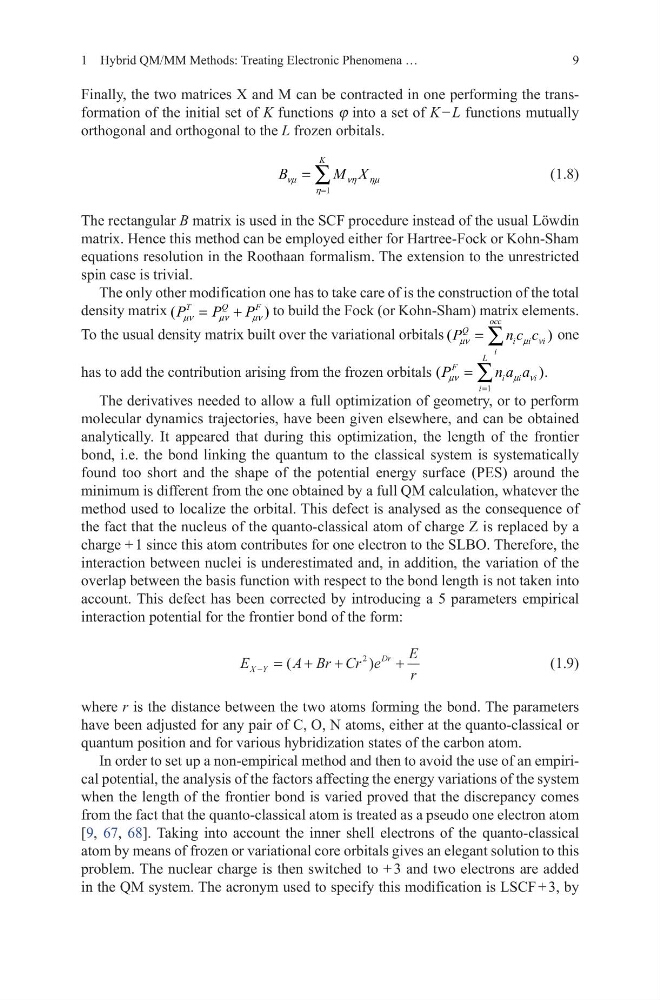
Finally, the two matrices X and M can be contracted in one performing the transformation of the initial set of K functions ϕ into a set of K − L functions mutually
orthogonal and orthogonal to the L frozen orbitals.
(1.8)
The rectangular B matrix is used in the SCF procedure instead of the usual Löwdin
matrix. Hence this method can be employed either for Hartree-Fock or Kohn-Sham
equations resolution in the Roothaan formalism. The extension to the unrestricted
spin case is trivial.
The only other modification one has to take care of is the construction of the total
density matrix (
)
T
Q
F
P
P
P
µν
µν
µν
=
+
to build the Fock (or Kohn-Sham) matrix elements.
To the usual density matrix built over the variational orbitals (
)
occ
Q
i i i
i
P
n c c
µν
µ ν
= ∑
one
has to add the contribution arising from the frozen orbitals
1
(
)
L
F
i
i
i
i
P
n a a
µν
µ ν
=
= ∑
.
The derivatives needed to allow a full optimization of geometry, or to perform
molecular dynamics trajectories, have been given elsewhere, and can be obtained
analytically. It appeared that during this optimization, the length of the frontier
bond, i.e. the bond linking the quantum to the classical system is systematically
found too short and the shape of the potential energy surface (PES) around the
minimum is different from the one obtained by a full QM calculation, whatever the
method used to localize the orbital. This defect is analysed as the consequence of
the fact that the nucleus of the quanto-classical atom of charge Z is replaced by a
charge + 1 since this atom contributes for one electron to the SLBO. Therefore, the
interaction between nuclei is underestimated and, in addition, the variation of the
overlap between the basis function with respect to the bond length is not taken into
account. This defect has been corrected by introducing a 5 parameters empirical
interaction potential for the frontier bond of the form:
(1.9)
where r is the distance between the two atoms forming the bond. The parameters
have been adjusted for any pair of C, O, N atoms, either at the quanto-classical or
quantum position and for various hybridization states of the carbon atom.
In order to set up a non-empirical method and then to avoid the use of an empirical potential, the analysis of the factors affecting the energy variations of the system
when the length of the frontier bond is varied proved that the discrepancy comes
from the fact that the quanto-classical atom is treated as a pseudo one electron atom
[9, 67, 68]. Taking into account the inner shell electrons of the quanto-classical
atom by means of frozen or variational core orbitals gives an elegant solution to this
problem. The nuclear charge is then switched to + 3 and two electrons are added
in the QM system. The acronym used to specify this modification is LSCF + 3, by
1
K
B
M X
νµ
νη ηµ
η=
= ∑
E
A Br Cr e
E
r
X Y
Dr
− = + +
+
(
)
2
1 Hybrid QM/MM Methods: Treating Electronic Phenomena …
Finally, the two matrices X and M can be contracted in one performing the transformation of the initial set of K functions ϕ into a set of K − L functions mutually
orthogonal and orthogonal to the L frozen orbitals.
(1.8)
The rectangular B matrix is used in the SCF procedure instead of the usual Löwdin
matrix. Hence this method can be employed either for Hartree-Fock or Kohn-Sham
equations resolution in the Roothaan formalism. The extension to the unrestricted
spin case is trivial.
The only other modification one has to take care of is the construction of the total
density matrix (
)
T
Q
F
P
P
P
µν
µν
µν
=
+
to build the Fock (or Kohn-Sham) matrix elements.
To the usual density matrix built over the variational orbitals (
)
occ
Q
i i i
i
P
n c c
µν
µ ν
= ∑
one
has to add the contribution arising from the frozen orbitals
1
(
)
L
F
i
i
i
i
P
n a a
µν
µ ν
=
= ∑
.
The derivatives needed to allow a full optimization of geometry, or to perform
molecular dynamics trajectories, have been given elsewhere, and can be obtained
analytically. It appeared that during this optimization, the length of the frontier
bond, i.e. the bond linking the quantum to the classical system is systematically
found too short and the shape of the potential energy surface (PES) around the
minimum is different from the one obtained by a full QM calculation, whatever the
method used to localize the orbital. This defect is analysed as the consequence of
the fact that the nucleus of the quanto-classical atom of charge Z is replaced by a
charge + 1 since this atom contributes for one electron to the SLBO. Therefore, the
interaction between nuclei is underestimated and, in addition, the variation of the
overlap between the basis function with respect to the bond length is not taken into
account. This defect has been corrected by introducing a 5 parameters empirical
interaction potential for the frontier bond of the form:
(1.9)
where r is the distance between the two atoms forming the bond. The parameters
have been adjusted for any pair of C, O, N atoms, either at the quanto-classical or
quantum position and for various hybridization states of the carbon atom.
In order to set up a non-empirical method and then to avoid the use of an empirical potential, the analysis of the factors affecting the energy variations of the system
when the length of the frontier bond is varied proved that the discrepancy comes
from the fact that the quanto-classical atom is treated as a pseudo one electron atom
[9, 67, 68]. Taking into account the inner shell electrons of the quanto-classical
atom by means of frozen or variational core orbitals gives an elegant solution to this
problem. The nuclear charge is then switched to + 3 and two electrons are added
in the QM system. The acronym used to specify this modification is LSCF + 3, by
1
K
B
M X
νµ
νη ηµ
η=
= ∑
E
A Br Cr e
E
r
X Y
Dr
− = + +
+
(
)
2