

189
6 Quantum Chemical Approaches in Modeling the Structure of DNA …
these studies since the size of G-quartet molecular system is not too large for QM
methods which are at the same time much more accurate than the methods based on
molecular mechanics, including MD, and provide more complete information on the
structure of quadruplex building blocks – guanine quartets. Since the latter are the
principal targets for virtually all G4-binding drugs, the availability of accurate molecular structures of G-tetrads is of critical importance for successful drug design.
Guanine bases in quadruplexes are held together by a number of non-covalent
interactions: hydrogen bonds responsible for the organization of four guanine fragments into the planar quartet; π-π-stacking interactions between individual quartets
enable the assembly of their stacks, and the presence of a monovalent cation (typically Na
+
, K
+
or NH 4
+
) between the quartet planes within the quadruplex channel
stabilizes G4 structure by neutralizing the electrostatic repulsion between guanine
O
6
oxygen atoms that form the inner rim of the quartet [78–81]. Some variations in
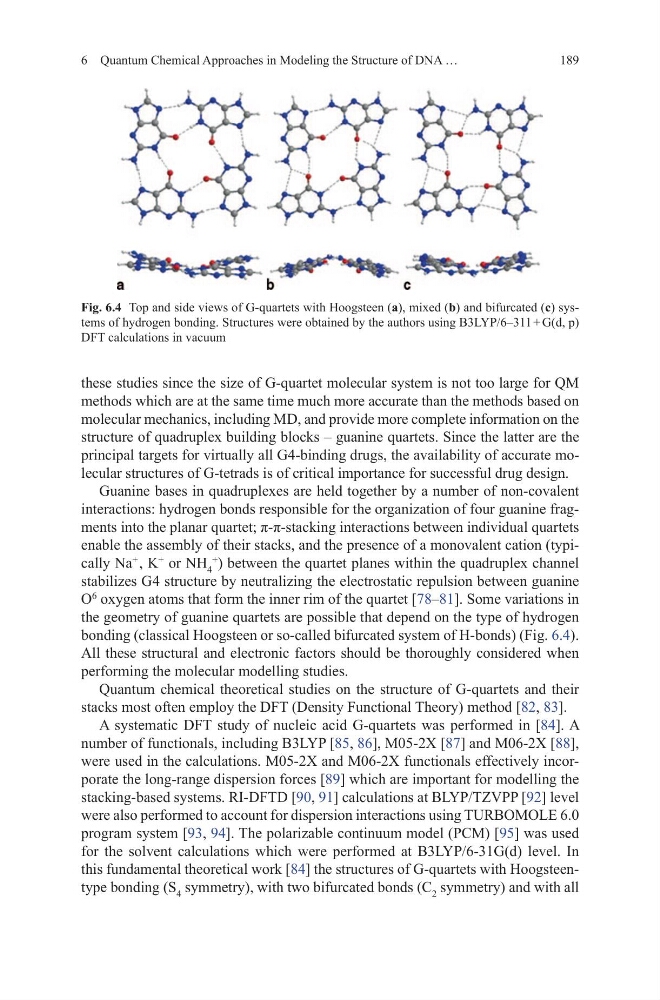
the geometry of guanine quartets are possible that depend on the type of hydrogen
bonding (classical Hoogsteen or so-called bifurcated system of H-bonds) (Fig. 6.4).
All these structural and electronic factors should be thoroughly considered when
performing the molecular modelling studies.
Quantum chemical theoretical studies on the structure of G-quartets and their
stacks most often employ the DFT (Density Functional Theory) method [82, 83].
A systematic DFT study of nucleic acid G-quartets was performed in [84]. A
number of functionals, including B3LYP [85, 86], M05-2X [87] and M06-2X [88],
were used in the calculations. M05-2X and M06-2X functionals effectively incorporate the long-range dispersion forces [89] which are important for modelling the
stacking-based systems. RI-DFTD [90, 91] calculations at BLYP/TZVPP [92] level
were also performed to account for dispersion interactions using TURBOMOLE 6.0
program system [93, 94]. The polarizable continuum model (PCM) [95] was used
for the solvent calculations which were performed at B3LYP/6-31G(d) level. In
this fundamental theoretical work [84] the structures of G-quartets with Hoogsteentype bonding (S 4 symmetry), with two bifurcated bonds (C 2 symmetry) and with all
Fig. 6.4 Top and side views of G-quartets with Hoogsteen (a), mixed (b) and bifurcated (c) systems of hydrogen bonding. Structures were obtained by the authors using B3LYP/6–311 + G(d, p)
DFT calculations in vacuum
6 Quantum Chemical Approaches in Modeling the Structure of DNA …
these studies since the size of G-quartet molecular system is not too large for QM
methods which are at the same time much more accurate than the methods based on
molecular mechanics, including MD, and provide more complete information on the
structure of quadruplex building blocks – guanine quartets. Since the latter are the
principal targets for virtually all G4-binding drugs, the availability of accurate molecular structures of G-tetrads is of critical importance for successful drug design.
Guanine bases in quadruplexes are held together by a number of non-covalent
interactions: hydrogen bonds responsible for the organization of four guanine fragments into the planar quartet; π-π-stacking interactions between individual quartets
enable the assembly of their stacks, and the presence of a monovalent cation (typically Na
+
, K
+
or NH 4
+
) between the quartet planes within the quadruplex channel
stabilizes G4 structure by neutralizing the electrostatic repulsion between guanine
O
6
oxygen atoms that form the inner rim of the quartet [78–81]. Some variations in
the geometry of guanine quartets are possible that depend on the type of hydrogen
bonding (classical Hoogsteen or so-called bifurcated system of H-bonds) (Fig. 6.4).
All these structural and electronic factors should be thoroughly considered when
performing the molecular modelling studies.
Quantum chemical theoretical studies on the structure of G-quartets and their
stacks most often employ the DFT (Density Functional Theory) method [82, 83].
A systematic DFT study of nucleic acid G-quartets was performed in [84]. A
number of functionals, including B3LYP [85, 86], M05-2X [87] and M06-2X [88],
were used in the calculations. M05-2X and M06-2X functionals effectively incorporate the long-range dispersion forces [89] which are important for modelling the
stacking-based systems. RI-DFTD [90, 91] calculations at BLYP/TZVPP [92] level
were also performed to account for dispersion interactions using TURBOMOLE 6.0
program system [93, 94]. The polarizable continuum model (PCM) [95] was used
for the solvent calculations which were performed at B3LYP/6-31G(d) level. In
this fundamental theoretical work [84] the structures of G-quartets with Hoogsteentype bonding (S 4 symmetry), with two bifurcated bonds (C 2 symmetry) and with all
Fig. 6.4 Top and side views of G-quartets with Hoogsteen (a), mixed (b) and bifurcated (c) systems of hydrogen bonding. Structures were obtained by the authors using B3LYP/6–311 + G(d, p)
DFT calculations in vacuum