

188
M. Ilchenko and I. Dubey
As a result, known to date G4 ligands share some common structural features as
well: they are based on large planar polycyclic heteroaromatic scaffolds able to
interact with guanine tetrads, and usually contain one or several cationic substituents for strengthening the interaction with anionic DNA backbone (sometimes the
aromatic core of the ligand can be cationic itself, e.g. in ethidium-based compounds
or acridinium derivative RHPS4, although most known G4 ligands are based on the
neutral heteroaromatic systems).
There are also G4 ligands that bind at the grooves of quadruplexes, with structures similar to those for duplex DNA minor groove binding ligands [76, 77].
6.3.2.2 DFT Calculations of the Structure of G-Quartets
and Their Interaction With Metal Cations
Since G-quartets and their stacked arrays are a unique component of all topological
types of G-quadruplexes, much effort were made to study guanine quartets and octets by quantum chemical methods. QM-based approaches are very appropriate for
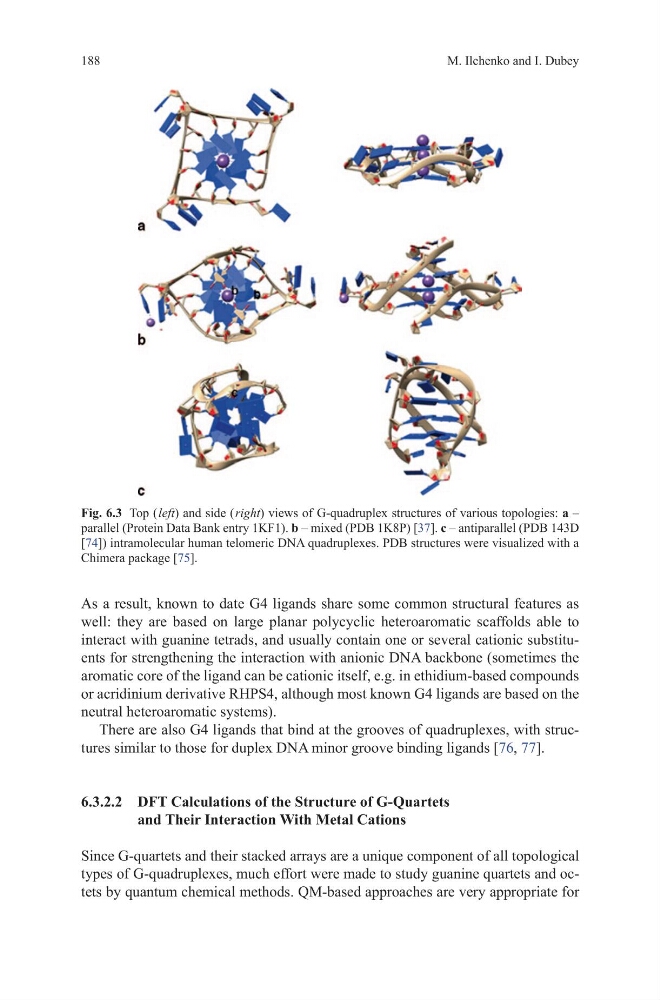
Fig. 6.3 Top ( left) and side ( right) views of G-quadruplex structures of various topologies: a –
parallel (Protein Data Bank entry 1KF1). b – mixed (PDB 1K8P) [37]. c – antiparallel (PDB 143D
[74]) intramolecular human telomeric DNA quadruplexes. PDB structures were visualized with a
Chimera package [75].
M. Ilchenko and I. Dubey
As a result, known to date G4 ligands share some common structural features as
well: they are based on large planar polycyclic heteroaromatic scaffolds able to
interact with guanine tetrads, and usually contain one or several cationic substituents for strengthening the interaction with anionic DNA backbone (sometimes the
aromatic core of the ligand can be cationic itself, e.g. in ethidium-based compounds
or acridinium derivative RHPS4, although most known G4 ligands are based on the
neutral heteroaromatic systems).
There are also G4 ligands that bind at the grooves of quadruplexes, with structures similar to those for duplex DNA minor groove binding ligands [76, 77].
6.3.2.2 DFT Calculations of the Structure of G-Quartets
and Their Interaction With Metal Cations
Since G-quartets and their stacked arrays are a unique component of all topological
types of G-quadruplexes, much effort were made to study guanine quartets and octets by quantum chemical methods. QM-based approaches are very appropriate for
Fig. 6.3 Top ( left) and side ( right) views of G-quadruplex structures of various topologies: a –
parallel (Protein Data Bank entry 1KF1). b – mixed (PDB 1K8P) [37]. c – antiparallel (PDB 143D
[74]) intramolecular human telomeric DNA quadruplexes. PDB structures were visualized with a
Chimera package [75].