

184
M. Ilchenko and I. Dubey
A number of efficient quadruplex binding/stabilizing ligands with anticancer
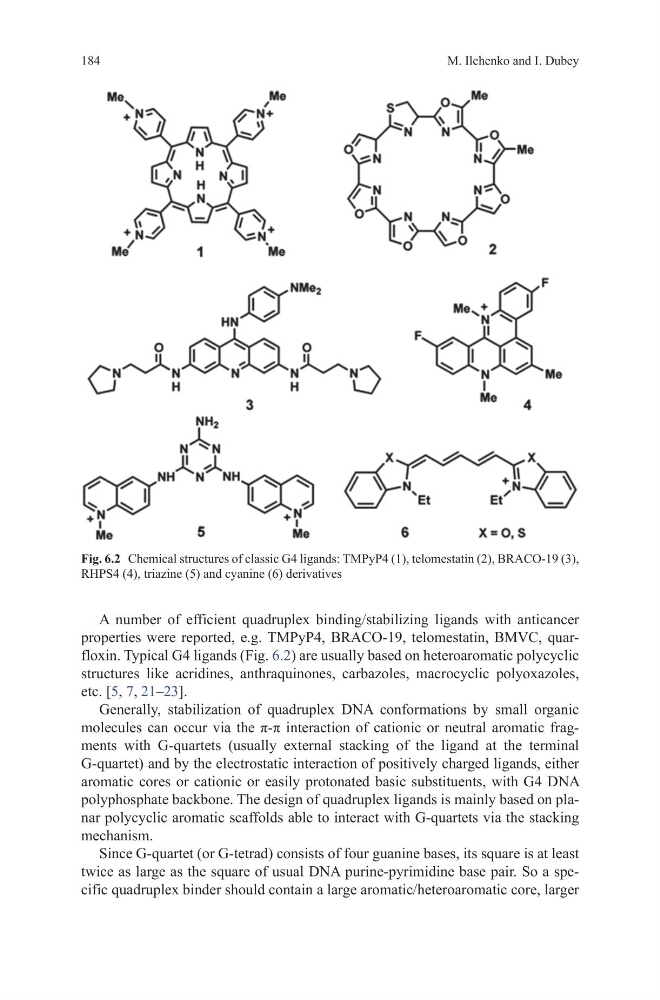
properties were reported, e.g. TMPyP4, BRACO-19, telomestatin, BMVC, quarfloxin. Typical G4 ligands (Fig. 6.2) are usually based on heteroaromatic polycyclic
structures like acridines, anthraquinones, carbazoles, macrocyclic polyoxazoles,
etc. [5, 7, 21–23].
Generally, stabilization of quadruplex DNA conformations by small organic
molecules can occur via the π-π interaction of cationic or neutral aromatic fragments with G-quartets (usually external stacking of the ligand at the terminal
G-quartet) and by the electrostatic interaction of positively charged ligands, either
aromatic cores or cationic or easily protonated basic substituents, with G4 DNA
polyphosphate backbone. The design of quadruplex ligands is mainly based on planar polycyclic aromatic scaffolds able to interact with G-quartets via the stacking
mechanism.
Since G-quartet (or G-tetrad) consists of four guanine bases, its square is at least
twice as large as the square of usual DNA purine-pyrimidine base pair. So a specific quadruplex binder should contain a large aromatic/heteroaromatic core, larger
Fig. 6.2 Chemical structures of classic G4 ligands: TMPyP4 (1), telomestatin (2), BRACO-19 (3),
RHPS4 (4), triazine (5) and cyanine (6) derivatives
M. Ilchenko and I. Dubey
A number of efficient quadruplex binding/stabilizing ligands with anticancer
properties were reported, e.g. TMPyP4, BRACO-19, telomestatin, BMVC, quarfloxin. Typical G4 ligands (Fig. 6.2) are usually based on heteroaromatic polycyclic
structures like acridines, anthraquinones, carbazoles, macrocyclic polyoxazoles,
etc. [5, 7, 21–23].
Generally, stabilization of quadruplex DNA conformations by small organic
molecules can occur via the π-π interaction of cationic or neutral aromatic fragments with G-quartets (usually external stacking of the ligand at the terminal
G-quartet) and by the electrostatic interaction of positively charged ligands, either
aromatic cores or cationic or easily protonated basic substituents, with G4 DNA
polyphosphate backbone. The design of quadruplex ligands is mainly based on planar polycyclic aromatic scaffolds able to interact with G-quartets via the stacking
mechanism.
Since G-quartet (or G-tetrad) consists of four guanine bases, its square is at least
twice as large as the square of usual DNA purine-pyrimidine base pair. So a specific quadruplex binder should contain a large aromatic/heteroaromatic core, larger
Fig. 6.2 Chemical structures of classic G4 ligands: TMPyP4 (1), telomestatin (2), BRACO-19 (3),
RHPS4 (4), triazine (5) and cyanine (6) derivatives