

183
6 Quantum Chemical Approaches in Modeling the Structure of DNA …
6.2 G-Quadruplex DNA and its Ligands
G-quadruplexes are specific structures that include planar G-quartet stacks and four
grooves providing different geometries and spatial distribution of functional group
as compared to duplex DNA. This difference allows specific recognition of quadruplexes by low-molecular ligands and binding selectivity over duplex DNA, i.e.
the ability to interact only with quadruplex but not duplex nucleic acids. Selective
G4 ligands stabilizing G4 structures may disturb the binding of enzyme to telomeric DNA and thus block its elongation that results in anticancer activity [4, 5,
7, 10]. In other words, single-stranded DNA is a substrate of telomerase, whereas
G-quadruplex DNA is not.
It is interesting to note that in this approach enzyme inhibition is achieved due
to the interaction of a ligand with telomerase substrate, i. e. telomeric DNA, rather
than with the enzyme itself.
Thermodynamic and kinetic data suggest that quadruplex stability depends on
a number of factors, including the type of structure adopted by the DNA strand
(or strands), strand sequence, the size of intervening loops, base and phosphate
modifications, pH and the presence of cations [19]. Small molecules may stabilize quadruplex DNA (or facilitate DNA folding into quadruplex structures) due to
shifting the competitive equilibrium between the single-stranded or Watson-Crick
duplex and quadruplex DNA towards the latter form [19, 20]. Inhibition activity of
G4 ligands depends mainly on the stability of their complexes with telomeric DNA
quadruplexes.
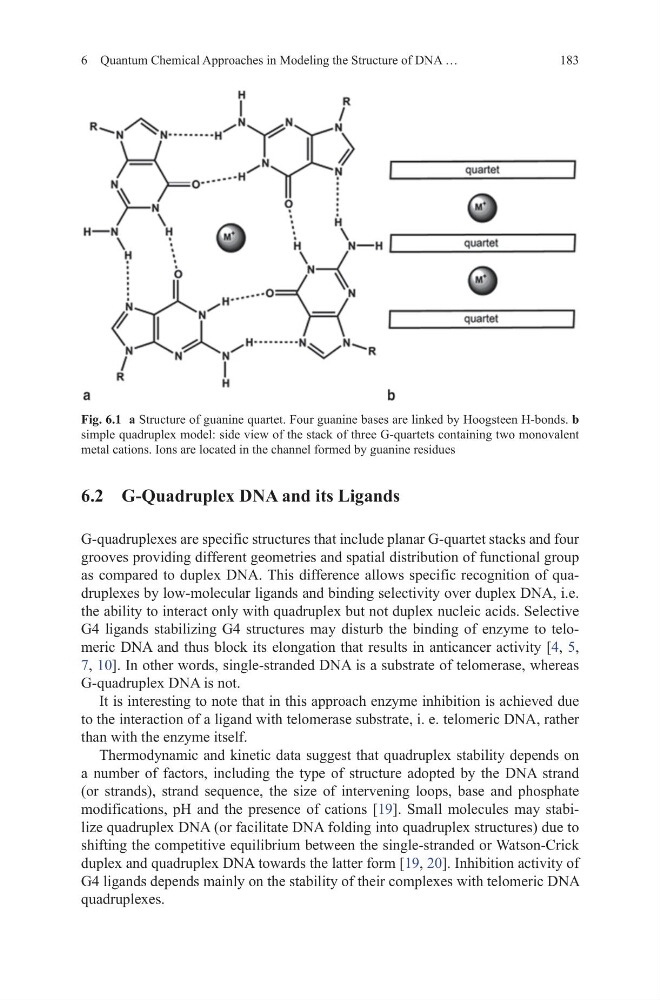
Fig. 6.1 a Structure of guanine quartet. Four guanine bases are linked by Hoogsteen H-bonds. b
simple quadruplex model: side view of the stack of three G-quartets containing two monovalent
metal cations. Ions are located in the channel formed by guanine residues
6 Quantum Chemical Approaches in Modeling the Structure of DNA …
6.2 G-Quadruplex DNA and its Ligands
G-quadruplexes are specific structures that include planar G-quartet stacks and four
grooves providing different geometries and spatial distribution of functional group
as compared to duplex DNA. This difference allows specific recognition of quadruplexes by low-molecular ligands and binding selectivity over duplex DNA, i.e.
the ability to interact only with quadruplex but not duplex nucleic acids. Selective
G4 ligands stabilizing G4 structures may disturb the binding of enzyme to telomeric DNA and thus block its elongation that results in anticancer activity [4, 5,
7, 10]. In other words, single-stranded DNA is a substrate of telomerase, whereas
G-quadruplex DNA is not.
It is interesting to note that in this approach enzyme inhibition is achieved due
to the interaction of a ligand with telomerase substrate, i. e. telomeric DNA, rather
than with the enzyme itself.
Thermodynamic and kinetic data suggest that quadruplex stability depends on
a number of factors, including the type of structure adopted by the DNA strand
(or strands), strand sequence, the size of intervening loops, base and phosphate
modifications, pH and the presence of cations [19]. Small molecules may stabilize quadruplex DNA (or facilitate DNA folding into quadruplex structures) due to
shifting the competitive equilibrium between the single-stranded or Watson-Crick
duplex and quadruplex DNA towards the latter form [19, 20]. Inhibition activity of
G4 ligands depends mainly on the stability of their complexes with telomeric DNA
quadruplexes.
Fig. 6.1 a Structure of guanine quartet. Four guanine bases are linked by Hoogsteen H-bonds. b
simple quadruplex model: side view of the stack of three G-quartets containing two monovalent
metal cations. Ions are located in the channel formed by guanine residues