

143
5 Molecular Structures, Relative Stability, and Proton Affinities of Nucleotides
The most striking differences in the molecular structure of DNTs, revealed by the
results of calculations performed using an extended basis set 6-31++G(d,p) (compared to 6-31 (d)), are found for conformers with a south/syn orientation of the nucleobase. The obtained data concluded that pure south/syn conformers correspond
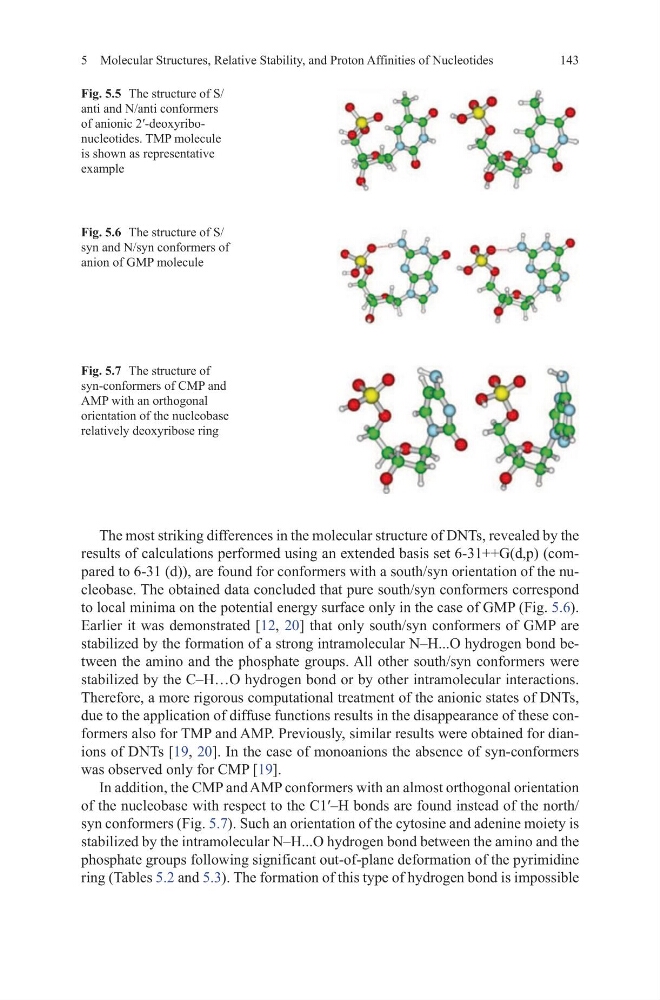
to local minima on the potential energy surface only in the case of GMP (Fig. 5.6).
Earlier it was demonstrated [12, 20] that only south/syn conformers of GMP are
stabilized by the formation of a strong intramolecular N–H...O hydrogen bond between the amino and the phosphate groups. All other south/syn conformers were
stabilized by the C–H…O hydrogen bond or by other intramolecular interactions.
Therefore, a more rigorous computational treatment of the anionic states of DNTs,
due to the application of diffuse functions results in the disappearance of these conformers also for TMP and AMP. Previously, similar results were obtained for dianions of DNTs [19, 20]. In the case of monoanions the absence of syn-conformers
was observed only for CMP [19].
In addition, the CMP and AMP conformers with an almost orthogonal orientation
of the nucleobase with respect to the C1′–H bonds are found instead of the north/
syn conformers (Fig. 5.7). Such an orientation of the cytosine and adenine moiety is
stabilized by the intramolecular N–H...O hydrogen bond between the amino and the
phosphate groups following significant out-of-plane deformation of the pyrimidine
ring (Tables 5.2 and 5.3). The formation of this type of hydrogen bond is impossible
Fig. 5.6 The structure of S/
syn and N/syn conformers of
anion of GMP molecule
Fig. 5.5 The structure of S/
anti and N/anti conformers
of anionic 2′-deoxyribonucleotides. TMP molecule
is shown as representative
example
Fig. 5.7 The structure of
syn-conformers of CMP and
AMP with an orthogonal
orientation of the nucleobase
relatively deoxyribose ring
5 Molecular Structures, Relative Stability, and Proton Affinities of Nucleotides
The most striking differences in the molecular structure of DNTs, revealed by the
results of calculations performed using an extended basis set 6-31++G(d,p) (compared to 6-31 (d)), are found for conformers with a south/syn orientation of the nucleobase. The obtained data concluded that pure south/syn conformers correspond
to local minima on the potential energy surface only in the case of GMP (Fig. 5.6).
Earlier it was demonstrated [12, 20] that only south/syn conformers of GMP are
stabilized by the formation of a strong intramolecular N–H...O hydrogen bond between the amino and the phosphate groups. All other south/syn conformers were
stabilized by the C–H…O hydrogen bond or by other intramolecular interactions.
Therefore, a more rigorous computational treatment of the anionic states of DNTs,
due to the application of diffuse functions results in the disappearance of these conformers also for TMP and AMP. Previously, similar results were obtained for dianions of DNTs [19, 20]. In the case of monoanions the absence of syn-conformers
was observed only for CMP [19].
In addition, the CMP and AMP conformers with an almost orthogonal orientation
of the nucleobase with respect to the C1′–H bonds are found instead of the north/
syn conformers (Fig. 5.7). Such an orientation of the cytosine and adenine moiety is
stabilized by the intramolecular N–H...O hydrogen bond between the amino and the
phosphate groups following significant out-of-plane deformation of the pyrimidine
ring (Tables 5.2 and 5.3). The formation of this type of hydrogen bond is impossible
Fig. 5.6 The structure of S/
syn and N/syn conformers of
anion of GMP molecule
Fig. 5.5 The structure of S/
anti and N/anti conformers
of anionic 2′-deoxyribonucleotides. TMP molecule
is shown as representative
example
Fig. 5.7 The structure of
syn-conformers of CMP and
AMP with an orthogonal
orientation of the nucleobase
relatively deoxyribose ring