

142
T. A. Zubatiuk et al.
5.3 The Structure and the Relative Stability
of 2′-Deoxorybonucleotides Conformers
Theoretical studies [19, 20] of the molecular structure of canonical DNTs, namely,
2′-deoxythymidine-5′-phosphate (TMP), 2′-deoxycytidine-5′-phosphate (CMP),
2′-deoxy-adenosine-5′-phosphate (AMP), and 2′-deoxyguanosine-5′-phosphate
(GMP), have revealed the presence of numerous intramolecular N–H…O and C–
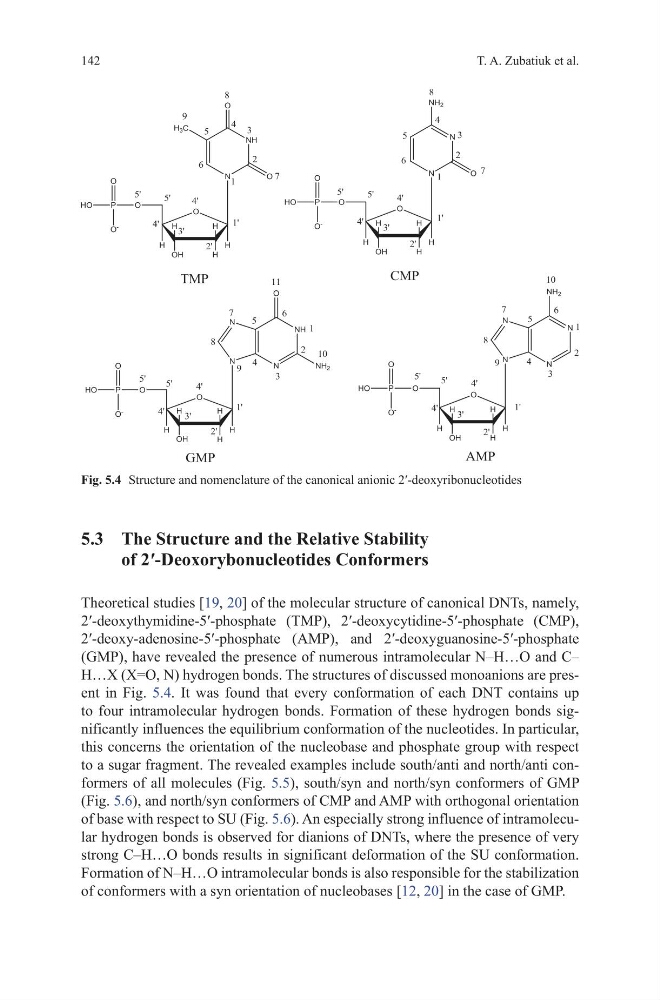
H…X (X=O, N) hydrogen bonds. The structures of discussed monoanions are present in Fig. 5.4. It was found that every conformation of each DNT contains up
to four intramolecular hydrogen bonds. Formation of these hydrogen bonds significantly influences the equilibrium conformation of the nucleotides. In particular,
this concerns the orientation of the nucleobase and phosphate group with respect
to a sugar fragment. The revealed examples include south/anti and north/anti conformers of all molecules (Fig. 5.5), south/syn and north/syn conformers of GMP
(Fig. 5.6), and north/syn conformers of CMP and AMP with orthogonal orientation
of base with respect to SU (Fig. 5.6). An especially strong influence of intramolecular hydrogen bonds is observed for dianions of DNTs, where the presence of very
strong C–H…O bonds results in significant deformation of the SU conformation.
Formation of N–H…O intramolecular bonds is also responsible for the stabilization
of conformers with a syn orientation of nucleobases [12, 20] in the case of GMP.
Fig. 5.4 Structure and nomenclature of the canonical anionic 2′-deoxyribonucleotides
T. A. Zubatiuk et al.
5.3 The Structure and the Relative Stability
of 2′-Deoxorybonucleotides Conformers
Theoretical studies [19, 20] of the molecular structure of canonical DNTs, namely,
2′-deoxythymidine-5′-phosphate (TMP), 2′-deoxycytidine-5′-phosphate (CMP),
2′-deoxy-adenosine-5′-phosphate (AMP), and 2′-deoxyguanosine-5′-phosphate
(GMP), have revealed the presence of numerous intramolecular N–H…O and C–
H…X (X=O, N) hydrogen bonds. The structures of discussed monoanions are present in Fig. 5.4. It was found that every conformation of each DNT contains up
to four intramolecular hydrogen bonds. Formation of these hydrogen bonds significantly influences the equilibrium conformation of the nucleotides. In particular,
this concerns the orientation of the nucleobase and phosphate group with respect
to a sugar fragment. The revealed examples include south/anti and north/anti conformers of all molecules (Fig. 5.5), south/syn and north/syn conformers of GMP
(Fig. 5.6), and north/syn conformers of CMP and AMP with orthogonal orientation
of base with respect to SU (Fig. 5.6). An especially strong influence of intramolecular hydrogen bonds is observed for dianions of DNTs, where the presence of very
strong C–H…O bonds results in significant deformation of the SU conformation.
Formation of N–H…O intramolecular bonds is also responsible for the stabilization
of conformers with a syn orientation of nucleobases [12, 20] in the case of GMP.
Fig. 5.4 Structure and nomenclature of the canonical anionic 2′-deoxyribonucleotides