

140
T. A. Zubatiuk et al.
another with a certain “directionality”, known technically as “5-prime to 3-prime”,
in a head-to-tail sense. The two strands run in opposite directions, as shown in
Fig. 5.1 by the labels 5′ and 3′, and by the arrows.
Each nucleotide is made of about 20 atoms, such as carbon, nitrogen, and oxygen. These atoms can again be grouped into smaller parts which are connected
in a particular way. The three parts of a nucleotide are its sugar, phosphate, and
base. Numerous experimental and theoretical studies of 2′-deoxyribonucleotides,
e.g. [37–39] indicate that these molecules are very flexible and they can adopt
many different conformations. These conformations may be classified based on
geometrical parameters of deoxyribose ring (SU), sugar–phosphate backbone
(BB), and orientation of the base (BU) with respect to deoxyribose ring. These
main fragments of DNT can adopt different stable conformations leading to numerous conformers of DNTs with different combination of configurations of its
fragments.
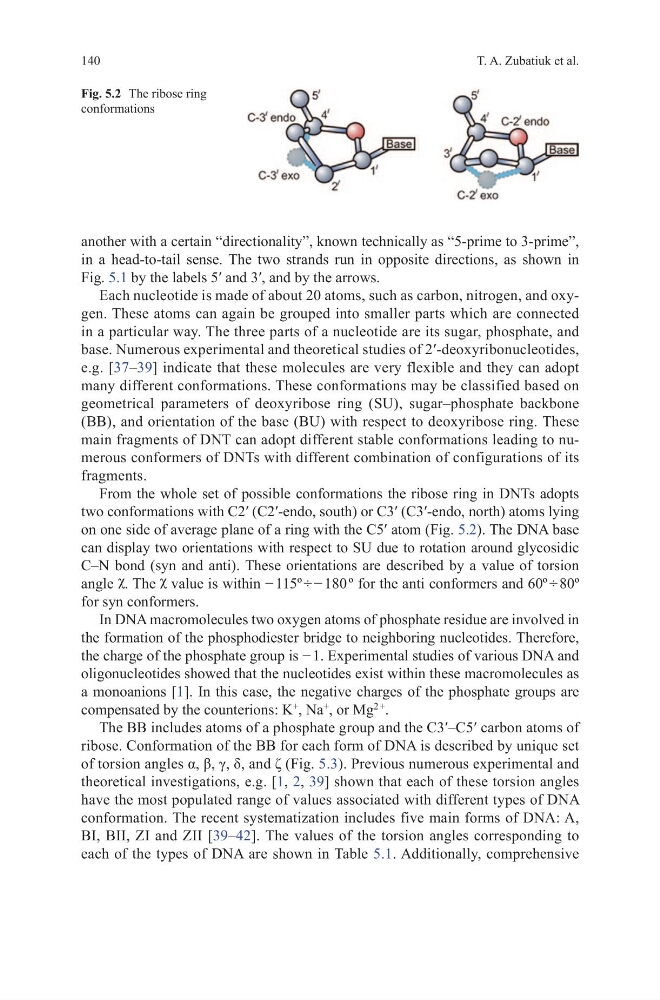
From the whole set of possible conformations the ribose ring in DNTs adopts
two conformations with C2′ (C2′-endo, south) or C3′ (C3′-endo, north) atoms lying
on one side of average plane of a ring with the C5′ atom (Fig. 5.2). The DNA base
can display two orientations with respect to SU due to rotation around glycosidic
C–N bond (syn and anti). These orientations are described by a value of torsion
angle χ . The χ value is within − 115º ÷ − 180 º for the anti conformers and 60º ÷ 80º
for syn conformers.
In DNA macromolecules two oxygen atoms of phosphate residue are involved in
the formation of the phosphodiester bridge to neighboring nucleotides. Therefore,
the charge of the phosphate group is − 1. Experimental studies of various DNA and
oligonucleotides showed that the nucleotides exist within these macromolecules as
a monoanions [1]. In this case, the negative charges of the phosphate groups are
compensated by the counterions: K
+
, Na
+
, or Mg
2 +
.
The BB includes atoms of a phosphate group and the C3′–C5′ carbon atoms of
ribose. Conformation of the BB for each form of DNA is described by unique set
of torsion angles α, β, γ, δ, and ζ (Fig. 5.3). Previous numerous experimental and
theoretical investigations, e.g. [1, 2, 39] shown that each of these torsion angles
have the most populated range of values associated with different types of DNA
conformation. The recent systematization includes five main forms of DNA: A,
BI, BII, ZI and ZII [39–42]. The values of the torsion angles corresponding to
each of the types of DNA are shown in Table 5.1. Additionally, comprehensive
Fig. 5.2 The ribose ring
conformations
T. A. Zubatiuk et al.
another with a certain “directionality”, known technically as “5-prime to 3-prime”,
in a head-to-tail sense. The two strands run in opposite directions, as shown in
Fig. 5.1 by the labels 5′ and 3′, and by the arrows.
Each nucleotide is made of about 20 atoms, such as carbon, nitrogen, and oxygen. These atoms can again be grouped into smaller parts which are connected
in a particular way. The three parts of a nucleotide are its sugar, phosphate, and
base. Numerous experimental and theoretical studies of 2′-deoxyribonucleotides,
e.g. [37–39] indicate that these molecules are very flexible and they can adopt
many different conformations. These conformations may be classified based on
geometrical parameters of deoxyribose ring (SU), sugar–phosphate backbone
(BB), and orientation of the base (BU) with respect to deoxyribose ring. These
main fragments of DNT can adopt different stable conformations leading to numerous conformers of DNTs with different combination of configurations of its
fragments.
From the whole set of possible conformations the ribose ring in DNTs adopts
two conformations with C2′ (C2′-endo, south) or C3′ (C3′-endo, north) atoms lying
on one side of average plane of a ring with the C5′ atom (Fig. 5.2). The DNA base
can display two orientations with respect to SU due to rotation around glycosidic
C–N bond (syn and anti). These orientations are described by a value of torsion
angle χ . The χ value is within − 115º ÷ − 180 º for the anti conformers and 60º ÷ 80º
for syn conformers.
In DNA macromolecules two oxygen atoms of phosphate residue are involved in
the formation of the phosphodiester bridge to neighboring nucleotides. Therefore,
the charge of the phosphate group is − 1. Experimental studies of various DNA and
oligonucleotides showed that the nucleotides exist within these macromolecules as
a monoanions [1]. In this case, the negative charges of the phosphate groups are
compensated by the counterions: K
+
, Na
+
, or Mg
2 +
.
The BB includes atoms of a phosphate group and the C3′–C5′ carbon atoms of
ribose. Conformation of the BB for each form of DNA is described by unique set
of torsion angles α, β, γ, δ, and ζ (Fig. 5.3). Previous numerous experimental and
theoretical investigations, e.g. [1, 2, 39] shown that each of these torsion angles
have the most populated range of values associated with different types of DNA
conformation. The recent systematization includes five main forms of DNA: A,
BI, BII, ZI and ZII [39–42]. The values of the torsion angles corresponding to
each of the types of DNA are shown in Table 5.1. Additionally, comprehensive
Fig. 5.2 The ribose ring
conformations