

139
5 Molecular Structures, Relative Stability, and Proton Affinities of Nucleotides
the molecule. This facilitates investigation of intramolecular interactions [19–21].
One needs to acknowledge that modern computer resources are adequate for
conformational studies of molecules at a high theory level, revealing data of the
experimental accuracy. This opens up new possibilities for the study of conformational characteristics and intramolecular interactions of fundamental biologically
active molecules, such as nucleotides.
In the past conformational characteristics of DNTs were studied using force field
[10–12] and semi-empirical quantum-chemical, e.g. [13] methods. Although these
methods deliver valuable insight into the conformational features of DNTs they are
not able to provide accurate quantitative data related to the conformational characteristics of these molecules. The most reliable structural data of DNTs may be
obtained from static and dynamic ab initio and DFT quantum-mechanical (QM)
calculations. However, such methods are much more time and resources demanding than the classical MD simulations. By now, published results of DFT molecular
dynamic simulations and QM studies on simple DNA constituents revealed huge
amount of data. Such studies have been reported for nucleobases and base pairs, e.g.
[22–30], nucleosides and nucleotides, e.g. [31–36]. They provide vital information
about molecular and electronic structure, conformational flexibility, tautomerism,
and interactions with metals, water, and other molecules.
In this review, we present the recent results of the comprehensive studies of
the conformational and energy characteristics of the anions of the canonical DNTs,
their methyl ethers, and protonated methyl ethers anions. The special attention is
paid to the analysis and classification of the ample set of intramolecular hydrogen
bonds which are an essential part of the structures of the nucleotide molecules.
We discuss special criteria which allow delineating the hydrogen bonds with
some stable electrostatic interactions in a nucleotide. Noticeable consideration is
given to data that explain the effect of hydrogen bonding on structural geometry
changes in nucleotides. The specific biological relevant composition of DNA is
described from the point of view of the non-standard “orthogonal” syn-conformers
of 2′-deoxycytidine-5′-phosphate and 2′-deoxyadenosine-5′-phosphate, which are
stabilized due to unusual strong intramolecular hydrogen bonds N–H…O between
the amino group of nucleobase and the oxygen atom of the phosphate group.
5.2 Structure of 2′-Deoxyribonucleotides in DNA
Macromolecules and Oligonucleotides
The main interest in canonical DNTs is caused by the fact that they are building
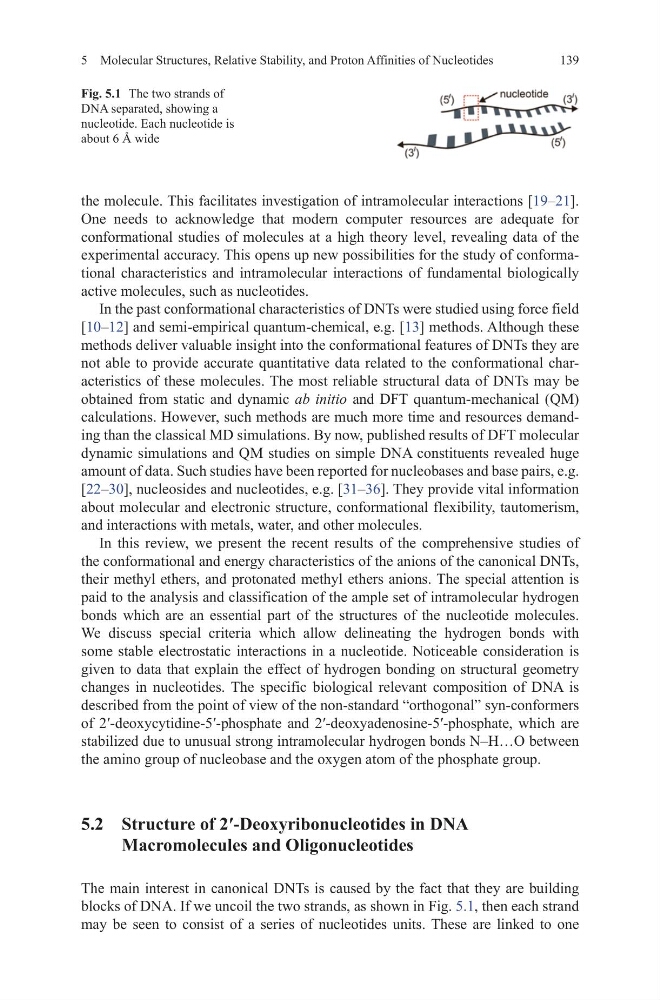
blocks of DNA. If we uncoil the two strands, as shown in Fig. 5.1, then each strand
may be seen to consist of a series of nucleotides units. These are linked to one
Fig. 5.1 The two strands of
DNA separated, showing a
nucleotide. Each nucleotide is
about 6 Å wide
5 Molecular Structures, Relative Stability, and Proton Affinities of Nucleotides
the molecule. This facilitates investigation of intramolecular interactions [19–21].
One needs to acknowledge that modern computer resources are adequate for
conformational studies of molecules at a high theory level, revealing data of the
experimental accuracy. This opens up new possibilities for the study of conformational characteristics and intramolecular interactions of fundamental biologically
active molecules, such as nucleotides.
In the past conformational characteristics of DNTs were studied using force field
[10–12] and semi-empirical quantum-chemical, e.g. [13] methods. Although these
methods deliver valuable insight into the conformational features of DNTs they are
not able to provide accurate quantitative data related to the conformational characteristics of these molecules. The most reliable structural data of DNTs may be
obtained from static and dynamic ab initio and DFT quantum-mechanical (QM)
calculations. However, such methods are much more time and resources demanding than the classical MD simulations. By now, published results of DFT molecular
dynamic simulations and QM studies on simple DNA constituents revealed huge
amount of data. Such studies have been reported for nucleobases and base pairs, e.g.
[22–30], nucleosides and nucleotides, e.g. [31–36]. They provide vital information
about molecular and electronic structure, conformational flexibility, tautomerism,
and interactions with metals, water, and other molecules.
In this review, we present the recent results of the comprehensive studies of
the conformational and energy characteristics of the anions of the canonical DNTs,
their methyl ethers, and protonated methyl ethers anions. The special attention is
paid to the analysis and classification of the ample set of intramolecular hydrogen
bonds which are an essential part of the structures of the nucleotide molecules.
We discuss special criteria which allow delineating the hydrogen bonds with
some stable electrostatic interactions in a nucleotide. Noticeable consideration is
given to data that explain the effect of hydrogen bonding on structural geometry
changes in nucleotides. The specific biological relevant composition of DNA is
described from the point of view of the non-standard “orthogonal” syn-conformers
of 2′-deoxycytidine-5′-phosphate and 2′-deoxyadenosine-5′-phosphate, which are
stabilized due to unusual strong intramolecular hydrogen bonds N–H…O between
the amino group of nucleobase and the oxygen atom of the phosphate group.
5.2 Structure of 2′-Deoxyribonucleotides in DNA
Macromolecules and Oligonucleotides
The main interest in canonical DNTs is caused by the fact that they are building
blocks of DNA. If we uncoil the two strands, as shown in Fig. 5.1, then each strand
may be seen to consist of a series of nucleotides units. These are linked to one
Fig. 5.1 The two strands of
DNA separated, showing a
nucleotide. Each nucleotide is
about 6 Å wide