

120
ranked according to the FullFitness (FF) scoring function specified by the SwissDock algorithm (cluster 0 being the cluster with the best FullFitness score). Within
each cluster, the individual binding poses were further arranged and ranked based
on their FF score.
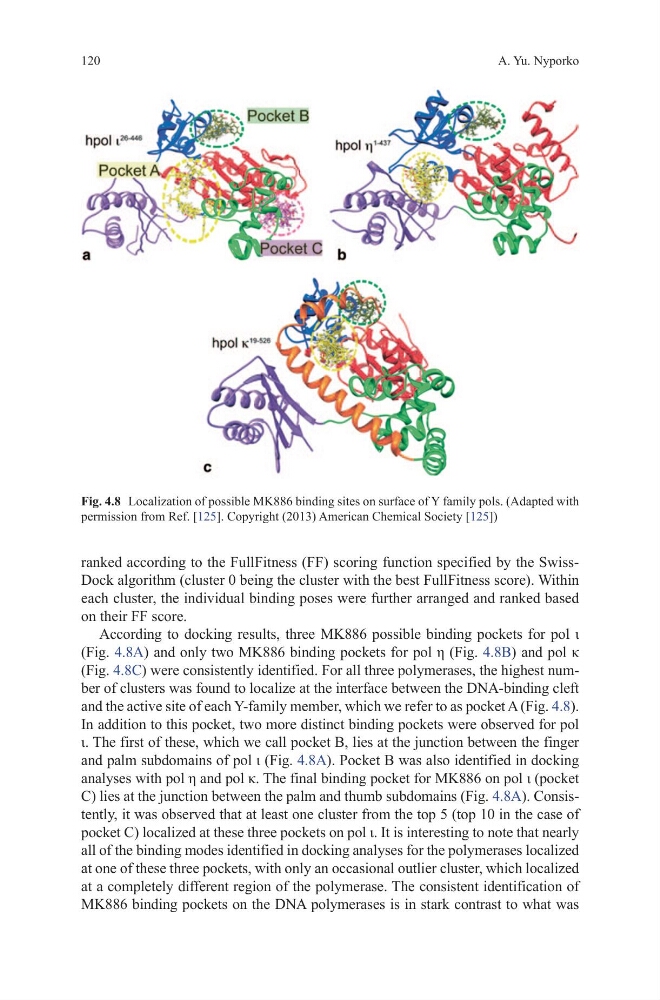
According to docking results, three MK886 possible binding pockets for pol ι
(Fig. 4.8A) and only two MK886 binding pockets for pol η (Fig. 4.8B) and pol κ
(Fig. 4.8C) were consistently identified. For all three polymerases, the highest number of clusters was found to localize at the interface between the DNA-binding cleft
and the active site of each Y-family member, which we refer to as pocket A (Fig. 4.8).
In addition to this pocket, two more distinct binding pockets were observed for pol
ι. The first of these, which we call pocket B, lies at the junction between the finger
and palm subdomains of pol ι (Fig. 4.8A). Pocket B was also identified in docking
analyses with pol η and pol κ. The final binding pocket for MK886 on pol ι (pocket
C) lies at the junction between the palm and thumb subdomains (Fig. 4.8A). Consistently, it was observed that at least one cluster from the top 5 (top 10 in the case of
pocket C) localized at these three pockets on pol ι. It is interesting to note that nearly
all of the binding modes identified in docking analyses for the polymerases localized
at one of these three pockets, with only an occasional outlier cluster, which localized
at a completely different region of the polymerase. The consistent identification of
MK886 binding pockets on the DNA polymerases is in stark contrast to what was
Fig. 4.8 Localization of possible MK886 binding sites on surface of Y family pols. (Adapted with
permission from Ref. [125]. Copyright (2013) American Chemical Society [125])
A. Yu. Nyporko
ranked according to the FullFitness (FF) scoring function specified by the SwissDock algorithm (cluster 0 being the cluster with the best FullFitness score). Within
each cluster, the individual binding poses were further arranged and ranked based
on their FF score.
According to docking results, three MK886 possible binding pockets for pol ι
(Fig. 4.8A) and only two MK886 binding pockets for pol η (Fig. 4.8B) and pol κ
(Fig. 4.8C) were consistently identified. For all three polymerases, the highest number of clusters was found to localize at the interface between the DNA-binding cleft
and the active site of each Y-family member, which we refer to as pocket A (Fig. 4.8).
In addition to this pocket, two more distinct binding pockets were observed for pol
ι. The first of these, which we call pocket B, lies at the junction between the finger
and palm subdomains of pol ι (Fig. 4.8A). Pocket B was also identified in docking
analyses with pol η and pol κ. The final binding pocket for MK886 on pol ι (pocket
C) lies at the junction between the palm and thumb subdomains (Fig. 4.8A). Consistently, it was observed that at least one cluster from the top 5 (top 10 in the case of
pocket C) localized at these three pockets on pol ι. It is interesting to note that nearly
all of the binding modes identified in docking analyses for the polymerases localized
at one of these three pockets, with only an occasional outlier cluster, which localized
at a completely different region of the polymerase. The consistent identification of
MK886 binding pockets on the DNA polymerases is in stark contrast to what was
Fig. 4.8 Localization of possible MK886 binding sites on surface of Y family pols. (Adapted with
permission from Ref. [125]. Copyright (2013) American Chemical Society [125])
A. Yu. Nyporko