

119
catalytic core of the protein, potentially inhibiting the enzyme activity. The docking
simulation provides important molecular insights into how PGG inhibits pol β in a
competitive manner with respect to the dNTP substrate and DNA template–primer
[94]. It is extremely exciting that PGG binding by polymerases from different families proceeds by distinct mechanisms (it is non-competitive for pol α and pol k but
competitive for pol β), and future investigations of these processes can essentially
extend our knowledge about structural insights of specificity and selectivity of lowweight molecular compound in relation to various biomolecular targets.
Recently, the structural mechanisms of Y-family pol k inhibition by1H-Indole2-propanoic acid (MK-866) were investigated with in silico docking (Ketkar et al.
[125]). Docking runs were performed using the PDB files 4EBC (pol ι), 3MR2 (pol
η) and 2OH2 (pol κ) downloaded from the Protein Data Bank [126], for target Yfamily DNA polymerases, either with the DNA coordinates (binary) in place or after
removing the DNA atoms (apoenzyme). The protein PDB files were preliminarily
prepared for docking using the Dock Prep tool [127] available in the free software
package UCSF Chimera [128]. This involved the addition of hydrogens, removal
of water and other extra molecules, and assigning partial charges (using the AMBER99 force field).
The spatial coordinates for the MK886 molecule were generated using the Marvin Sketch free software tool in the ChemAxon package (http://www.chemaxon.
com/products/marvin/marvinsketch). Automated in silico docking was performed
using the web-based docking server SwissDock (http://www.swissdock.ch/) that is
based on the docking algorithm EADock DSS [129]. The processed coordinates file
(as described above) for each of the proteins and for the ligand MK886 were uploaded, and docking runs were performed using the “Accurate” parameters option,
which is the most exhaustive in terms of the number of binding modes sampled.
Docking runs were performed as blind, covering the entire protein surface, and
not defining any specific region of the protein as the binding pocket in order to
avoid sampling bias. Output clusters were obtained after each docking run and were
4 DNA Dependent DNA Polymerases as Targets for Low-Weight …
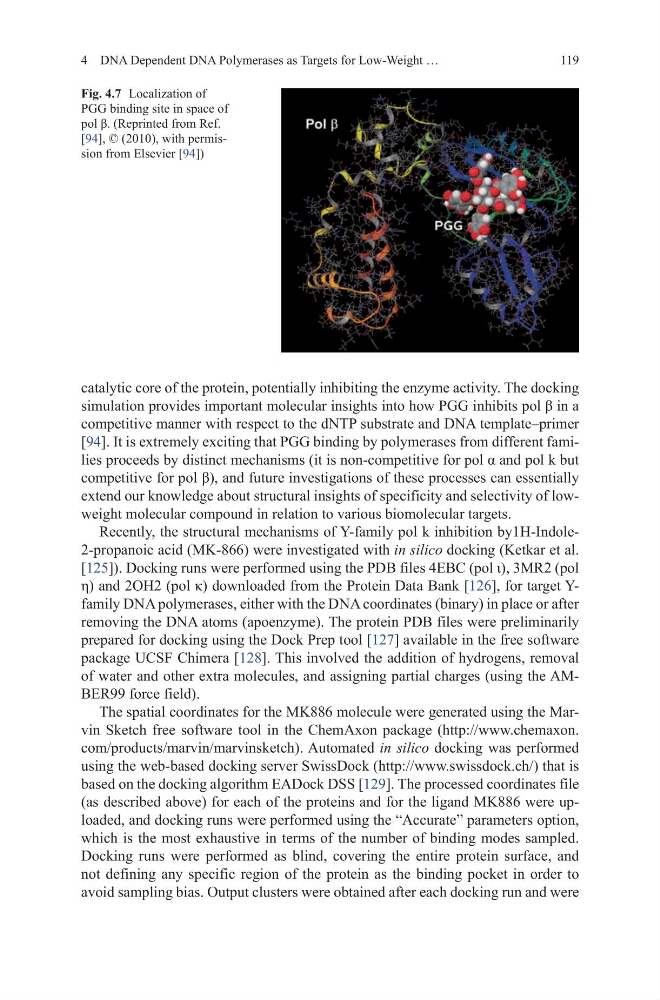
Fig. 4.7 Localization of
PGG binding site in space of
pol β. (Reprinted from Ref.
[94], © (2010), with permission from Elsevier [94])
catalytic core of the protein, potentially inhibiting the enzyme activity. The docking
simulation provides important molecular insights into how PGG inhibits pol β in a
competitive manner with respect to the dNTP substrate and DNA template–primer
[94]. It is extremely exciting that PGG binding by polymerases from different families proceeds by distinct mechanisms (it is non-competitive for pol α and pol k but
competitive for pol β), and future investigations of these processes can essentially
extend our knowledge about structural insights of specificity and selectivity of lowweight molecular compound in relation to various biomolecular targets.
Recently, the structural mechanisms of Y-family pol k inhibition by1H-Indole2-propanoic acid (MK-866) were investigated with in silico docking (Ketkar et al.
[125]). Docking runs were performed using the PDB files 4EBC (pol ι), 3MR2 (pol
η) and 2OH2 (pol κ) downloaded from the Protein Data Bank [126], for target Yfamily DNA polymerases, either with the DNA coordinates (binary) in place or after
removing the DNA atoms (apoenzyme). The protein PDB files were preliminarily
prepared for docking using the Dock Prep tool [127] available in the free software
package UCSF Chimera [128]. This involved the addition of hydrogens, removal
of water and other extra molecules, and assigning partial charges (using the AMBER99 force field).
The spatial coordinates for the MK886 molecule were generated using the Marvin Sketch free software tool in the ChemAxon package (http://www.chemaxon.
com/products/marvin/marvinsketch). Automated in silico docking was performed
using the web-based docking server SwissDock (http://www.swissdock.ch/) that is
based on the docking algorithm EADock DSS [129]. The processed coordinates file
(as described above) for each of the proteins and for the ligand MK886 were uploaded, and docking runs were performed using the “Accurate” parameters option,
which is the most exhaustive in terms of the number of binding modes sampled.
Docking runs were performed as blind, covering the entire protein surface, and
not defining any specific region of the protein as the binding pocket in order to
avoid sampling bias. Output clusters were obtained after each docking run and were
4 DNA Dependent DNA Polymerases as Targets for Low-Weight …
Fig. 4.7 Localization of
PGG binding site in space of
pol β. (Reprinted from Ref.
[94], © (2010), with permission from Elsevier [94])