

106
itself at the level of pol families as well as at the level of individual polymerases. So,
classical antibiotic aphidicolin is able to inhibit only animal (human in particular)
pol α [52, 56], curcumin derivates are able to oppress only pol λ [85, 86], but glycyrrhetinic acid inhibits effectively the mammalian pols α (B family), k (Y family), β
and λ (X family) [70], and kohamaic acid A derivative 11 decreases activity of the
all eukaryotic pol families [76].
Besides of eukaryotic pols, non-nucleotide inhibitors are known for DNA pols
from viruses. Non-nucleotide inhibitors of viral pols are presented by few classes of compounds. So, the 4-oxo-dihydroquinoline-3-carboxamides (4-oxo-DHQ)
demonstrated inhibition of HCMV, HSV, and VZV polymerases in subnanomolar
concentrations [91, 92]. High specificity for viral DNA polymerases compared to
human pols α, γ and δ is observed. 4-Oxo-DHQs are inactive against unrelated
DNA or RNA viruses, indicating specificity for herpesviruses. A strong correlation
between the inhibition of viral DNA polymerases and the antiviral activity for this
class of compounds supports inhibition of the viral DNA polymerase as the mechanism of antiviral activity. The 4-oxo-DHQs were found to be competitive inhibitors
of nucleoside binding [107].
Further SAR studies led to the discovery of 4-oxo-4,7-dihydrothienopyridines
(DHTPs) [108, 109] and 7-oxo-4,7-dihydrothieno [3, 2-b]pyridine-6-carboxamides
tenofovir
adefovifovir
acyclovir
gancyclovir
brivudin
penciclovir
famcyclovir
valacyclovir
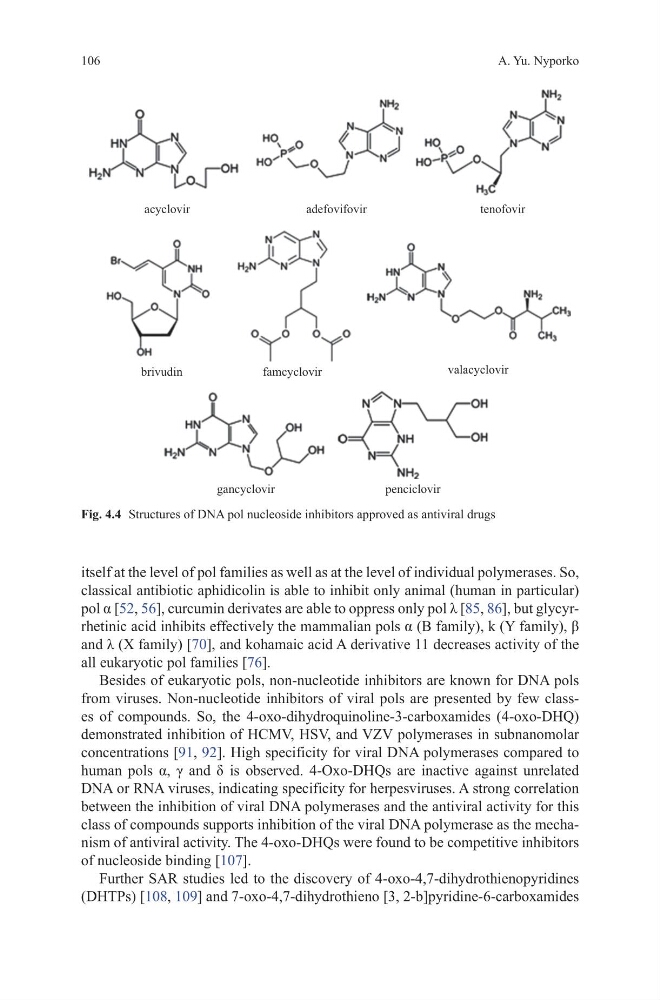
Fig. 4.4 Structures of DNA pol nucleoside inhibitors approved as antiviral drugs
A. Yu. Nyporko
itself at the level of pol families as well as at the level of individual polymerases. So,
classical antibiotic aphidicolin is able to inhibit only animal (human in particular)
pol α [52, 56], curcumin derivates are able to oppress only pol λ [85, 86], but glycyrrhetinic acid inhibits effectively the mammalian pols α (B family), k (Y family), β
and λ (X family) [70], and kohamaic acid A derivative 11 decreases activity of the
all eukaryotic pol families [76].
Besides of eukaryotic pols, non-nucleotide inhibitors are known for DNA pols
from viruses. Non-nucleotide inhibitors of viral pols are presented by few classes of compounds. So, the 4-oxo-dihydroquinoline-3-carboxamides (4-oxo-DHQ)
demonstrated inhibition of HCMV, HSV, and VZV polymerases in subnanomolar
concentrations [91, 92]. High specificity for viral DNA polymerases compared to
human pols α, γ and δ is observed. 4-Oxo-DHQs are inactive against unrelated
DNA or RNA viruses, indicating specificity for herpesviruses. A strong correlation
between the inhibition of viral DNA polymerases and the antiviral activity for this
class of compounds supports inhibition of the viral DNA polymerase as the mechanism of antiviral activity. The 4-oxo-DHQs were found to be competitive inhibitors
of nucleoside binding [107].
Further SAR studies led to the discovery of 4-oxo-4,7-dihydrothienopyridines
(DHTPs) [108, 109] and 7-oxo-4,7-dihydrothieno [3, 2-b]pyridine-6-carboxamides
tenofovir
adefovifovir
acyclovir
gancyclovir
brivudin
penciclovir
famcyclovir
valacyclovir
Fig. 4.4 Structures of DNA pol nucleoside inhibitors approved as antiviral drugs
A. Yu. Nyporko