

3.2 Multipulse
Electroporation
1. Add 2–5 μg of linearized plasmid DNA into the 0.15 mL
aliquot of the cells (see Note 8).
2. Transfer the cell-DNA mixture into an electroporation cuvette
with 0.2 cm gap.
3. Set the cuvette in the NEPA21 electroporation apparatus.
4. Confirm the electrical impedance. It should be around 300 Ω
(see Note 9).
5. Apply electroporation pulses with the following settings:
Square electric poring pulses: 300 V, 5 ms pulse duration,
8 pulses, 50 ms interval, 10% decay rate. Transfer pulses:
8 V, pulse duration, 50 ms pulse duration, 5 pulses for each
direction, interval 50 ms, 40% decay rate (see Note 10).
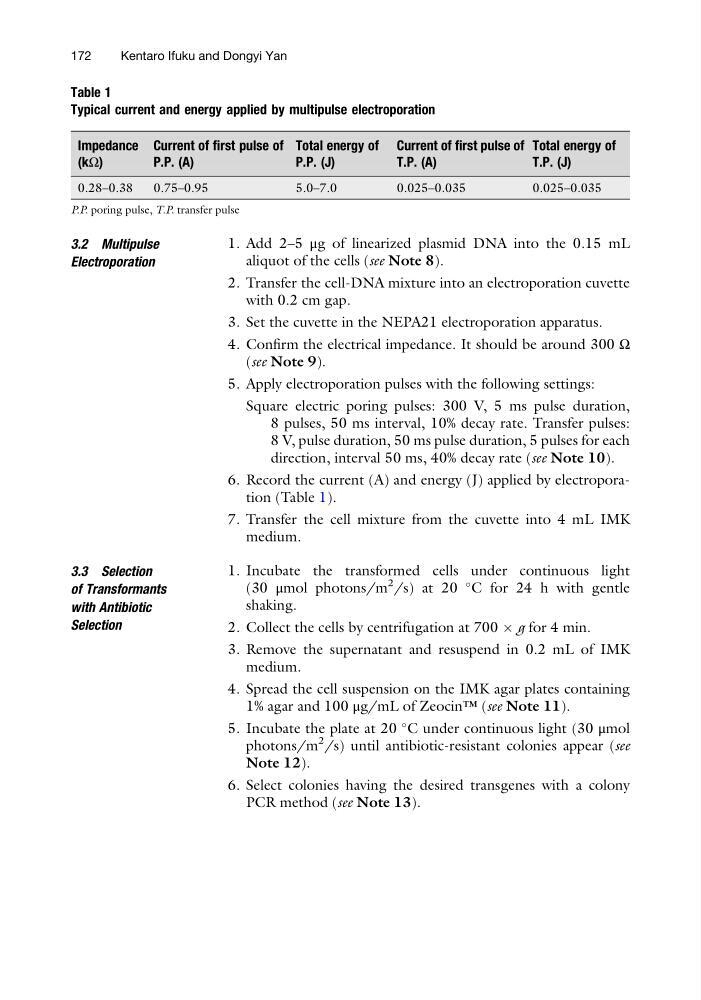
6. Record the current (A) and energy (J) applied by electroporation (Table 1).
7. Transfer the cell mixture from the cuvette into 4 mL IMK
medium.
3.3 Selection
of Transformants
with Antibiotic
Selection
1. Incubate the transformed cells under continuous light
(30 μmol photons/m
2 /s) at 20
C for 24 h with gentle
shaking.
2. Collect the cells by centrifugation at 700 Â g for 4 min.
3. Remove the supernatant and resuspend in 0.2 mL of IMK
medium.
4. Spread the cell suspension on the IMK agar plates containing
1% agar and 100 μg/mL of Zeocin™ (see Note 11).
5. Incubate the plate at 20
C under continuous light (30 μmol
photons/m
2 /s) until antibiotic-resistant colonies appear (see
Note 12).
6. Select colonies having the desired transgenes with a colony
PCR method (see Note 13).
Table 1
Typical current and energy applied by multipulse electroporation
Impedance
(kΩ)
Current of first pulse of
P.P. (A)
Total energy of
P.P. (J)
Current of first pulse of
T.P. (A)
Total energy of
T.P. (J)
0.28–0.38
0.75–0.95
5.0–7.0
0.025–0.035
0.025–0.035
P.P. poring pulse, T.P. transfer pulse
172
Kentaro Ifuku and Dongyi Yan
Electroporation
1. Add 2–5 μg of linearized plasmid DNA into the 0.15 mL
aliquot of the cells (see Note 8).
2. Transfer the cell-DNA mixture into an electroporation cuvette
with 0.2 cm gap.
3. Set the cuvette in the NEPA21 electroporation apparatus.
4. Confirm the electrical impedance. It should be around 300 Ω
(see Note 9).
5. Apply electroporation pulses with the following settings:
Square electric poring pulses: 300 V, 5 ms pulse duration,
8 pulses, 50 ms interval, 10% decay rate. Transfer pulses:
8 V, pulse duration, 50 ms pulse duration, 5 pulses for each
direction, interval 50 ms, 40% decay rate (see Note 10).
6. Record the current (A) and energy (J) applied by electroporation (Table 1).
7. Transfer the cell mixture from the cuvette into 4 mL IMK
medium.
3.3 Selection
of Transformants
with Antibiotic
Selection
1. Incubate the transformed cells under continuous light
(30 μmol photons/m
2 /s) at 20
C for 24 h with gentle
shaking.
2. Collect the cells by centrifugation at 700 Â g for 4 min.
3. Remove the supernatant and resuspend in 0.2 mL of IMK
medium.
4. Spread the cell suspension on the IMK agar plates containing
1% agar and 100 μg/mL of Zeocin™ (see Note 11).
5. Incubate the plate at 20
C under continuous light (30 μmol
photons/m
2 /s) until antibiotic-resistant colonies appear (see
Note 12).
6. Select colonies having the desired transgenes with a colony
PCR method (see Note 13).
Table 1
Typical current and energy applied by multipulse electroporation
Impedance
(kΩ)
Current of first pulse of
P.P. (A)
Total energy of
P.P. (J)
Current of first pulse of
T.P. (A)
Total energy of
T.P. (J)
0.28–0.38
0.75–0.95
5.0–7.0
0.025–0.035
0.025–0.035
P.P. poring pulse, T.P. transfer pulse
172
Kentaro Ifuku and Dongyi Yan