

4.4 Monte Carlo Simulation
57
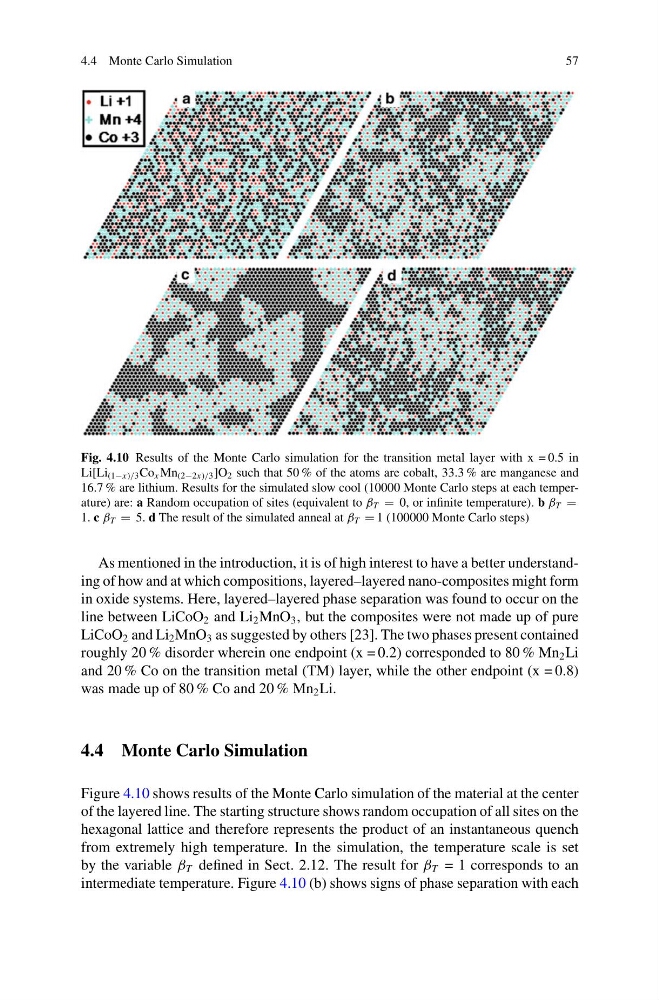
Fig. 4.10 Results of the Monte Carlo simulation for the transition metal layer with x = 0.5 in
Li[Li (1−x)/3 Co x Mn (2−2x)/3 ]O 2 such that 50 % of the atoms are cobalt, 33.3 % are manganese and
16.7 % are lithium. Results for the simulated slow cool (10000 Monte Carlo steps at each temperature) are: a Random occupation of sites (equivalent to β T = 0, or infinite temperature). b β T =
1. c β T = 5. d The result of the simulated anneal at β T = 1 (100000 Monte Carlo steps)
As mentioned in the introduction, it is of high interest to have a better understanding of how and at which compositions, layered–layered nano-composites might form
in oxide systems. Here, layered–layered phase separation was found to occur on the
line between LiCoO 2 and Li 2 MnO 3 , but the composites were not made up of pure
LiCoO 2 and Li 2 MnO 3 as suggested by others [23]. The two phases present contained
roughly 20 % disorder wherein one endpoint (x = 0.2) corresponded to 80 % Mn 2 Li
and 20 % Co on the transition metal (TM) layer, while the other endpoint (x = 0.8)
was made up of 80 % Co and 20 % Mn 2 Li.
4.4 Monte Carlo Simulation
Figure 4.10 shows results of the Monte Carlo simulation of the material at the center
of the layered line. The starting structure shows random occupation of all sites on the
hexagonal lattice and therefore represents the product of an instantaneous quench
from extremely high temperature. In the simulation, the temperature scale is set
by the variable β T defined in Sect. 2.12. The result for β T = 1 corresponds to an
intermediate temperature. Figure 4.10 (b) shows signs of phase separation with each
57
Fig. 4.10 Results of the Monte Carlo simulation for the transition metal layer with x = 0.5 in
Li[Li (1−x)/3 Co x Mn (2−2x)/3 ]O 2 such that 50 % of the atoms are cobalt, 33.3 % are manganese and
16.7 % are lithium. Results for the simulated slow cool (10000 Monte Carlo steps at each temperature) are: a Random occupation of sites (equivalent to β T = 0, or infinite temperature). b β T =
1. c β T = 5. d The result of the simulated anneal at β T = 1 (100000 Monte Carlo steps)
As mentioned in the introduction, it is of high interest to have a better understanding of how and at which compositions, layered–layered nano-composites might form
in oxide systems. Here, layered–layered phase separation was found to occur on the
line between LiCoO 2 and Li 2 MnO 3 , but the composites were not made up of pure
LiCoO 2 and Li 2 MnO 3 as suggested by others [23]. The two phases present contained
roughly 20 % disorder wherein one endpoint (x = 0.2) corresponded to 80 % Mn 2 Li
and 20 % Co on the transition metal (TM) layer, while the other endpoint (x = 0.8)
was made up of 80 % Co and 20 % Mn 2 Li.
4.4 Monte Carlo Simulation
Figure 4.10 shows results of the Monte Carlo simulation of the material at the center
of the layered line. The starting structure shows random occupation of all sites on the
hexagonal lattice and therefore represents the product of an instantaneous quench
from extremely high temperature. In the simulation, the temperature scale is set
by the variable β T defined in Sect. 2.12. The result for β T = 1 corresponds to an
intermediate temperature. Figure 4.10 (b) shows signs of phase separation with each