

3.2 Thermo-Gravimetric Analyzer (TGA) Results for Lithium Loss During Synthesis
39
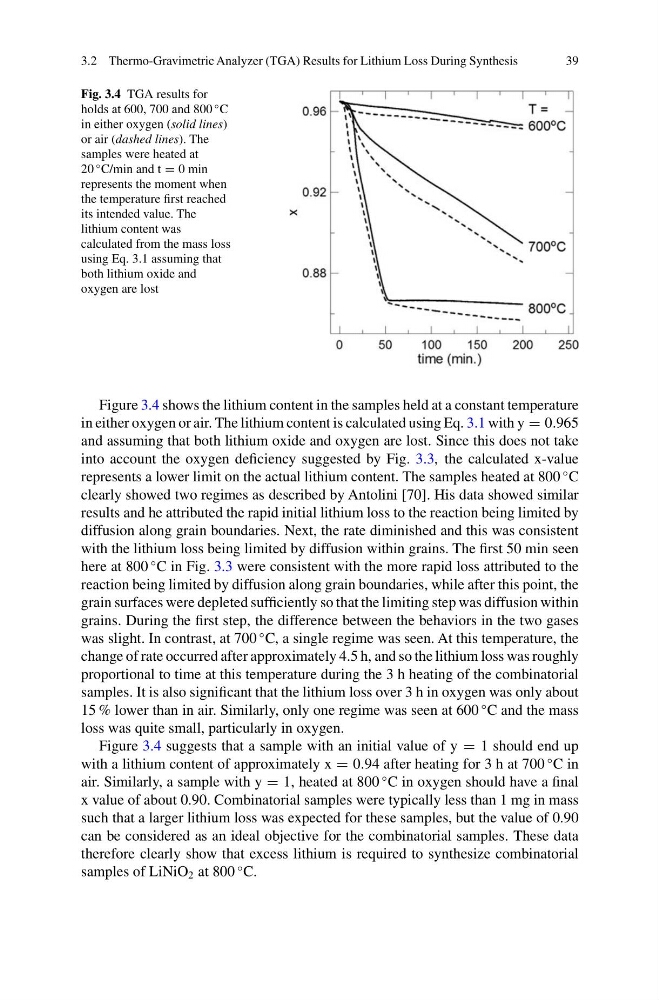
Fig. 3.4 TGA results for
holds at 600, 700 and 800
◦ C
in either oxygen (solid lines)
or air (dashed lines). The
samples were heated at
20
◦ C/min and t = 0 min
represents the moment when
the temperature first reached
its intended value. The
lithium content was
calculated from the mass loss
using Eq. 3.1 assuming that
both lithium oxide and
oxygen are lost
Figure 3.4 shows the lithium content in the samples held at a constant temperature
in either oxygen or air. The lithium content is calculated using Eq. 3.1 with y = 0.965
and assuming that both lithium oxide and oxygen are lost. Since this does not take
into account the oxygen deficiency suggested by Fig. 3.3, the calculated x-value
represents a lower limit on the actual lithium content. The samples heated at 800
◦ C
clearly showed two regimes as described by Antolini [70]. His data showed similar
results and he attributed the rapid initial lithium loss to the reaction being limited by
diffusion along grain boundaries. Next, the rate diminished and this was consistent
with the lithium loss being limited by diffusion within grains. The first 50 min seen
here at 800
◦ C in Fig. 3.3 were consistent with the more rapid loss attributed to the
reaction being limited by diffusion along grain boundaries, while after this point, the
grain surfaces were depleted sufficiently so that the limiting step was diffusion within
grains. During the first step, the difference between the behaviors in the two gases
was slight. In contrast, at 700
◦ C, a single regime was seen. At this temperature, the
change of rate occurred after approximately 4.5 h, and so the lithium loss was roughly
proportional to time at this temperature during the 3 h heating of the combinatorial
samples. It is also significant that the lithium loss over 3 h in oxygen was only about
15 % lower than in air. Similarly, only one regime was seen at 600
◦ C and the mass
loss was quite small, particularly in oxygen.
Figure 3.4 suggests that a sample with an initial value of y = 1 should end up
with a lithium content of approximately x = 0.94 after heating for 3 h at 700
◦ C in
air. Similarly, a sample with y = 1, heated at 800
◦ C in oxygen should have a final
x value of about 0.90. Combinatorial samples were typically less than 1 mg in mass
such that a larger lithium loss was expected for these samples, but the value of 0.90
can be considered as an ideal objective for the combinatorial samples. These data
therefore clearly show that excess lithium is required to synthesize combinatorial
samples of LiNiO 2 at 800
◦ C.
39
Fig. 3.4 TGA results for
holds at 600, 700 and 800
◦ C
in either oxygen (solid lines)
or air (dashed lines). The
samples were heated at
20
◦ C/min and t = 0 min
represents the moment when
the temperature first reached
its intended value. The
lithium content was
calculated from the mass loss
using Eq. 3.1 assuming that
both lithium oxide and
oxygen are lost
Figure 3.4 shows the lithium content in the samples held at a constant temperature
in either oxygen or air. The lithium content is calculated using Eq. 3.1 with y = 0.965
and assuming that both lithium oxide and oxygen are lost. Since this does not take
into account the oxygen deficiency suggested by Fig. 3.3, the calculated x-value
represents a lower limit on the actual lithium content. The samples heated at 800
◦ C
clearly showed two regimes as described by Antolini [70]. His data showed similar
results and he attributed the rapid initial lithium loss to the reaction being limited by
diffusion along grain boundaries. Next, the rate diminished and this was consistent
with the lithium loss being limited by diffusion within grains. The first 50 min seen
here at 800
◦ C in Fig. 3.3 were consistent with the more rapid loss attributed to the
reaction being limited by diffusion along grain boundaries, while after this point, the
grain surfaces were depleted sufficiently so that the limiting step was diffusion within
grains. During the first step, the difference between the behaviors in the two gases
was slight. In contrast, at 700
◦ C, a single regime was seen. At this temperature, the
change of rate occurred after approximately 4.5 h, and so the lithium loss was roughly
proportional to time at this temperature during the 3 h heating of the combinatorial
samples. It is also significant that the lithium loss over 3 h in oxygen was only about
15 % lower than in air. Similarly, only one regime was seen at 600
◦ C and the mass
loss was quite small, particularly in oxygen.
Figure 3.4 suggests that a sample with an initial value of y = 1 should end up
with a lithium content of approximately x = 0.94 after heating for 3 h at 700
◦ C in
air. Similarly, a sample with y = 1, heated at 800
◦ C in oxygen should have a final
x value of about 0.90. Combinatorial samples were typically less than 1 mg in mass
such that a larger lithium loss was expected for these samples, but the value of 0.90
can be considered as an ideal objective for the combinatorial samples. These data
therefore clearly show that excess lithium is required to synthesize combinatorial
samples of LiNiO 2 at 800
◦ C.